
Cocoa July Live with Experts: main highlights
The cocoa market remains volatile, reflecting a combination of macroeconomic uncertainty, shifts in global supply and demand flows, and climate-related risks for upcoming crops. In this context, this report summarizes the key topics discussed during the July 30 Live with Experts session, covering the macroeconomic backdrop, cocoa supply and demand dynamics, weather developments, and the overall market balance to provide context for recent price movements and future risks.
Cocoa July Live with Experts: main highlights
The cocoa market remains volatile, reflecting a combination of macroeconomic uncertainty, shifts in global supply and demand flows, and climate-related risks for upcoming crops. In this context, this report summarizes the key topics discussed during the July 30 Live with Experts session, covering the macroeconomic backdrop, cocoa supply and demand dynamics, weather developments, and the overall market balance to provide context for recent price movements and future risks.
Macroeconomic Environment and Prices
Despite the signing of a Memorandum of Understanding between the United States and Iran in the previous month, geopolitical tensions resurfaced in early July, once again raising concerns about the energy market and the global economy. Although attacks eased later in the month and U.S. officials adopted a more conciliatory tone, the possibility of renewed conflict remained an important source of uncertainty for financial markets.
On the monetary policy front, the Federal Reserve left interest rates unchanged for a fifth consecutive meeting, while market attention shifted toward the September meeting. In Europe, inflation slowed more than expected, reinforcing the ECB's decision to keep rates unchanged. Combined with rising weather concerns and early signs of demand recovery, this environment supported higher cocoa prices during July, resulting in a more bullish market tone compared with previous months.
Demand
July’s highlight was the release of second-quarter 2026 grindings data. Results were mixed across processing regions, with declines in Europe and growth in Asia and North America.
In Asia, positive performance was driven primarily by Malaysia and Indonesia. Malaysia recorded strong growth in cocoa paste exports, while Indonesia reported increased cocoa powder exports. These results reinforced signs of stronger regional demand, a trend that was already reflected in the performance of major cocoa processors and chocolate manufacturers.
In contrast, Europe reported another decline in grindings, likely influenced by lower bean imports and higher imports of processed cocoa products, particularly from Ivory Coast. Meanwhile, North American grindings increased 7.7%, supported by higher imports of cocoa beans and cocoa products. Overall, aggregate grindings across the major regions increased 6% compared with the same quarter last year, reinforcing signs of a potential early-stage recovery in global demand, although part of this improvement had already been priced into the market.
However, one point of attention remains the return of cocoa prices to higher levels during July, which could limit or slow this initial demand recovery if elevated costs begin to pressure consumption in the coming quarters.
Supply and Weather
In Ivory Coast, near-average rainfall, improved weather conditions, and cocoa port arrivals above last year's levels led to an upward revision of the country's 2025/26 production estimate to 1.9 million tonnes. Nevertheless, reports of lower pod formation rates and climate-related risks lead us to expect a production decline of approximately 9% in 2026/27, to around 1.8 million tonnes.
In Ghana, the 2025/26 production estimate remains unchanged at 650 thousand tonnes, although a decline is also expected in the following crop. Excessive rainfall remains a key concern, particularly due to the risk of disease pressure. As a result, we currently estimate production at approximately 595 thousand tonnes for 2026/27. In Ecuador, projections remain stable at 600 thousand tonnes for 2025/26 and at a similar level for 2026/27, although weather conditions continue to be closely monitored due to below-average rainfall and elevated temperatures.
The main risk factor on the supply side remains the potential development of a strong El Niño event between August and November. The key risk lies in potential damage to pod development during the latter part of the main crop and to flowering conditions for the 2026/27 mid-crop.
However, it is important to note that there is no consistent relationship between El Niño events and cocoa production outcomes in West Africa, making continuous monitoring of weather developments and regional climate patterns essential. As such, our estimates already incorporate part of the potential impact from El Niño, but we continue to take a cautious approach while awaiting greater clarity on its intensity and effects across key producing regions.
Global Balance
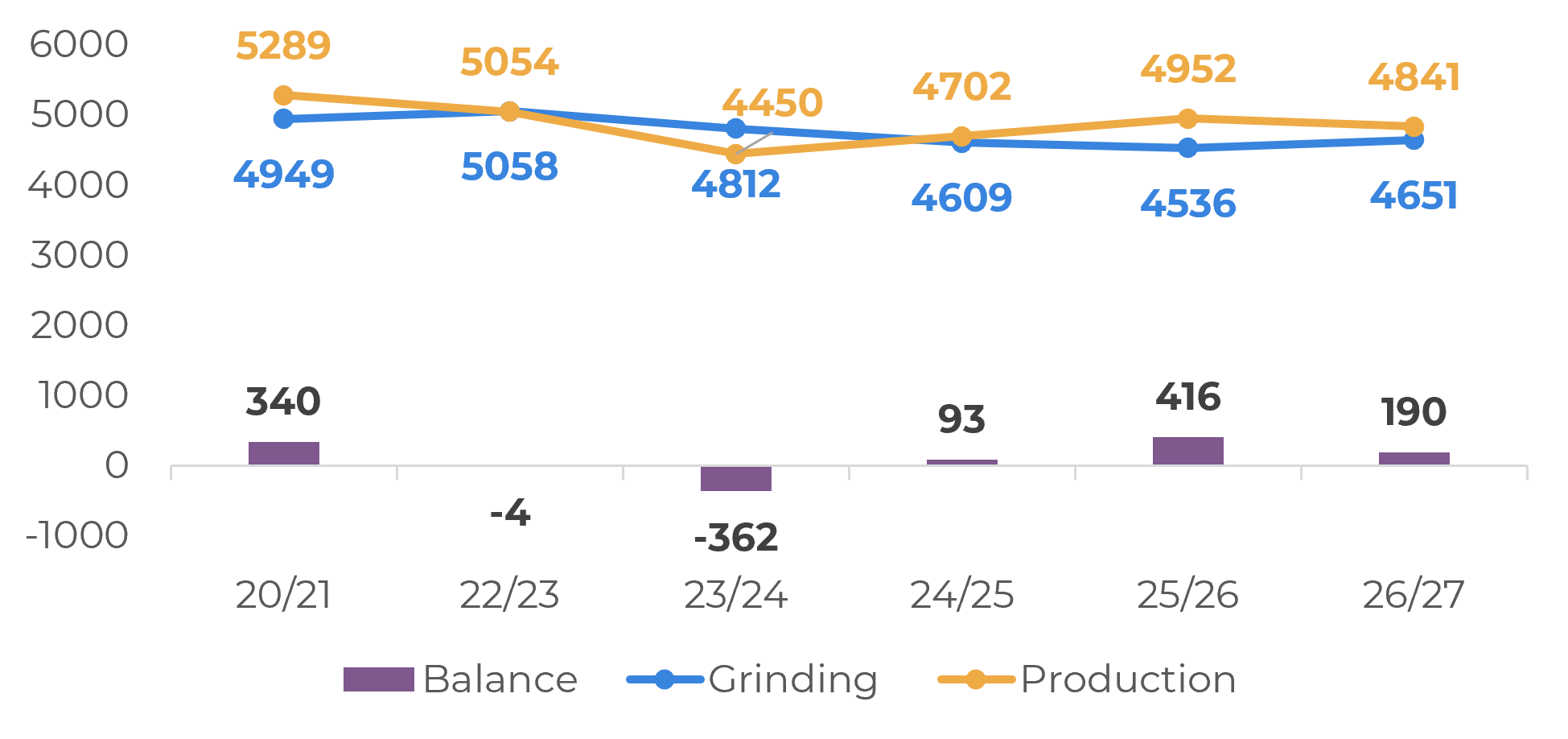
Following the latest revisions, our current outlook points to a global surplus of 416 thousand tonnes in 2025/26, driven by both a partial increase in supply and weaker global demand.
For 2026/27, we also expect a surplus, although a smaller one, estimated at 190 thousand tonnes. Therefore, while the market has adopted a more bullish tone in recent weeks due to climate risks and early signs of demand recovery, the consensus still points to a global surplus. As a result, the more comfortable short-term supply situation is likely to limit more significant and sustained price rallies, although prices may remain volatile as new information on weather, production, and demand emerges.
Global Supply and Demand for Cocoa (‘000 tons)
Source: ICCO, Hedgepoint
In Summary
The cocoa market ends July with a more bullish tone, supported by macroeconomic factors, early signs of demand recovery, and growing concerns about the potential impact of El Niño on the 2026/27 crop. Despite higher prices, short-term supply remains relatively comfortable, with certified stocks and Ivory Coast cocoa port arrivals above levels seen in the previous season. Therefore, while weather-related risks continue to provide support to the market, the consensus still points to global surpluses in the coming seasons, which may limit more prolonged upside price movements.
Weekly Report — Cocoa
carolina.frança@hedgepointglobal.com
livea.coda@hedgepointglobal.com
Disclaimer
This document has been prepared by Hedgepoint Schweiz AG and its affiliates (“Hedgepoint”) solely for informational and instructional purposes, without intending to create obligations or commitments to third parties. It is not intended to promote or solicit an offer for the sale or purchase of any securities, commodities interests, or investment products. Hedgepoint and its associates expressly disclaim any liability for the use of the information contained herein that directly or indirectly results in any kind of damages. Information is obtained from sources which we believe to be reliable, but we do not warrant or guarantee the timeliness or accuracy of this information. The trading of commodities interests, such as futures, options, and swaps, involves substantial risk of loss and may not be suitable for all investors. You should carefully consider wither such trading is suitable for you in light of your financial condition. Past performance is not necessarily indicative of future results. Customers should rely on their own independent judgment and/or consult advisors before entering into any transactions. Hedgepoint does not provide legal, tax or accounting advice and you are responsible for seeking any such advice separately. Hedgepoint Schweiz AG is organized, incorporated, and existing under the laws of Switzerland, is filiated to ARIF, the Association Romande des Intermédiaires Financiers, which is a FINMA-authorized Self-Regulatory Organization. Hedgepoint Commodities LLC is organized, incorporated, and existing under the laws of the USA, and is authorized and regulated by the Commodity Futures Trading Commission (CFTC) and a member of the National Futures Association (NFA) to act as an Introducing Broker and Commodity Trading Advisor. HedgePoint Global Markets Limited is Regulated by the Dubai Financial Services Authority. The content is directed at Professional Clients and not Retail Clients. Hedgepoint Global Markets PTE. Ltd is organized, incorporated, and existing under the laws of Singapore, exempted from obtaining a financial services license as per the Second Schedule of the Securities and Futures (Licensing and Conduct of Business) Act, by the Monetary Authority of Singapore (MAS). Hedgepoint Global Markets DTVM Ltda. is authorized and regulated in Brazil by the Central Bank of Brazil (BCB) and the Brazilian Securities Commission (CVM). Hedgepoint Serviços Ltda. is organized, incorporated, and existing under the laws of Brazil. Hedgepoint Global Markets S.A. is organized, incorporated, and existing under the laws of Uruguay. In case of questions not resolved by the first instance of customer contact (client.services@Hedgepointglobal.com), please contact internal ombudsman channel (ombudsman@hedgepointglobal.com – global or ouvidoria@hedgepointglobal.com – Brazil only) or call 0800-8788408 (Brazil only). Integrity, ethics, and transparency are values that guide our culture. To further strengthen our practices, Hedgepoint has a whistleblower channel for employees and third-parties by e-mail ethicline@hedgepointglobal.com or forms Ethic Line – Hedgepoint Global Markets. “HedgePoint” and the “HedgePoint” logo are marks for the exclusive use of HedgePoint and/or its affiliates. Use or reproduction is prohibited, unless expressly authorized by HedgePoint. Furthermore, the use of any other marks in this document has been authorized for identification purposes only. It does not, therefore, imply any rights of HedgePoint in these marks or imply endorsement, association or seal by the owners of these marks with HedgePoint or its affiliates.