
Outlook H2 2026: main highlights
Outlook H2 2026: main highlights
The cocoa market enters the second half of 2026 with a more bullish tone than at the beginning of the year. While the expectation of a global surplus in the 2026/27 season remains the consensus, early signs of demand recovery and persistent supply risks have supported prices and kept volatility high. As a result, the market remains caught between expectations of a surplus next season and a series of uncertainties that could reduce this excess, particularly those related to supply prospects in the main producing countries.
From a macroeconomic perspective, attention remains focused on the escalation of tensions between the United States and Iran, which have increased market volatility by impacting the energy sector and reinforcing inflationary concerns. Higher oil prices have created additional uncertainty on the global inflation outlook, keeping investors focused on monetary policy decisions in both the United States and Europe.
A combination of technical and fundamental factors has supported the recovery in cocoa prices over recent months. Beyond the macroeconomic backdrop, the market reacted to updates on El Niño, short-covering activity and, most importantly, indicators suggesting a possible improvement in demand after a prolonged adjustment driven by historically high cocoa prices.
In this context, demand remains one of the key areas of focus for the market. After a weaker consumption period, portfolio reformulations and adjustments in cocoa content across the industry, recent data showed the first signs of improvement. However, the key message remains one of caution. Current indicators point to early signs of recovery, but they are not yet sufficient to confirm a sustained rebound in global demand.
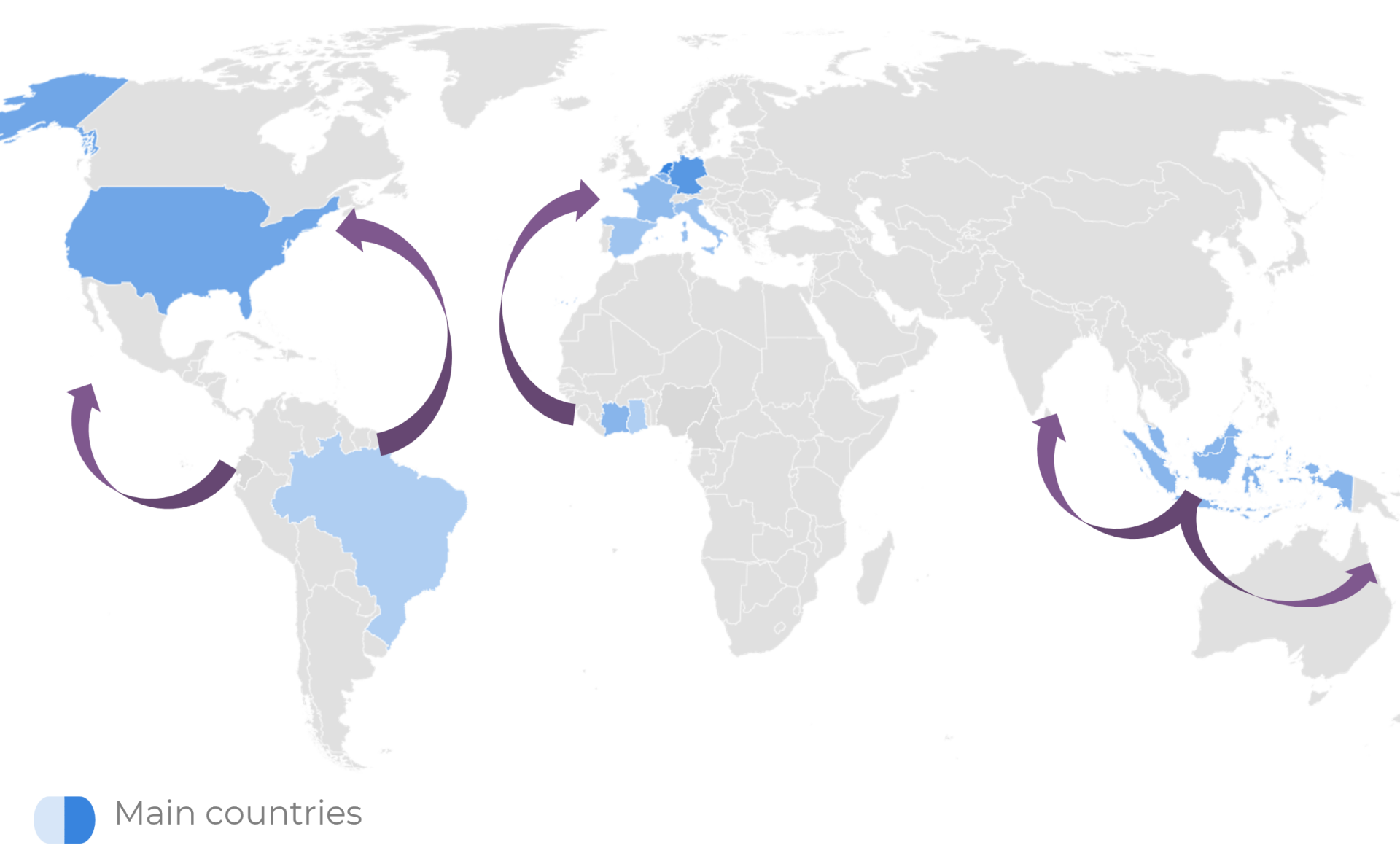
Regional performance supports this view. Asia delivered the stronger consumption results, driven mainly by higher grindings and changes in trade flows involving Malaysia and Indonesia. In North America, the recovery in processing volumes was accompanied by higher imports of cocoa beans and byproducts, indicating stronger regional demand. Brazil also posted higher grindings and a significant increase in cocoa butter exports. In contrast, Europe continued to show weaker results, with cumulative net cocoa bean imports remaining below the previous season's levels, besides further evidence of changes in trade flows for cocoa products.
When aggregated, grinding data from Europe, Asia and North America showed a 6% increase, reinforcing the view that demand conditions have improved compared to previous quarters. However, questions remain about the sustainability of this recovery. The market continues to monitor how demand will respond to cocoa prices near US$6,000 per metric ton. In addition, some of the changes implemented by industry during the period of high prices are gradual and may not be reversed in the short term. Therefore, despite the encouraging signals, the demand outlook remains cautious.
Cocoa demand main flows
Source: Hedgepoint
On the supply side, attention remains concentrated on West Africa. In Ivory Coast, the 2025/26 production outlook was revised upward following strong cocoa arrivals and improving weather conditions. For 2026/27, however, production is expected to decline to 1,801 kt, reflecting reports of lower pod counts, the impact of excessive rainfall in some producing regions and broader weather-related uncertainties. In Ghana, the outlook is even more cautious, with concerns over heavy rainfall since February and rising temperatures, factors that could affect crop development and next season's production, currently estimated at 595 kt, down around 9%.
For Nigeria and Cameroon, prospects are relatively more stable, supported by more favorable weather conditions. In Ecuador, production is expected to remain stable at around 600 kt, although risks associated with high temperatures and below-average rainfall continue to be monitored.
Still on the supply side, one important trend is the growing effort by West African countries to expand domestic cocoa processing. This behavior could gradually reshape global trade flows, leading to higher exports of cocoa products and lower availability of beans for export. Changes already observed in trade flows between producing and consuming regions suggest that this transition begins to gain relevance for market dynamics.
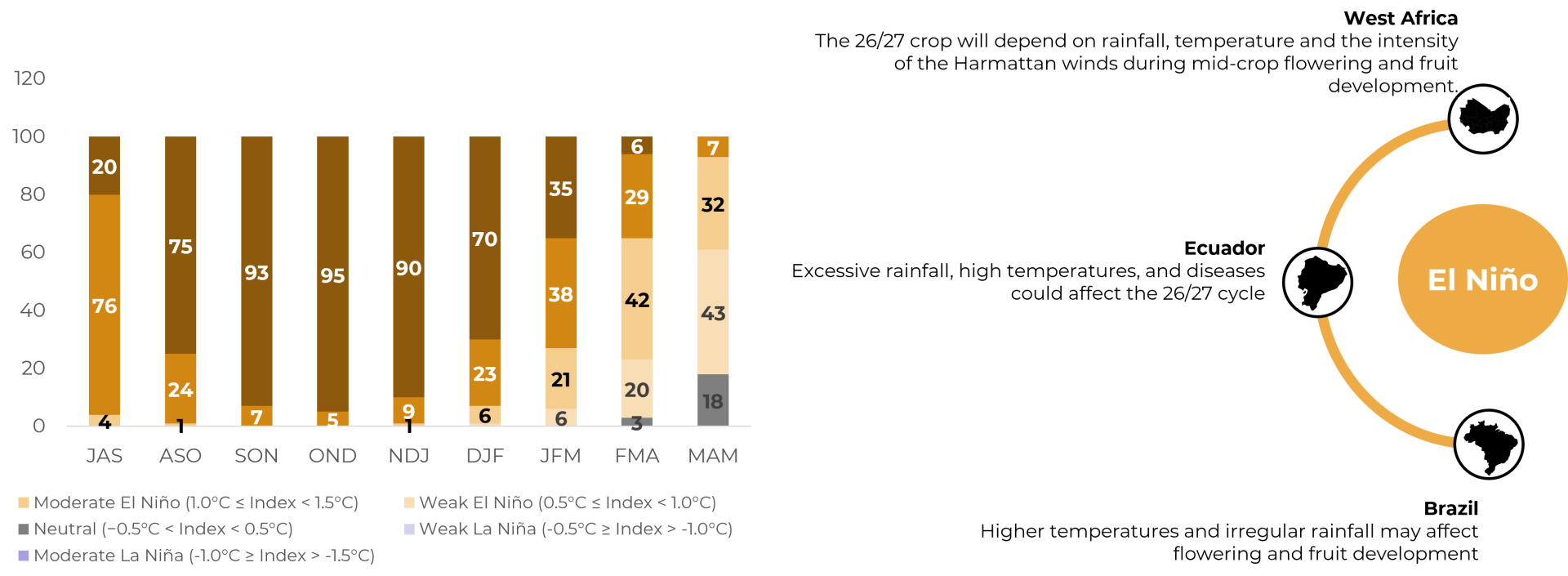
Among supply risks, El Niño remains a central focus for the market. The expected strengthening of the phenomenon coincides with key stages of crop development for the 2026/27 season. However, historical analysis shows no clear relationship between El Niño events and cocoa production losses. The impact depends on how the phenomenon interacts with regional weather patterns, particularly the West African monsoon and Harmattan winds. As a result, the risk is evident, but it remains too early to determine its effect on global production and on the size of the surplus expected for next season.
ENSO Strength Probabilities (%) - Aug 2026
Source: NOAA, Hedgepoint
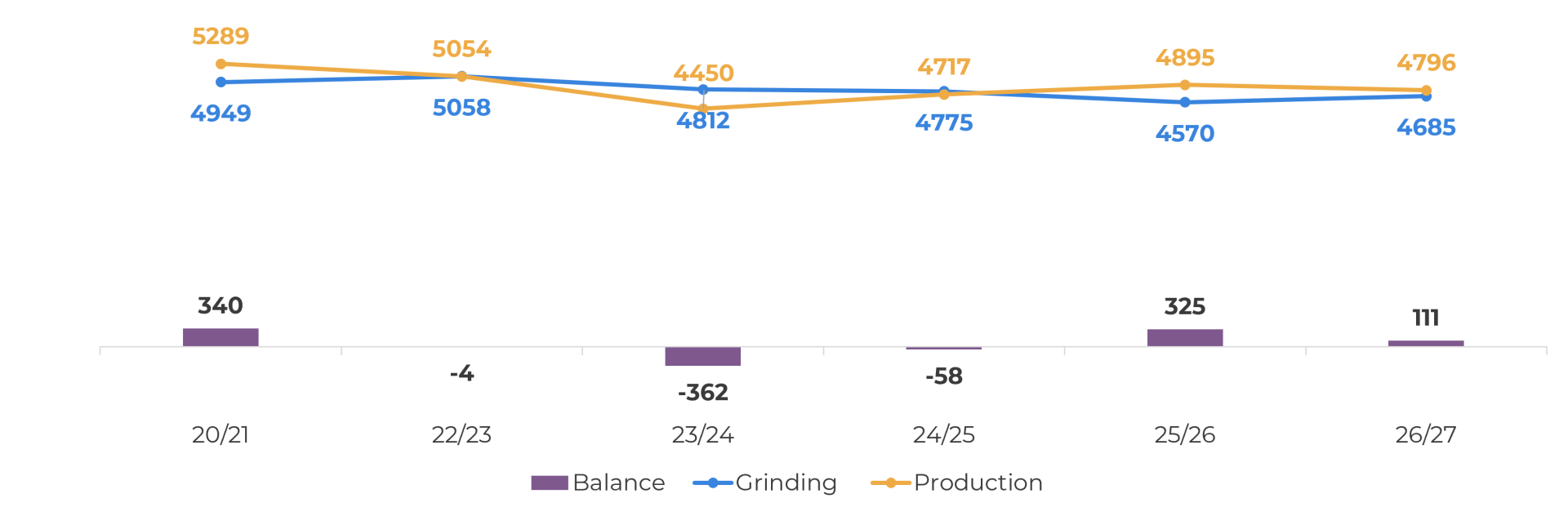
In summary, the cocoa market enters the second half of 2026 driven by three main themes. The first is the expectation of a global surplus in 2026/27, currently estimated at 111 kt, although its size remains subject to revision given the risks to supply. The second is the emergence of early signs of demand recovery, whose sustainability has yet to be confirmed in a higher-price environment. The third is the persistence of risks related to weather conditions, El Niño, changing trade flows and the implementation of EUDR. Therefore, while the global balance still points to a surplus, uncertainties surrounding both supply and demand continue to support a highly volatile cocoa market.
Global Supply and Demand for Cocoa (‘000 tons)
Source: Hedgepoint, ICCO
In Summary
The cocoa market enters the second half of 2026 with a more bullish tone, supported by early signs of demand recovery and ongoing supply risks. While the market still expects a global surplus in 2026/27, the size of this surplus remains uncertain due to concerns over production prospects in West Africa and the potential impact of El Niño. At the same time, grinding data points to improving demand, particularly in Asia and North America, although it is still too early to confirm a sustained recovery, especially with cocoa prices remaining close to US$6,000/t. As a result, uncertainties surrounding both supply and demand are likely to keep market volatility high in the coming months.
Weekly Report — Cocoa
carolina.frança@hedgepointglobal.com
livea.coda@hedgepointglobal.com
Disclaimer
This document has been prepared by Hedgepoint Schweiz AG and its affiliates (“Hedgepoint”) solely for informational and instructional purposes, without intending to create obligations or commitments to third parties. It is not intended to promote or solicit an offer for the sale or purchase of any securities, commodities interests, or investment products. Hedgepoint and its associates expressly disclaim any liability for the use of the information contained herein that directly or indirectly results in any kind of damages. Information is obtained from sources which we believe to be reliable, but we do not warrant or guarantee the timeliness or accuracy of this information. The trading of commodities interests, such as futures, options, and swaps, involves substantial risk of loss and may not be suitable for all investors. You should carefully consider wither such trading is suitable for you in light of your financial condition. Past performance is not necessarily indicative of future results. Customers should rely on their own independent judgment and/or consult advisors before entering into any transactions. Hedgepoint does not provide legal, tax or accounting advice and you are responsible for seeking any such advice separately. Hedgepoint Schweiz AG is organized, incorporated, and existing under the laws of Switzerland, and a member of ARIF. ARIF (Association Romande des Intermédiaires Financiers) is a self-regulatory organization approved by the Swiss Financial Market Supervisory Authority (FINMA) for the supervision of financial intermediaries covered under Article 2, paragraph 3, of the Swiss Federal Act on Combating Money Laundering and Terrorist Financing in the Financial Sector (AMLA). Hedgepoint Commodities LLC is organized, incorporated, and existing under the laws of the USA, and is authorized and regulated by the Commodity Futures Trading Commission (CFTC) and a member of the National Futures Association (NFA) to act as an Introducing Broker and Commodity Trading Advisor. Hedgepoint Global Markets Limited is Regulated by the Dubai Financial Services Authority. The content is directed at Professional Clients and not Retail Clients. Hedgepoint Global Markets PTE. Ltd is organized, incorporated, and existing under the laws of Singapore and is classified as exempted from holding a capital markets services licence under paragraph 3A(1)(d) of the Second Schedule to the Securities and Futures (Licensing and Conduct of Business) Regulations (Rg 10). Hedgepoint Global Markets DTVM Ltda. is authorized and regulated in Brazil by the Central Bank of Brazil (BCB) and the Brazilian Securities Commission (CVM). Hedgepoint Serviços Ltda. is organized, incorporated, and existing under the laws of Brazil. Hedgepoint Global Markets S.A. is organized, incorporated, and existing under the laws of Uruguay. In case of questions not resolved by the first instance of customer contact (client.services@Hedgepointglobal.com), please contact internal ombudsman channel (ombudsman@hedgepointglobal.com – global or ouvidoria@hedgepointglobal.com – Brazil only) or call 0800-8788408 (Brazil only). Integrity, ethics, and transparency are values that guide our culture. To further strengthen our practices, Hedgepoint has a whistleblower channel for employees and third-parties by e-mail ethicline@hedgepointglobal.com. “Hedgepoint” and the “Hedgepoint” logo are marks for the exclusive use of Hedgepoint and/or its affiliates. Use or reproduction is prohibited, unless expressly authorized by Hedgepoint. Furthermore, the use of any other marks in this document has been authorized for identification purposes only. It does not, therefore, imply any rights of Hedgepoint in these marks or imply endorsement, association or seal by the owners of these marks with Hedgepoint or its affiliates.