
Stocks, Ecuador and El Niño: Key Themes on the Cocoa Market Radar
- Cocoa futures underwent a correction this week, driven mainly by technical and macroeconomic factors following a recent period of rising prices.
- Open interest analysis suggests long liquidation in New York, while London showed signs of new participants entering the market during the price decline.
- Certified stocks and stronger Ivory Coast port arrivals point to a more comfortable supply situation in the short term, although the effective availability of these volumes remains uncertain.
- Ecuador continues to gain importance in global cocoa supply, with a growing share of certified stocks and expectations for strong exports at the start of the 26/27 crop.
- The market remains focused on the potential impacts of El Niño, which could affect production and supply risks for 2027.
Stocks, Ecuador and El Niño: Key Themes on the Cocoa Market Radar
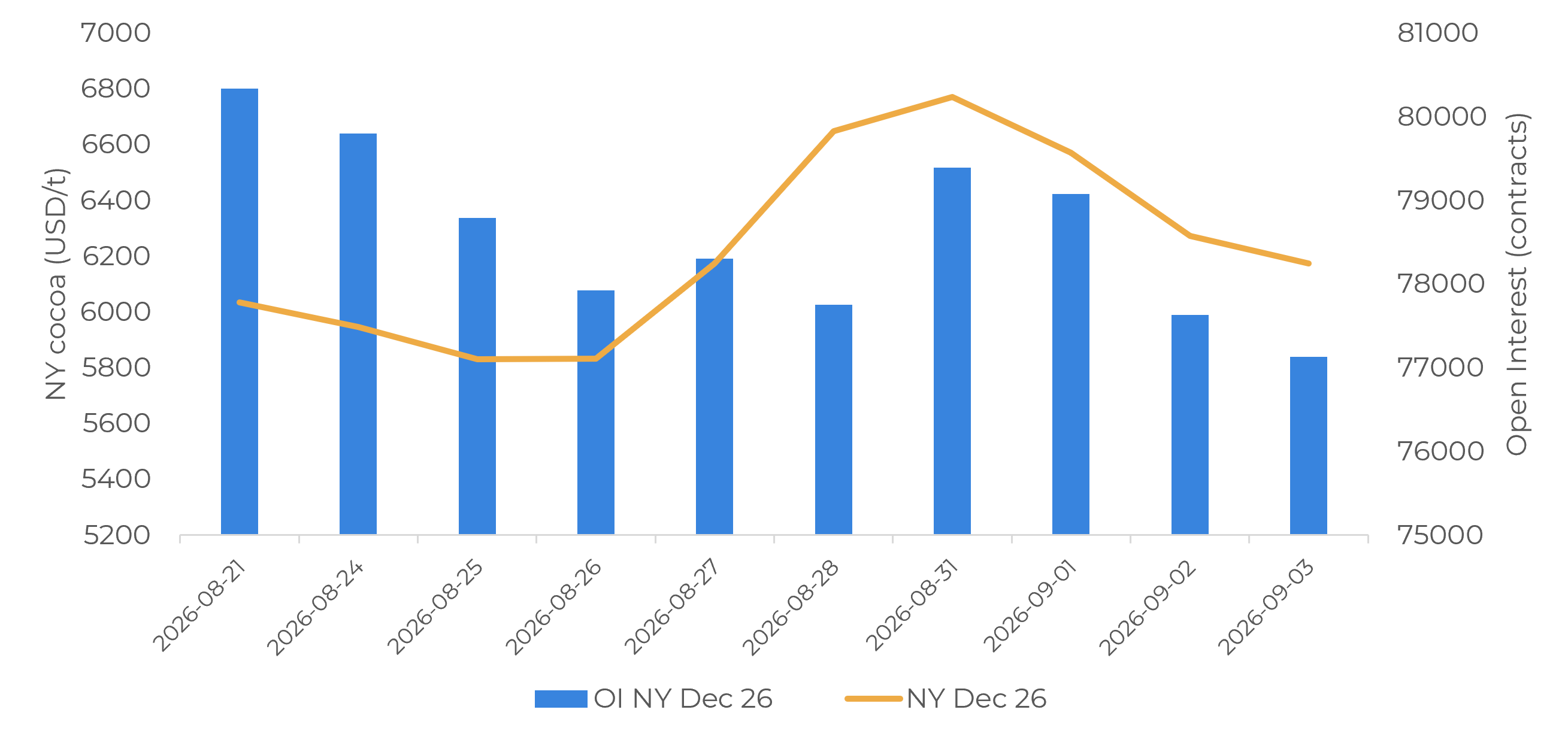
After starting September on a high and with prices in London reaching their highest level in the past 12 months, cocoa futures underwent a correction, closing the week of September 4 at 6,188 USD/t in New York and 4,518 USD/t in London. Technical indicators, such as the Relative Strength Index (RSI), were already pointing to overbought conditions, signaling the possibility of corrections or consolidation in the short term. Despite this, moving averages remain aligned with a more bullish trend, although they indicate a loss of momentum compared to the movement observed in July.
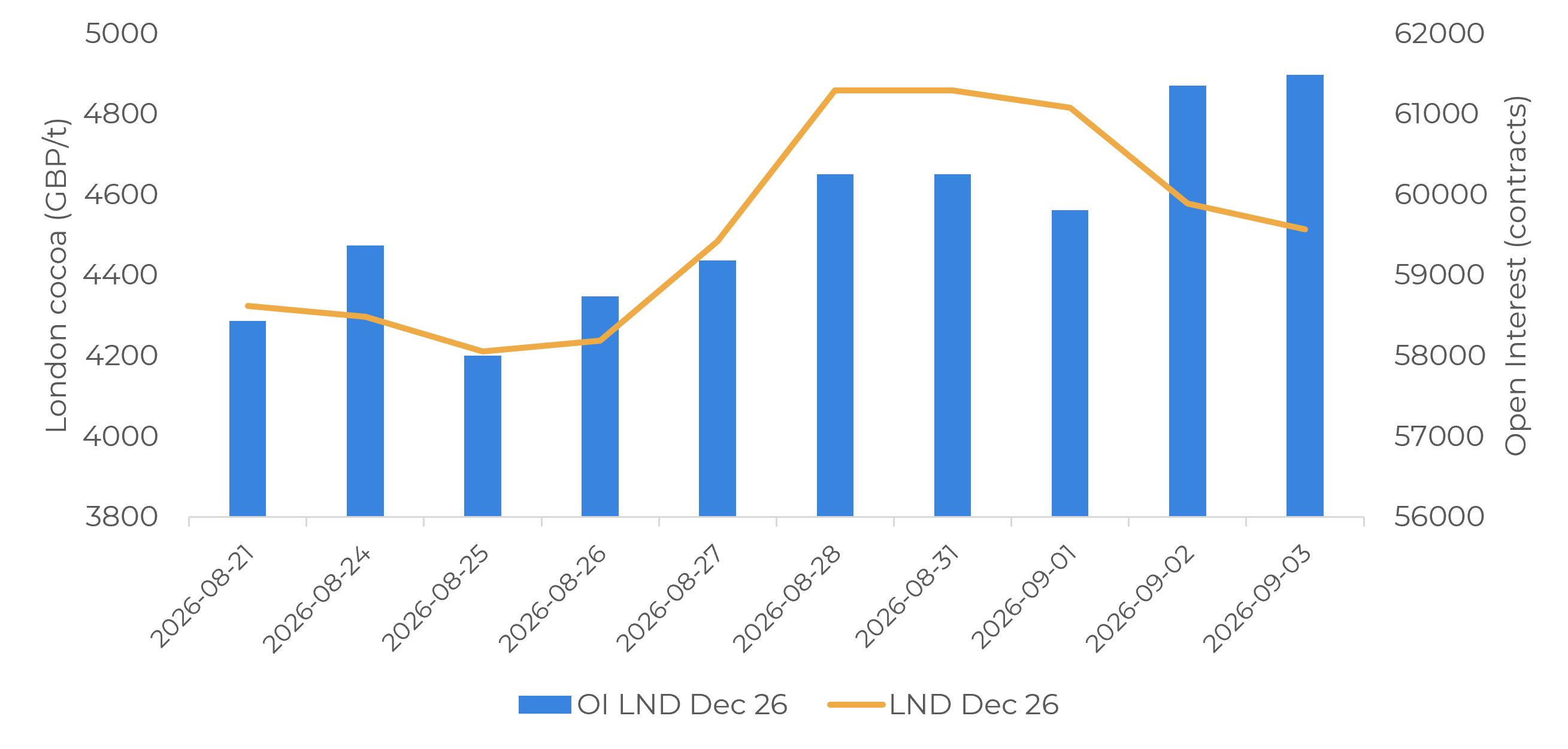
An analysis of open interest (OI) suggests differing dynamics between the two markets during recent trading sessions. In New York, the decline in OI during the price retreat may indicate a liquidation of long positions and profit-taking by market participants. In London, the initial behavior was similar, however, the increase in open interest observed during the September 2 session, even as prices continued to fall, may suggest the establishment of new positions, possibly reinforcing bets on the continuation of the corrective move.
Cocoa NY December 2026: open interest and prices
Source: LSEG
Cocoa London December 2026: open interest and prices
Source: LSEG
Macroeconomic factors continue to add volatility to the commodities market. The sharp rise in government bond yields in major global economies reflects concerns about inflation, geopolitical conflicts, and rising fiscal deficits, driving up financing costs. As a result, cocoa prices remain highly sensitive to any changes in fundamentals, which may contribute to market volatility.
Although recent movements have been driven primarily by technical and macroeconomic factors, in the absence of significant changes in fundamentals, certain news reports and market commentary may have helped sustain this momentum. Ivory Coast maintained the farmgate price at 1,200 CFA (approximately USD 2,127/t as of September 4) for the 26/27 season, which began in the first week of September, a figure 57.1% lower than the price set for the previous main crop year. The absence of a price adjustment, given the recent rise in market prices, may signal further caution about the outlook for the 26/27 cycle and uncertainties around expected production volume, which Hedgepoint currently estimates at a surplus of 111 kt.
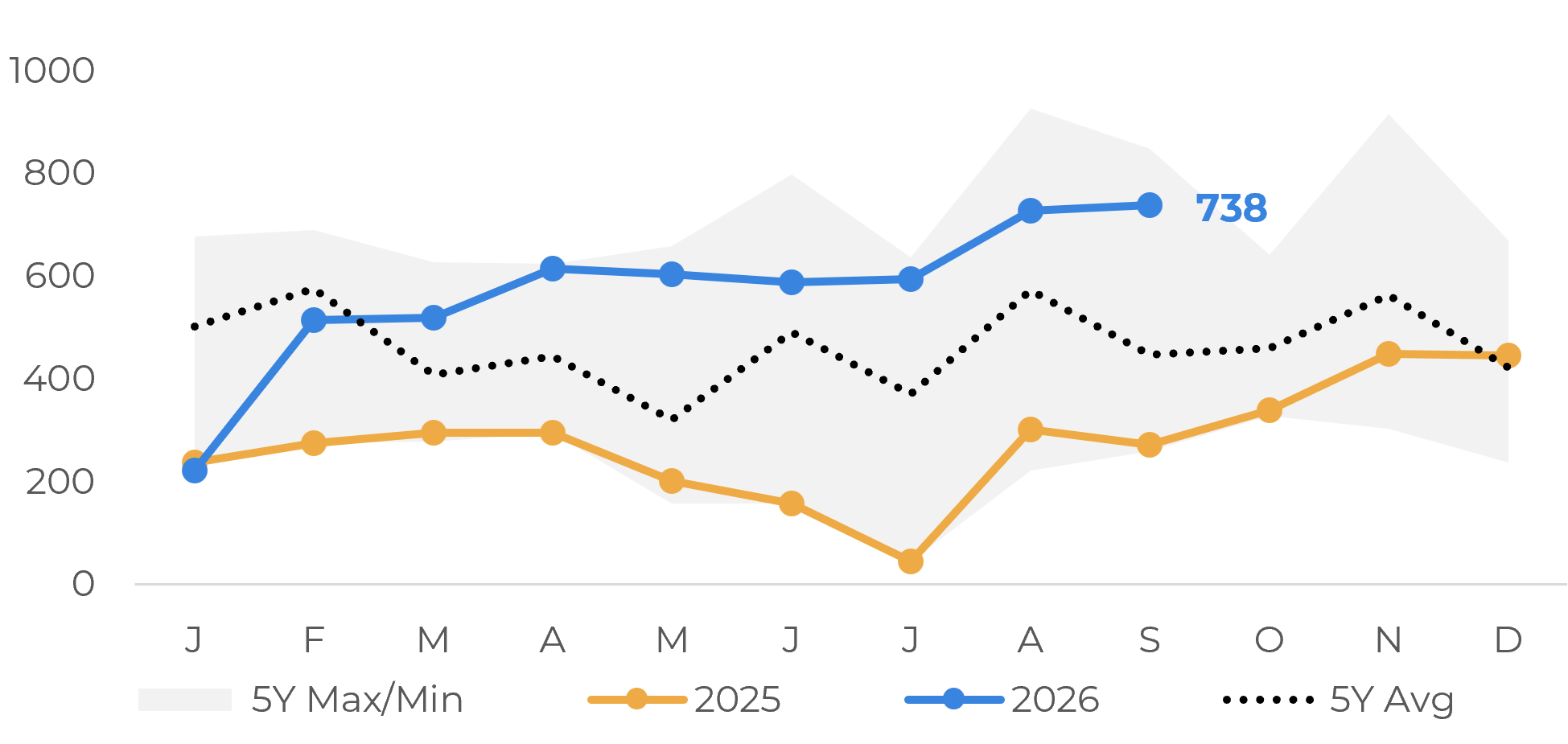
Another point highlighted by the market was the role of inventories in a scenario of declining production. Certified stocks on the ICE exchanges in the United States and Europe remain above the levels observed during the same period last year, with particular emphasis on the significant volume available in the U.S. market. Together with other indicators, such as Ivory Coast port arrivals, which ended August 19.6% higher than in the same period of the previous crop year, these figures suggest a relatively more comfortable supply situation in the short term.
Cocoa certified stocks – ICE US (‘000 bags)
Source: ICE
Cocoa certified stocks – ICE Europe (‘000 bags)
Source: ICE
Nevertheless, it is important to interpret these indicators with caution, since factors such as quality, location, and the actual availability of these stock for consumption remain relevant. In addition, the stocks levels maintained by processors and end consumers in major grinding hubs, such as Europe, North America, and Asia, are also an important variable. Since there is little visibility regarding these volumes, assessing the actual availability of cocoa throughout the supply chain remains uncertain.
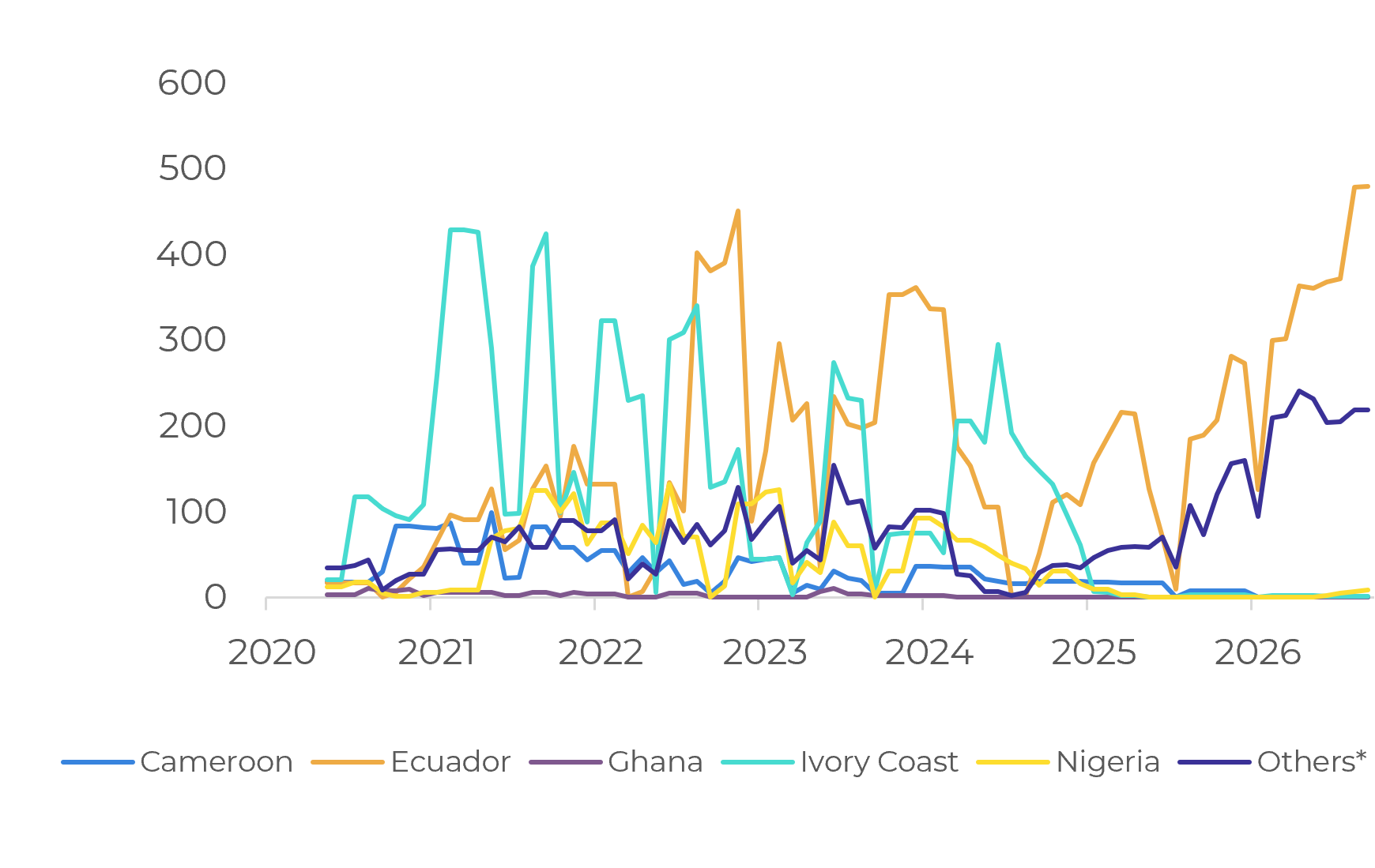
Still regarding certified stocks, one notable aspect is their composition by origin. When analyzing the recorded volumes, Ecuador’s share stands out, currently at its highest level since 2020. Although this trend has already been observed and discussed over the past few crops, it reinforces the country’s increasingly significant role in the global cocoa supply. This factor may prove particularly important during the 26/27 crop, although the potential impacts of El Niño on production remain a risk factor.
ICE US cocoa certified stocks by origin (‘000 bags)
Source: ICE. *Arriba (Ecuador), Colombia, Papua New Guinea, Peru, Venezuela.
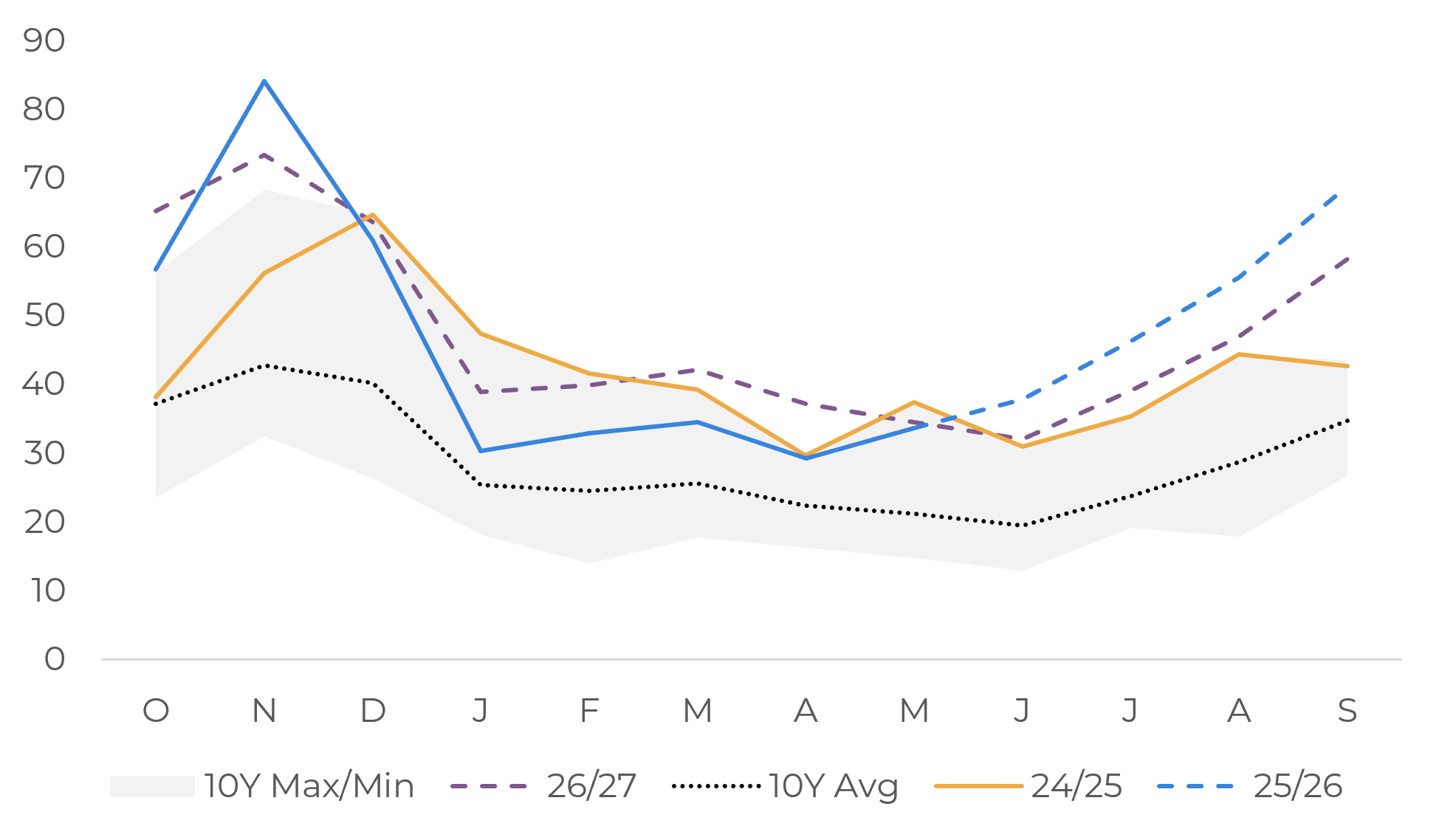
In this context, and possibly to anticipate any effects of the climate phenomenon, market reports suggest an acceleration in the country’s harvesting and export pace, a trend that appears to be partially reflected in certified stocks. Consequently, Ecuador’s export curve may shift over the course of the season, impacting the availability of beans on the international market. This factor could, to some extent, offset a potentially slower start to the main crop in the Ivory Coast and Ghana. Nevertheless, caution is warranted when interpreting these volumes. In addition to issues related to bean quality, it is also important to consider processors’ preferences. Currently, we estimate production of close to 600 kt for Ecuador, of which approximately 570 kt are expected to be available for export. The country remains a standout in the sector, with growth in planted area and investments in recent years.
Ecuador cocoa beans exports (‘000 tons)
Source: Ministry of Agriculture and Livestock of Ecuador
On the other hand, we continue to monitor weather conditions, particularly below-average rainfall and episodes of high temperatures observed in some producing regions. In addition, we remain attentive to the evolution of El Niño, as increased rainfall toward the end of the year could affect the pace of the harvest, crop flowering, and the incidence of diseases, with potential repercussions on production and crop quality.
Current indicators point to a less tight supply scenario in the short term than that observed in recent cycles, but one that is still insufficient to eliminate the uncertainties surrounding the 26/27 crop year. Production trends in Ecuador, the start of the crop in West Africa, and stock levels throughout the supply chain will be key factors in determining whether the market is moving toward a more comfortable balance or will remain vulnerable to new supply shocks. In addition, developments in weather conditions will remain on the market’s radar, especially given the risks associated with El Niño. Although its potential impacts are more concentrated toward the end of 2026, any effects on crop development, the harvest, and the incidence of diseases could influence the supply outlook for the first half of 2027, which could put pressure on the market, particularly for the March and May 2027 contracts.
In Summary
The cocoa market experienced a correction throughout the week, in a context primarily driven by technical and macroeconomic factors. Although indicators such as certified stocks and Ivory Coast port arrivals point to a more comfortable supply in the short term, uncertainties persist regarding the quality and availability of cocoa beans for the 26/27 season. At the same time, Ecuador continues to increase its share of the global supply, with a strong presence in certified stocks and favorable export prospects. Nevertheless, the market remains attentive to the weather risks associated with El Niño, which could affect the production and availability of beans in late 2026 and early 2027.
Weekly Report — Cocoa
carolina.frança@hedgepointglobal.com
livea.coda@hedgepointglobal.com
Disclaimer
This document has been prepared by Hedgepoint Schweiz AG and its affiliates (“Hedgepoint”) solely for informational and instructional purposes, without intending to create obligations or commitments to third parties. It is not intended to promote or solicit an offer for the sale or purchase of any securities, commodities interests, or investment products. Hedgepoint and its associates expressly disclaim any liability for the use of the information contained herein that directly or indirectly results in any kind of damages. Information is obtained from sources which we believe to be reliable, but we do not warrant or guarantee the timeliness or accuracy of this information. The trading of commodities interests, such as futures, options, and swaps, involves substantial risk of loss and may not be suitable for all investors. You should carefully consider wither such trading is suitable for you in light of your financial condition. Past performance is not necessarily indicative of future results. Customers should rely on their own independent judgment and/or consult advisors before entering into any transactions. Hedgepoint does not provide legal, tax or accounting advice and you are responsible for seeking any such advice separately. Hedgepoint Schweiz AG is organized, incorporated, and existing under the laws of Switzerland, is filiated to ARIF, the Association Romande des Intermédiaires Financiers, which is a FINMA-authorized Self-Regulatory Organization. Hedgepoint Commodities LLC is organized, incorporated, and existing under the laws of the USA, and is authorized and regulated by the Commodity Futures Trading Commission (CFTC) and a member of the National Futures Association (NFA) to act as an Introducing Broker and Commodity Trading Advisor. HedgePoint Global Markets Limited is Regulated by the Dubai Financial Services Authority. The content is directed at Professional Clients and not Retail Clients. Hedgepoint Global Markets PTE. Ltd is organized, incorporated, and existing under the laws of Singapore, exempted from obtaining a financial services license as per the Second Schedule of the Securities and Futures (Licensing and Conduct of Business) Act, by the Monetary Authority of Singapore (MAS). Hedgepoint Global Markets DTVM Ltda. is authorized and regulated in Brazil by the Central Bank of Brazil (BCB) and the Brazilian Securities Commission (CVM). Hedgepoint Serviços Ltda. is organized, incorporated, and existing under the laws of Brazil. Hedgepoint Global Markets S.A. is organized, incorporated, and existing under the laws of Uruguay. In case of questions not resolved by the first instance of customer contact (client.services@Hedgepointglobal.com), please contact internal ombudsman channel (ombudsman@hedgepointglobal.com – global or ouvidoria@hedgepointglobal.com – Brazil only) or call 0800-8788408 (Brazil only). Integrity, ethics, and transparency are values that guide our culture. To further strengthen our practices, Hedgepoint has a whistleblower channel for employees and third-parties by e-mail ethicline@hedgepointglobal.com or forms Ethic Line – Hedgepoint Global Markets. “HedgePoint” and the “HedgePoint” logo are marks for the exclusive use of HedgePoint and/or its affiliates. Use or reproduction is prohibited, unless expressly authorized by HedgePoint. Furthermore, the use of any other marks in this document has been authorized for identification purposes only. It does not, therefore, imply any rights of HedgePoint in these marks or imply endorsement, association or seal by the owners of these marks with HedgePoint or its affiliates.