
October Experts Live: Key Highlights
October Experts Live: Key Highlights
Cocoa prices underwent a correction in September, driven primarily by macroeconomic factors and investor repositioning amid a more challenging financial environment. Despite the recent bearish pressure, market fundamentals remain at the center of attention, particularly given signs of potentially more resilient demand, evolving weather conditions across key producing regions, and expectations for the 2026/27 crop. Against this backdrop, this report summarizes the main topics discussed during the October 8 Experts Live session, covering the macroeconomic environment, demand indicators, global supply prospects, and Hedgepoint’s updated outlook for the global cocoa balance.
Macroeconomic Environment and Prices
The cocoa market ended September with a significant correction, giving back part of the gains accumulated in previous months. New York cocoa futures declined approximately 19.3% during the month, while London contracts fell close to 15.8%. The move was largely driven by the macroeconomic backdrop, including a stronger US dollar, a more restrictive stance from major central banks, and lower investor risk appetite.
In the United States, ongoing inflation concerns and expectations that interest rates will remain elevated for longer supported the US dollar and weighed on commodity markets. In addition, rising energy prices linked to geopolitical tensions renewed concerns about global economic growth and demand prospects over the coming quarters.
In Europe, the European Central Bank also maintained a cautious stance throughout September. At the same time, managed money increased short positions and reduced long exposure, particularly in New York, adding further pressure to cocoa prices.
Although the magnitude of the correction was noteworthy, we believe it occurred without any meaningful change in market fundamentals. In other words, prices reacted mainly to macroeconomic and technical factors, while the structural drivers behind cocoa market volatility remain in place. As a result, market attention has shifted back to West African crop developments, signs of demand recovery, and weather risks for the 2026/27 season.
Demand
In Asia, indicators continue to suggest strong processing activity. Malaysia, one of the region’s key processing hubs, recorded approximately 122% growth in cocoa liquor exports between October 2025 and June 2026 compared to the same period of the previous season. The increase was mainly driven by higher shipments to China, Japan, and the United States. At the same time, bean imports returned to elevated levels and reached record highs in June, reinforcing Malaysia’s role as a major global processing center and signaling stronger demand for raw material.
In Indonesia, cocoa powder exports continued to be supported by demand from Asian markets, especially India and China. This performance reinforces the view that regional processors continue to absorb significant volumes of cocoa products despite the sharp increase in cocoa prices over recent years. In addition, the Indonesian government raised the cocoa bean export reference price for October, citing concerns over the potential impact of El Niño on global supply.
In the United States, net bean imports increased by more than 81% compared with the previous season. Imports of cocoa liquor and butter also remained near historical highs, suggesting continued industrial activity. While recent data point to some moderation relative to previous peaks, volumes remain elevated by historical standards.
Europe presented a different trend throughout the season. Net bean imports remained below year-ago levels for most of the crop year but accelerated during the final months, ending the season approximately 2.1% above the previous cycle. This movement supports our view that changes in cocoa prices tend to affect purchasing decisions and industrial activity with a certain lag.
At the same time, although cumulative cocoa butter imports remain around 17% above the previous season, growth slowed during August and September. This slowdown coincided with stronger bean imports, suggesting a partial shift from imported cocoa products toward beans destined for local processing. Inventory levels and replenishment needs remain important factors in this dynamic.
Another highlight was Brazil’s performance. Between January and September, cocoa butter exports increased by approximately 66.9%, supported by stronger shipments to the United States and Canada. The result reinforces the competitiveness of the Brazilian processing industry and contributes to the diversification of global cocoa product supply.
In our view, the main demand story remains the possibility of a recovery. Based on the indicators monitored by Hedgepoint, including bean imports, cocoa product trade, and processing activity across major consuming regions, we estimate that combined grindings in Asia, Europe, and North America could increase between 8% and 12% year-over-year in Q3 2026. Such performance would indicate a more consistent recovery in global demand and help explain part of the reduction in the projected surplus for 2026/27. Grinding results scheduled for release on October 15 will be key to confirming whether this trend continues to gain traction.
Supply and Weather
On the supply side, market attention remains focused on the 2026/27 crop in West Africa. The season started at a slower pace in both Ivory Coast and Ghana, reflecting weather conditions observed during the previous crop year and signals previously indicated by field reports. In Ivory Coast, below-average rainfall during much of the 2025/26 season contributed to a slower start to the main crop harvest. In Ghana, excessive rainfall in key producing regions may have affected pollination and limited early crop potential.
The main market focus, however, is not the current pace of the main crop but rather the weather conditions that will determine the development of the upcoming mid-crop. Continued dry conditions over the coming weeks could accelerate the end of the main crop, reduce mid-crop potential, and affect bean quality, increasing risks to cocoa availability throughout 2027.
For now, our production estimates remain unchanged. Ivory Coast production is projected at approximately 1.8 million tons for the 2026/27 season, down 6% year-over-year. Ghana production is estimated at 595 thousand tons, an 8% decline from the previous season. Nigeria and Cameroon production forecasts remain at approximately 290 thousand and 285 thousand tons, respectively. Although these estimates remain unchanged, the balance of risks still points toward possible downward revisions should weather conditions fail to improve.
Another important factor is producer pricing policy. While Ivory Coast kept its farmgate price unchanged for the new season, Ghana announced a higher producer price. This differential increases incentives for informal bean flows across borders and may influence officially reported trade and export volumes throughout the season.
At the same time, West Africa continues to advance its domestic processing strategy. In Ivory Coast, strong growth in cocoa liquor and cocoa powder exports reinforces the trend toward a greater share of value-added products in the export mix, supported by an installed grinding capacity of approximately 1.2 million tons per year.
In Ecuador, production for the 2026/27 season remains projected at approximately 600 thousand tons, maintaining the growth trend observed in recent years. However, El Niño risks remain on the market’s radar. Depending on its intensity, the phenomenon could increase temperatures and rainfall, raising disease pressure and reducing production potential.
Despite these uncertainties, Ecuador continues to increase its importance in global cocoa supply. Market reports indicate accelerating harvest activity and exports, with August shipments estimated at approximately 60 thousand tons. This additional availability has partially offset the slower start of the West African season, although quality considerations remain relevant.
This trend is also reflected in exchange-certified stocks. Both ICE US and ICE Europe inventories remain above year-ago levels, signaling a relatively more comfortable supply situation. As a result, certified stocks continue to act as a balancing factor for the market, limiting part of the upside pressure generated by weather-related concerns.
Globally, El Niño remains the main risk to the cocoa supply and demand balance. Production losses in Ivory Coast, Ghana, or Ecuador could reduce the currently projected surplus for 2026/27 and increase price volatility. For this reason, weather developments over the coming weeks will remain one of the key drivers of market expectations.
Global Balance
Under this scenario, the global balance continues to point to a surplus of approximately 111 thousand tons in the 2026/27 season, based on an estimated 2% decline in global production and a roughly 2.5% increase in grindings. Nevertheless, the size of this surplus will depend on whether production expectations are confirmed and on how demand evolves over the coming months.
Global Supply and Demand for Cocoa (‘000 tons)
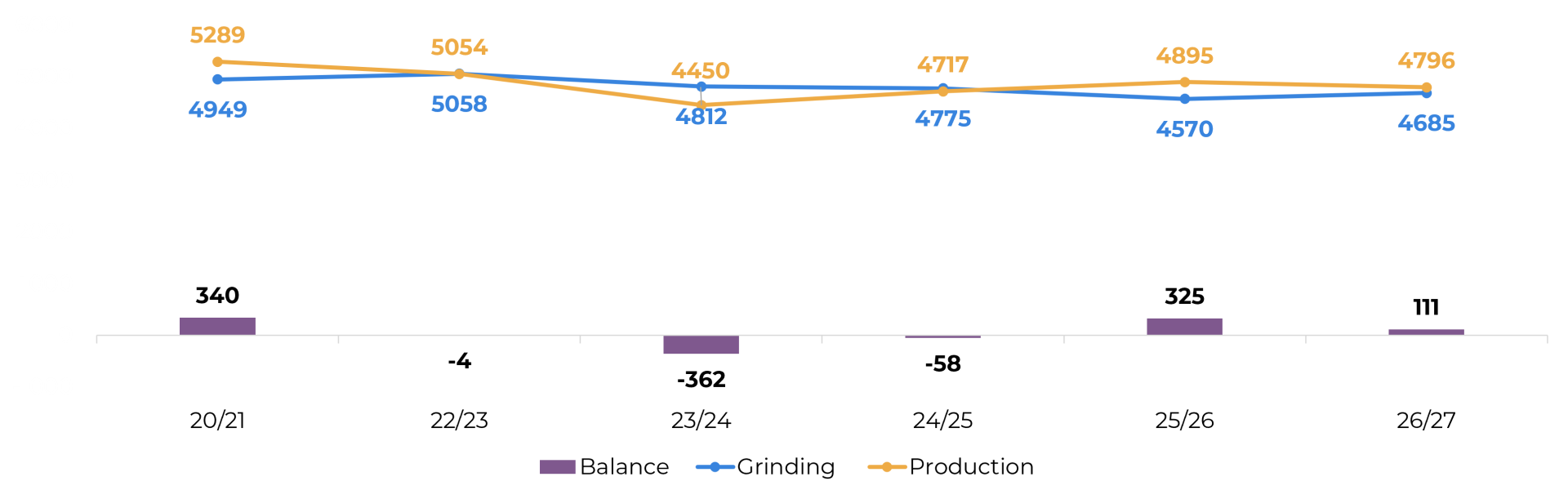
Source: ICCO, Hedgepoint
On the price side, the forward curve continues to reflect uncertainty regarding cocoa availability throughout 2027. Price differentials between contracts maturing from December 2026 through September 2027 suggest that the market still incorporates a weather-related risk premium associated with West Africa and the potential of the next mid-crop. In this context, Q3 grinding results take on additional importance, particularly in assessing the extent to which the price rally observed in July may affect demand.
As a result, price direction will largely depend on the interaction between supply and demand. Should grindings prove more resilient than expected and weather risks intensify, prices could receive additional support. On the other hand, weaker demand combined with stable production prospects would likely reduce concerns regarding cocoa availability during the 2026/27 season.
In addition, expectations for a surplus in 2026/27, even if smaller than in the previous season, remain an important factor for the market. Upward revisions to the 2025/26 surplus by some market participants further reinforce the perception of more comfortable cocoa availability at the start of the new crop year. Against this backdrop, weather concerns may continue to generate periods of volatility, but the fundamental outlook is likely to limit more sustained upside price moves unless there is clear evidence of a meaningful deterioration in supply.
In Summary
Following the sharp correction in September, market attention has shifted back to fundamentals. Demand indicators continue to point to a recovery in grinding activity, while the 2026/27 crop has started at a slower pace in West Africa. Despite weather risks related to both the mid-crop and El Niño, production estimates remain unchanged, keeping the projected global surplus at 111 thousand tons. Against this backdrop, weather developments and Q3 grinding results will be key factors in determining the balance between supply and demand and, ultimately, the direction of cocoa prices.
Weekly Report — Cocoa
carolina.frança@hedgepointglobal.com
laleska.moda@hedgepointglobal.com
Disclaimer
This document has been prepared by Hedgepoint Schweiz AG and its affiliates (“Hedgepoint”) solely for informational and instructional purposes, without intending to create obligations or commitments to third parties. It is not intended to promote or solicit an offer for the sale or purchase of any securities, commodities interests, or investment products. Hedgepoint and its associates expressly disclaim any liability for the use of the information contained herein that directly or indirectly results in any kind of damages. Information is obtained from sources which we believe to be reliable, but we do not warrant or guarantee the timeliness or accuracy of this information. The trading of commodities interests, such as futures, options, and swaps, involves substantial risk of loss and may not be suitable for all investors. You should carefully consider wither such trading is suitable for you in light of your financial condition. Past performance is not necessarily indicative of future results. Customers should rely on their own independent judgment and/or consult advisors before entering into any transactions. Hedgepoint does not provide legal, tax or accounting advice and you are responsible for seeking any such advice separately. Hedgepoint Schweiz AG is organized, incorporated, and existing under the laws of Switzerland, is filiated to ARIF, the Association Romande des Intermédiaires Financiers, which is a FINMA-authorized Self-Regulatory Organization. Hedgepoint Commodities LLC is organized, incorporated, and existing under the laws of the USA, and is authorized and regulated by the Commodity Futures Trading Commission (CFTC) and a member of the National Futures Association (NFA) to act as an Introducing Broker and Commodity Trading Advisor. HedgePoint Global Markets Limited is Regulated by the Dubai Financial Services Authority. The content is directed at Professional Clients and not Retail Clients. Hedgepoint Global Markets PTE. Ltd is organized, incorporated, and existing under the laws of Singapore, exempted from obtaining a financial services license as per the Second Schedule of the Securities and Futures (Licensing and Conduct of Business) Act, by the Monetary Authority of Singapore (MAS). Hedgepoint Global Markets DTVM Ltda. is authorized and regulated in Brazil by the Central Bank of Brazil (BCB) and the Brazilian Securities Commission (CVM). Hedgepoint Serviços Ltda. is organized, incorporated, and existing under the laws of Brazil. Hedgepoint Global Markets S.A. is organized, incorporated, and existing under the laws of Uruguay. In case of questions not resolved by the first instance of customer contact (client.services@Hedgepointglobal.com), please contact internal ombudsman channel (ombudsman@hedgepointglobal.com – global or ouvidoria@hedgepointglobal.com – Brazil only) or call 0800-8788408 (Brazil only). Integrity, ethics, and transparency are values that guide our culture. To further strengthen our practices, Hedgepoint has a whistleblower channel for employees and third-parties by e-mail ethicline@hedgepointglobal.com or forms Ethic Line – Hedgepoint Global Markets. “HedgePoint” and the “HedgePoint” logo are marks for the exclusive use of HedgePoint and/or its affiliates. Use or reproduction is prohibited, unless expressly authorized by HedgePoint. Furthermore, the use of any other marks in this document has been authorized for identification purposes only. It does not, therefore, imply any rights of HedgePoint in these marks or imply endorsement, association or seal by the owners of these marks with HedgePoint or its affiliates.