EUDR: a potential source of volatility for the cocoa market
- While the cocoa market has been fluctuating, reflecting the macroeconomic and political environment and investor repositioning, global supply and demand remain on market participants' radar.
- Among the supply-side factors, the EUDR emerges as an additional source of uncertainty, as the regulation is scheduled to enter into force on December 30, 2026, for large and medium-sized operators, after successive postponements.
- The legislation is essential, given the European market's dependence on African suppliers, especially for cocoa beans. However, the suppliers' level of preparedness remains uneven.
- With the legislation in force at the end of 2026, the cocoa market may see not only changes in import and export flows, but also in physical differentials between origins.
EUDR: a potential source of volatility for the cocoa market
Despite the recent movements in cocoa prices, associated mainly with the macroeconomic and political environment and with adjustments in investor positioning, the market remains attentive to supply and demand prospects. While weather conditions in West Africa remain decisive for production, grindings in the coming quarters will be key to gauging the global surplus. In this context, beyond the traditional fundamentals, the implementation of the European Union Deforestation Regulation (EUDR) represents an additional source of uncertainty.
Originally scheduled for December 2024, the application of the EUDR has been successively postponed and is currently scheduled for December 30, 2026, for large and medium-sized operators. The regulation requires proof that cocoa marketed in the European Union is not associated with deforestation after December 2020, in addition to compliance with legality and traceability requirements. Its implementation is particularly relevant given the concentration of production in West Africa, which accounts for approximately 60% of global supply, and Europe's heavy dependence on that region.
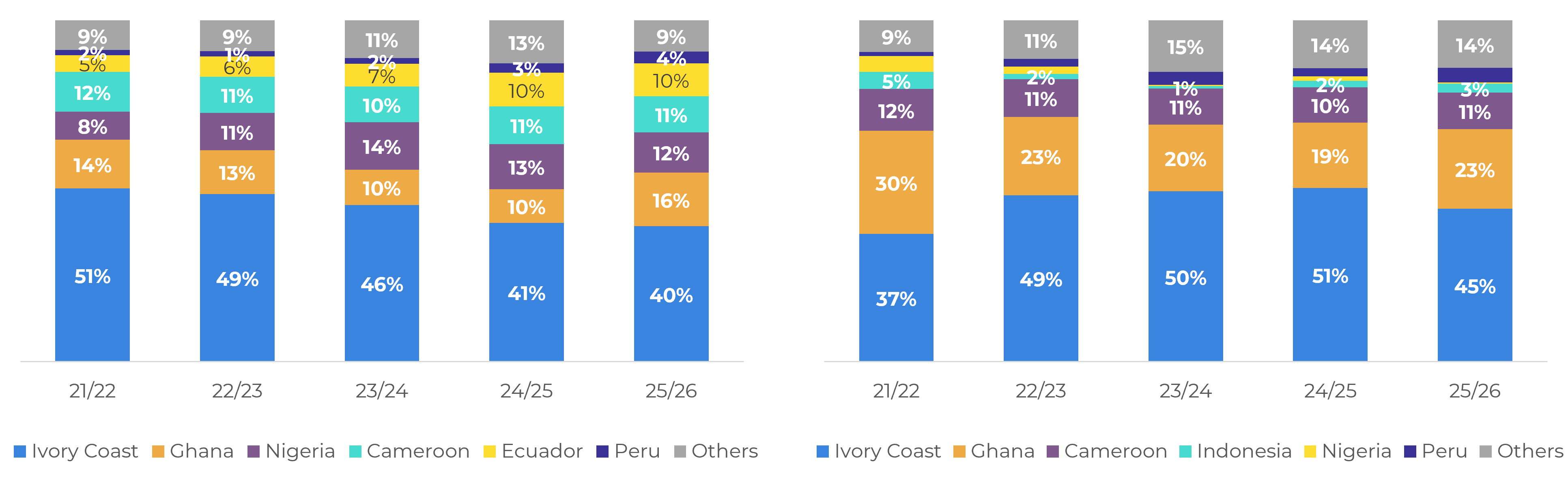
Considering the composition of European imports of cocoa and by-products, beans account for approximately 83% of the total volume, followed by butter, with an average share of 12%. Over the last ten crop years, Ivory Coast accounted for 48% of European bean imports, followed by Ghana (13%), Nigeria (11%) and Cameroon (10%), with these four countries concentrating more than 80% of supply.
Dependence is also significant in the butter segment, with Ivory Coast representing 42% of imports, Ghana 25% and Cameroon 10%, totaling 77%. This concentration highlights the importance of the main African suppliers adapting to European regulatory requirements, especially given the structural challenges of traceability and the fragmentation of production chains.
European Union: imports of cocoa beans (left) and butter (right) by origin (%)
Source: European Commission
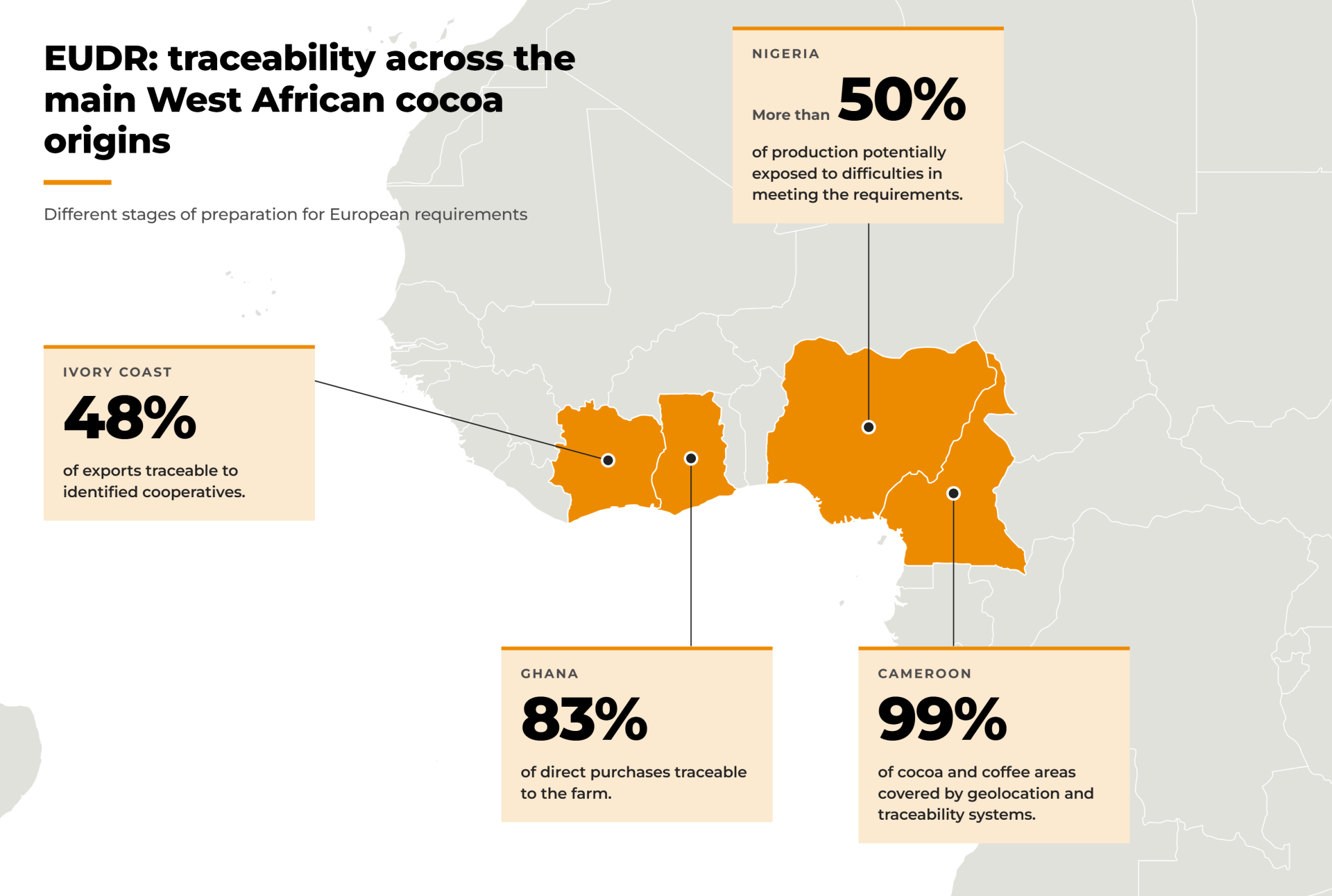
The degree of preparedness of the main African suppliers for the EUDR remains uneven. In Ivory Coast, a Trase survey released in 2026 indicates that only 48% of 2024 cocoa exports were directly traceable to identified cooperatives, while in Ghana 83% of direct purchases by companies participating in the Cocoa & Forests Initiative were traceable to the plot level in 2023.
In Nigeria, sector estimates indicate that more than half of production may struggle to meet European requirements. In contrast, Cameroon reported that 99% of cocoa and coffee production areas already had geolocation and traceability systems in place in 2025. Although the indicators have different scopes, the results point to different stages of preparedness and possible risks of trade restrictions for certain origins.
EUDR implementation on African suppliers
Source: LSEG, Trase, Cameroon Ministry of Trade, Hedgepoint
Among the possible consequences of the EUDR's implementation is a potential price differentiation between cocoa that complies with the regulation and cocoa that does not meet European requirements, which could be reflected in the physical differentials traded between origins. In addition, possible difficulties for the main suppliers to comply could influence trade flows, either through greater diversification of supply origins, a movement already observed in recent years with Ecuador's growing share amid supply constraints in West Africa, or through possible front-loading of European imports of beans and derivatives ahead of the regulation's application. Although the magnitude and direction of these effects remain uncertain, the EUDR could represent an additional factor of volatility, with possible implications for price differentials and the dynamics of international cocoa trade.
In Summary
The cocoa market remains driven by supply and demand fundamentals, but the EUDR adds a relevant layer of uncertainty, given the strong concentration of production and European imports in a few West African countries with uneven levels of traceability. Possible consequences include price differentiation between compliant and non-compliant cocoa, reflected in the physical differentials between origins, and changes in trade flows, whether through greater supplier diversification (such as Ecuador's expansion) or through front-loading of European imports before the rule takes effect. Although the magnitude and direction of these effects remain uncertain, the EUDR tends to be an additional factor of volatility for price differentials and for the dynamics of international cocoa trade.
Weekly Report — Cocoa
carolina.frança@hedgepointglobal.com
luiz.silverio@hedgepointglobal.com
Disclaimer
This document has been prepared by Hedgepoint Schweiz AG and its affiliates (“Hedgepoint”) solely for informational and instructional purposes, without intending to create obligations or commitments to third parties. It is not intended to promote or solicit an offer for the sale or purchase of any securities, commodities interests, or investment products. Hedgepoint and its associates expressly disclaim any liability for the use of the information contained herein that directly or indirectly results in any kind of damages. Information is obtained from sources which we believe to be reliable, but we do not warrant or guarantee the timeliness or accuracy of this information. The trading of commodities interests, such as futures, options, and swaps, involves substantial risk of loss and may not be suitable for all investors. You should carefully consider wither such trading is suitable for you in light of your financial condition. Past performance is not necessarily indicative of future results. Customers should rely on their own independent judgment and/or consult advisors before entering into any transactions. Hedgepoint does not provide legal, tax or accounting advice and you are responsible for seeking any such advice separately. Hedgepoint Schweiz AG is organized, incorporated, and existing under the laws of Switzerland, is filiated to ARIF, the Association Romande des Intermédiaires Financiers, which is a FINMA-authorized Self-Regulatory Organization. Hedgepoint Commodities LLC is organized, incorporated, and existing under the laws of the USA, and is authorized and regulated by the Commodity Futures Trading Commission (CFTC) and a member of the National Futures Association (NFA) to act as an Introducing Broker and Commodity Trading Advisor. HedgePoint Global Markets Limited is Regulated by the Dubai Financial Services Authority. The content is directed at Professional Clients and not Retail Clients. Hedgepoint Global Markets PTE. Ltd is organized, incorporated, and existing under the laws of Singapore, exempted from obtaining a financial services license as per the Second Schedule of the Securities and Futures (Licensing and Conduct of Business) Act, by the Monetary Authority of Singapore (MAS). Hedgepoint Global Markets DTVM Ltda. is authorized and regulated in Brazil by the Central Bank of Brazil (BCB) and the Brazilian Securities Commission (CVM). Hedgepoint Serviços Ltda. is organized, incorporated, and existing under the laws of Brazil. Hedgepoint Global Markets S.A. is organized, incorporated, and existing under the laws of Uruguay. In case of questions not resolved by the first instance of customer contact (client.services@Hedgepointglobal.com), please contact internal ombudsman channel (ombudsman@hedgepointglobal.com – global or ouvidoria@hedgepointglobal.com – Brazil only) or call 0800-8788408 (Brazil only). Integrity, ethics, and transparency are values that guide our culture. To further strengthen our practices, Hedgepoint has a whistleblower channel for employees and third-parties by e-mail ethicline@hedgepointglobal.com or forms Ethic Line – Hedgepoint Global Markets. “HedgePoint” and the “HedgePoint” logo are marks for the exclusive use of HedgePoint and/or its affiliates. Use or reproduction is prohibited, unless expressly authorized by HedgePoint. Furthermore, the use of any other marks in this document has been authorized for identification purposes only. It does not, therefore, imply any rights of HedgePoint in these marks or imply endorsement, association or seal by the owners of these marks with HedgePoint or its affiliates.