
Caution Prevails in the Cocoa Market
- Cocoa futures declined during the week after breaking key support levels, in a move driven primarily by technical factors, but also influenced by the broader macroeconomic environment and investors’ reassessment of market risks.
- Certified stocks remain above historical averages, supported mainly by beans from Ecuador, Peru, and Venezuela, contributing to a more comfortable short-term supply situation.
- Open interest and positioning data indicate that market participants are still waiting for clearer signals regarding the upcoming West African crop and the global supply-demand balance before expanding their exposure.
- Funds have reduced short positions without significantly increasing long exposure, while commercial participants remain active but below historical averages, reinforcing the perception of a cautious market with no dominant medium-term directional bias.
Caution Prevails in the Cocoa Market
Cocoa futures ended the first week of November lower, with the March 2027 contract declining 5.20% in New York and 4.98% in London. Following a series of corrections, prices failed to sustain the recovery seen in the November 4 session and fell to their lowest level in a month during trading on November 5, after breaking key support levels. As a result, although some fundamental developments continue to support the market, recent price movements appear to have been driven mainly by technical factors, the macroeconomic environment, and shifts in investor sentiment.
U.S. employment data released on November 6 came in above market expectations, with 165,000 jobs added and the unemployment rate declining to 4.1%. The stronger-than-expected report supported the U.S. dollar and pushed Treasury yields higher, reflecting increased expectations that the Federal Reserve could raise interest rates again in December. At the same time, investors continued to reassess global risks. The Democrats’ sweeping victory in both the House of Representatives and the Senate reinforced expectations of stricter regulation of the artificial intelligence sector, weighing on technology stocks and supporting more defensive assets such as U.S. Treasuries, the U.S. dollar, and the Japanese yen. Despite the losses accumulated throughout the week, cocoa prices recovered part of their decline on Friday, amid easing selling pressure and following the sharp correction seen in previous sessions.
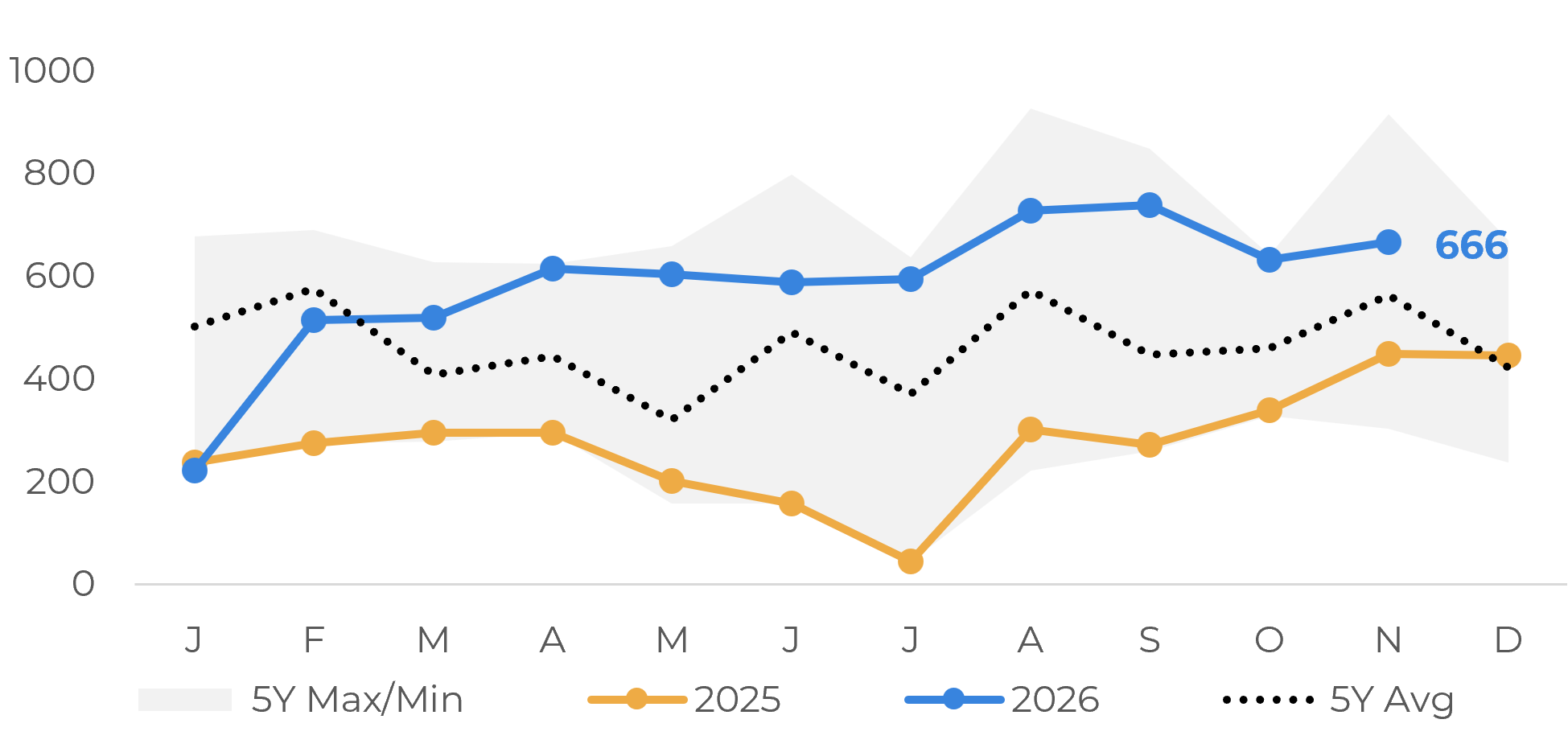
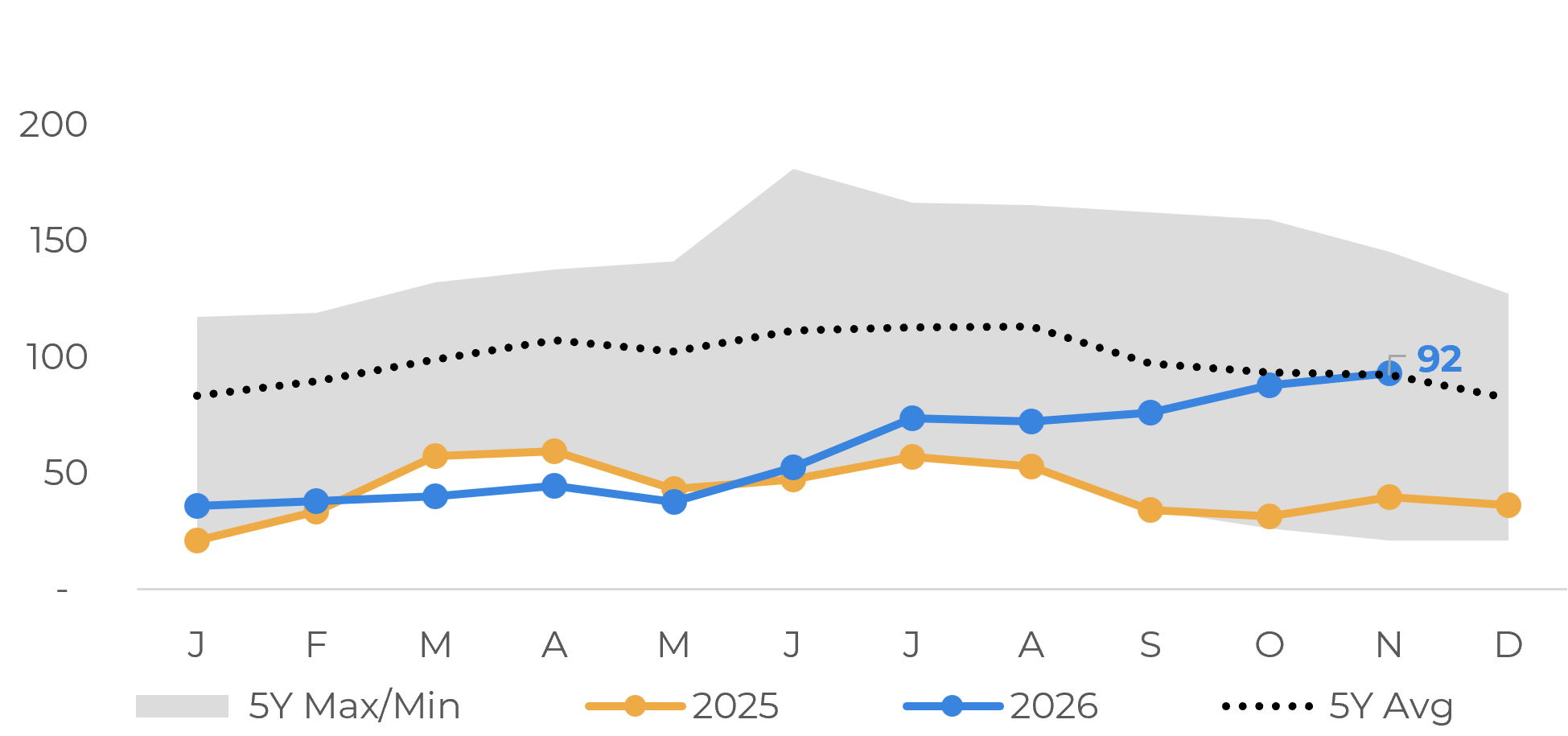
From a fundamental perspective, certified stocks, a key indicator of short-term availability, continue to point to a relatively comfortable supply situation in both markets. On ICE U.S., beans originating from Ecuador, as well as other Latin American origins such as Peru and Venezuela, continue to support inventories above historical averages. This level of availability, largely the result of the strong production recorded in the previous crop year, has helped offset risks associated with the current crop and early signs of demand recovery, limiting more immediate concerns about supply.
ICE U.S. – Cocoa Certified Stocks (‘000 bags)
Source: ICE
ICE Europe – Cocoa Certified/valid Stocks (‘000 tons)
Source: ICE
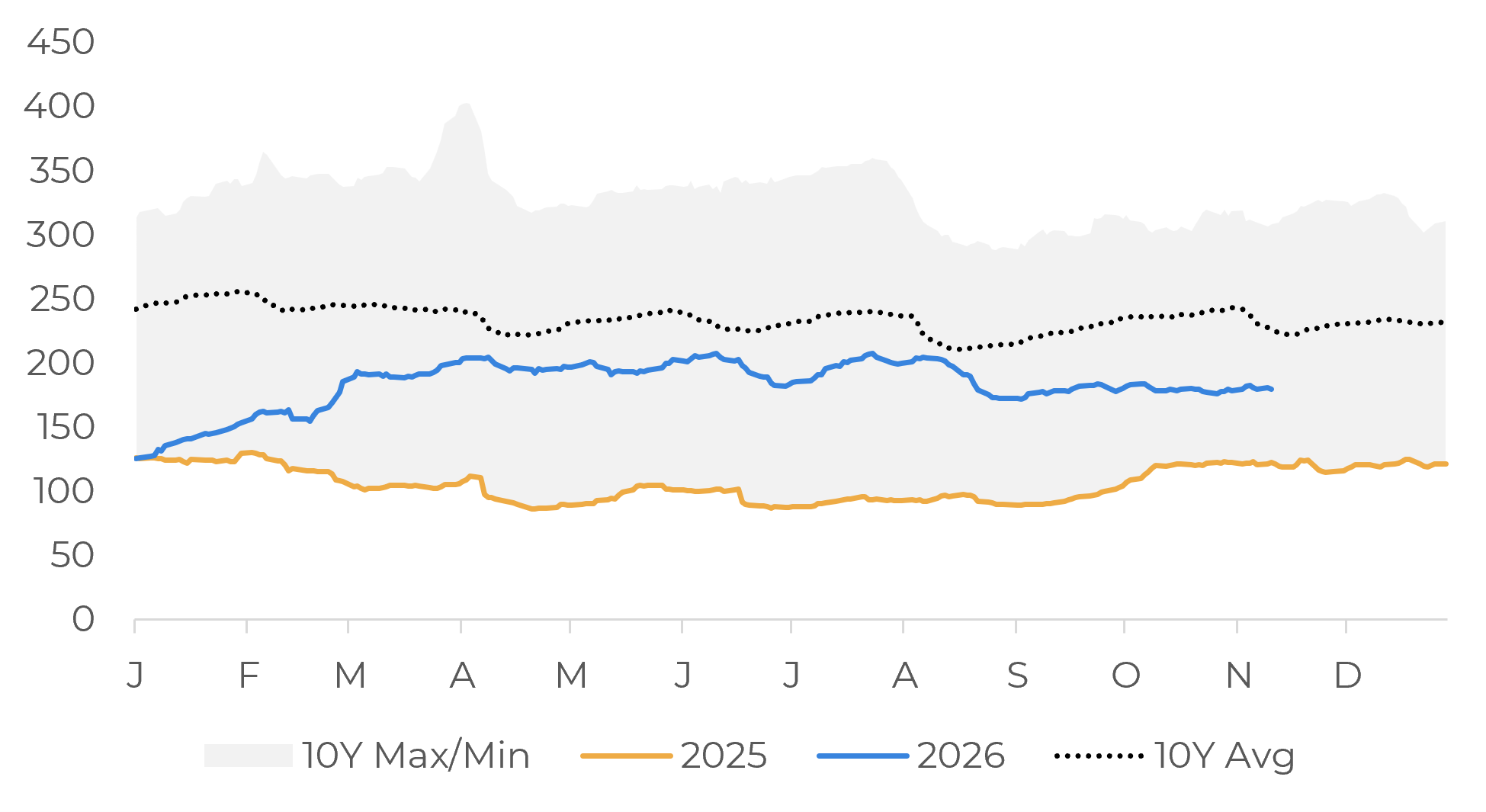
However, the market still appears to lack a clear directional bias. Positioning data and open interest suggest that the cocoa market is in a holding pattern, awaiting new signals from the fundamentals, particularly regarding West Africa’s production potential and the supply-demand balance for 2026/27. Open interest remains above the levels observed in 2025, indicating that the market continues to attract participants. However, the decline observed since August may suggest a loss of clear direction, with investors reducing their exposure while awaiting greater visibility on the upcoming crop and the evolution of global stocks.
Cocoa NY Open Interest (‘000 positions)
Source: Bloomberg, CFTC
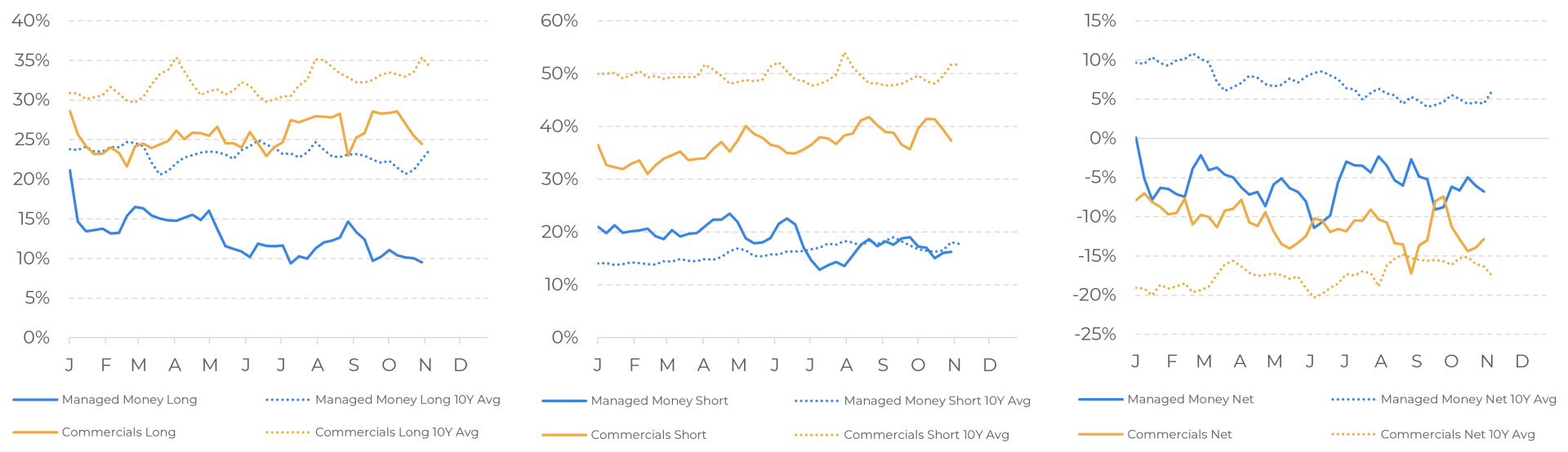
This more cautious stance can also be observed in the behavior of the funds. The Managed Money Long position remains well below the historical average, at around 10% of open interest, compared to an average of about 23% over the past ten years. This may indicate that financial investors have not yet adopted a broadly bullish outlook for the market, despite prices remaining at historically high levels. If there were a consolidated expectation of significant new deficits, a more pronounced long position would be expected.
Share of Long, Short, and Net Positions in Open Interest (%)
Source: Bloomberg, CFTC
The share of Managed Money Short positions also offers an interesting signal. Following increased concerns about supply and the possibility of further crop failures, funds reduced part of their short positions, causing their share to return to levels close to the historical average. In other words, investors have stopped maintaining a more bearish outlook in light of the increased risks to production. However, this reduction in short positions was not accompanied by a significant increase in long positions, suggesting that the funds chose to reduce their bearish bets without necessarily shifting to an openly bullish stance.
On the commercial side, the share of Producer Longs and Producer Shorts continues to represent a significant portion of open interest, highlighting the active presence of agents linked to the physical market. However, both positions remain below their historical averages, suggesting that neither sellers nor buyers in the production chain are aggressively expanding their positions. This behavior is consistent with an environment of uncertainty, in which participants appear to be awaiting clearer signals regarding the evolution of supply in West Africa and the global balance between supply and demand before taking on more significant positions.
Taken together, the indicators point to a market lacking clear conviction about the direction of prices in the medium term. Market participants appear to be awaiting further evidence regarding the recovery of supply in West Africa, the evolution of demand, and the tightness of the global supply-demand balance before taking more substantial positions. This relatively neutral positioning by funds suggests that the market still has room for significant movements in either direction as new fundamental information is priced in.
In Summary
Cocoa futures ended the first week of November lower, pressured mainly by technical factors and a more cautious macroeconomic environment, although fundamentals continue to provide some support. After reaching their lowest level in a month, prices recovered part of their losses on Friday, while certified stocks continued to indicate comfortable short-term availability, particularly on ICE U.S. At the same time, open interest and positioning data suggest a market lacking clear conviction about price direction, with both financial investors and commercial participants adopting a more defensive stance as they await greater visibility on the West African crop, demand trends, and the global supply-demand balance for 2026/27.
Weekly Report — Cocoa
carolina.frança@hedgepointglobal.com
laleska.moda@hedgepointglobal.com
Disclaimer
This document has been prepared by Hedgepoint Schweiz AG and its affiliates (“Hedgepoint”) solely for informational and instructional purposes, without intending to create obligations or commitments to third parties. It is not intended to promote or solicit an offer for the sale or purchase of any securities, commodities interests, or investment products. Hedgepoint and its associates expressly disclaim any liability for the use of the information contained herein that directly or indirectly results in any kind of damages. Information is obtained from sources which we believe to be reliable, but we do not warrant or guarantee the timeliness or accuracy of this information. The trading of commodities interests, such as futures, options, and swaps, involves substantial risk of loss and may not be suitable for all investors. You should carefully consider wither such trading is suitable for you in light of your financial condition. Past performance is not necessarily indicative of future results. Customers should rely on their own independent judgment and/or consult advisors before entering into any transactions. Hedgepoint does not provide legal, tax or accounting advice and you are responsible for seeking any such advice separately. Hedgepoint Schweiz AG is organized, incorporated, and existing under the laws of Switzerland, is filiated to ARIF, the Association Romande des Intermédiaires Financiers, which is a FINMA-authorized Self-Regulatory Organization. Hedgepoint Commodities LLC is organized, incorporated, and existing under the laws of the USA, and is authorized and regulated by the Commodity Futures Trading Commission (CFTC) and a member of the National Futures Association (NFA) to act as an Introducing Broker and Commodity Trading Advisor. HedgePoint Global Markets Limited is Regulated by the Dubai Financial Services Authority. The content is directed at Professional Clients and not Retail Clients. Hedgepoint Global Markets PTE. Ltd is organized, incorporated, and existing under the laws of Singapore, exempted from obtaining a financial services license as per the Second Schedule of the Securities and Futures (Licensing and Conduct of Business) Act, by the Monetary Authority of Singapore (MAS). Hedgepoint Global Markets DTVM Ltda. is authorized and regulated in Brazil by the Central Bank of Brazil (BCB) and the Brazilian Securities Commission (CVM). Hedgepoint Serviços Ltda. is organized, incorporated, and existing under the laws of Brazil. Hedgepoint Global Markets S.A. is organized, incorporated, and existing under the laws of Uruguay. In case of questions not resolved by the first instance of customer contact (client.services@Hedgepointglobal.com), please contact internal ombudsman channel (ombudsman@hedgepointglobal.com – global or ouvidoria@hedgepointglobal.com – Brazil only) or call 0800-8788408 (Brazil only). Integrity, ethics, and transparency are values that guide our culture. To further strengthen our practices, Hedgepoint has a whistleblower channel for employees and third-parties by e-mail ethicline@hedgepointglobal.com or forms Ethic Line – Hedgepoint Global Markets. “HedgePoint” and the “HedgePoint” logo are marks for the exclusive use of HedgePoint and/or its affiliates. Use or reproduction is prohibited, unless expressly authorized by HedgePoint. Furthermore, the use of any other marks in this document has been authorized for identification purposes only. It does not, therefore, imply any rights of HedgePoint in these marks or imply endorsement, association or seal by the owners of these marks with HedgePoint or its affiliates.