Outlook H2 2026: Coffee Market
- Brazil’s 2026/27 crop confirms a record production volume for both Arabica and Conilon, reinforcing projections of a global coffee supply surplus in the current marketing year. Even so, the market continues to experience elevated volatility, with futures prices remaining relatively high despite the expected surplus.
- This apparent contradiction can be explained by a combination of factors, including climate risk associated with the high probability of a strong El Niño between late 2026 and early 2027, limited inventories in consuming countries, the current market structure and the high costs of carrying stocks, as well as coffee being withheld at origin, particularly in Brazil.
- These and other topics were discussed during the second edition of the 2026 Coffee Outlook, presented on Wednesday, August 26. Key highlights are summarized below.
Outlook H2 2026: Coffee Market
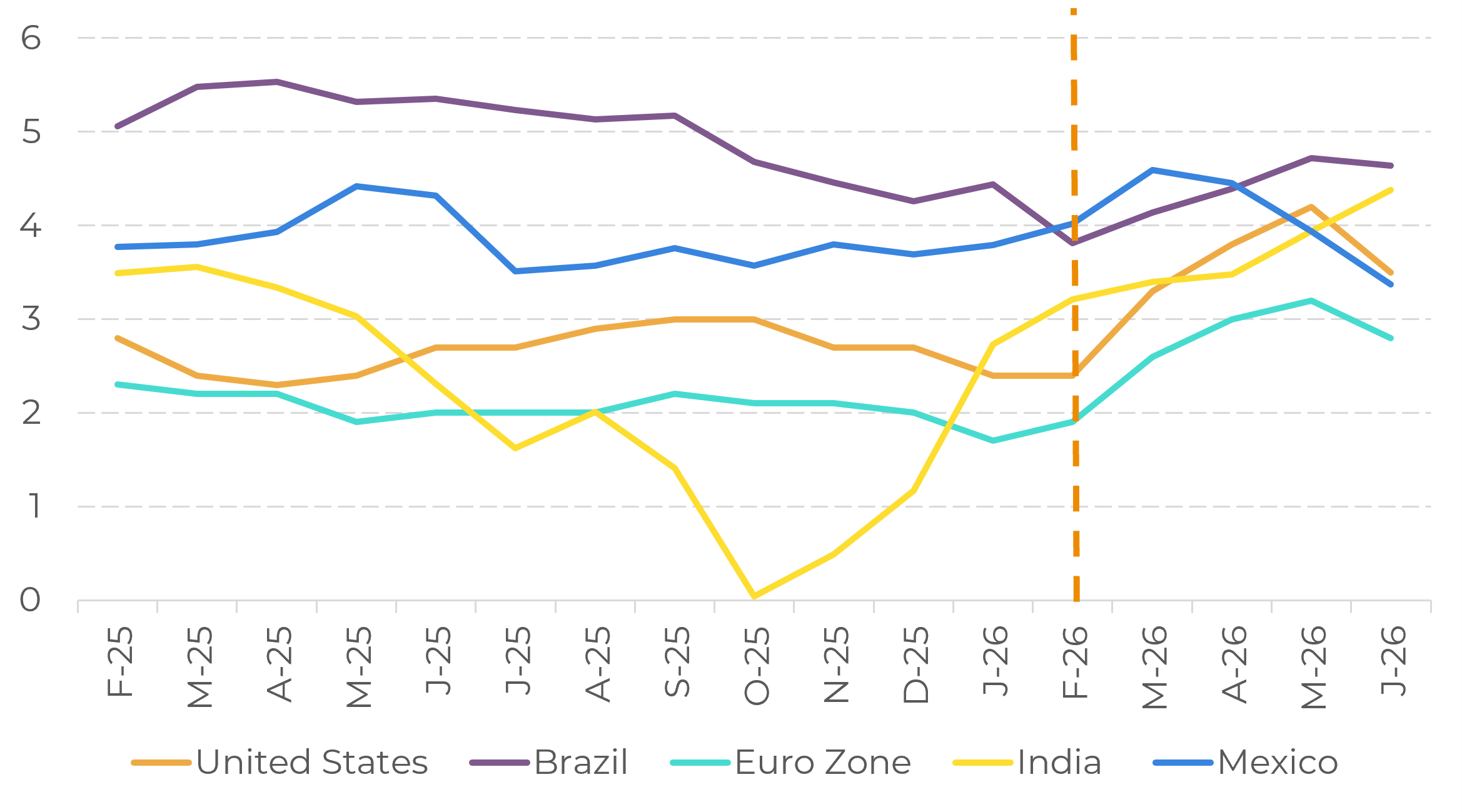
Key Countries CPI (% Y/Y)
Source: LSEG
These developments have periodically strengthened the U.S. dollar and placed intermittent pressure on emerging markets and commodity prices. Nevertheless, major producing countries such as Colombia and Brazil still offer attractive interest rate differentials, helping support local currencies. This, in turn, has affected selling activity in both countries by reducing the amount producers receive in local currency terms. In Brazil, the real may remain volatile in the coming months due to potential U.S. interest rate increases and rising political uncertainty linked to the start of the presidential race, factors that could also influence producer selling behavior.
In destination markets, higher interest rates directly increase the cost of financing inventories, particularly when the coffee market remains inverted. Demand, meanwhile, remains resilient, with Hedgepoint projecting consumption to recover to 181 million bags in 2026/27, while the USDA forecasts nearly 180 million bags, a record level. Major industry players also reported positive volume and revenue results during the first half of 2026, although there is a perceived change in consumer behavior, especially with the rise of in-home consumption.
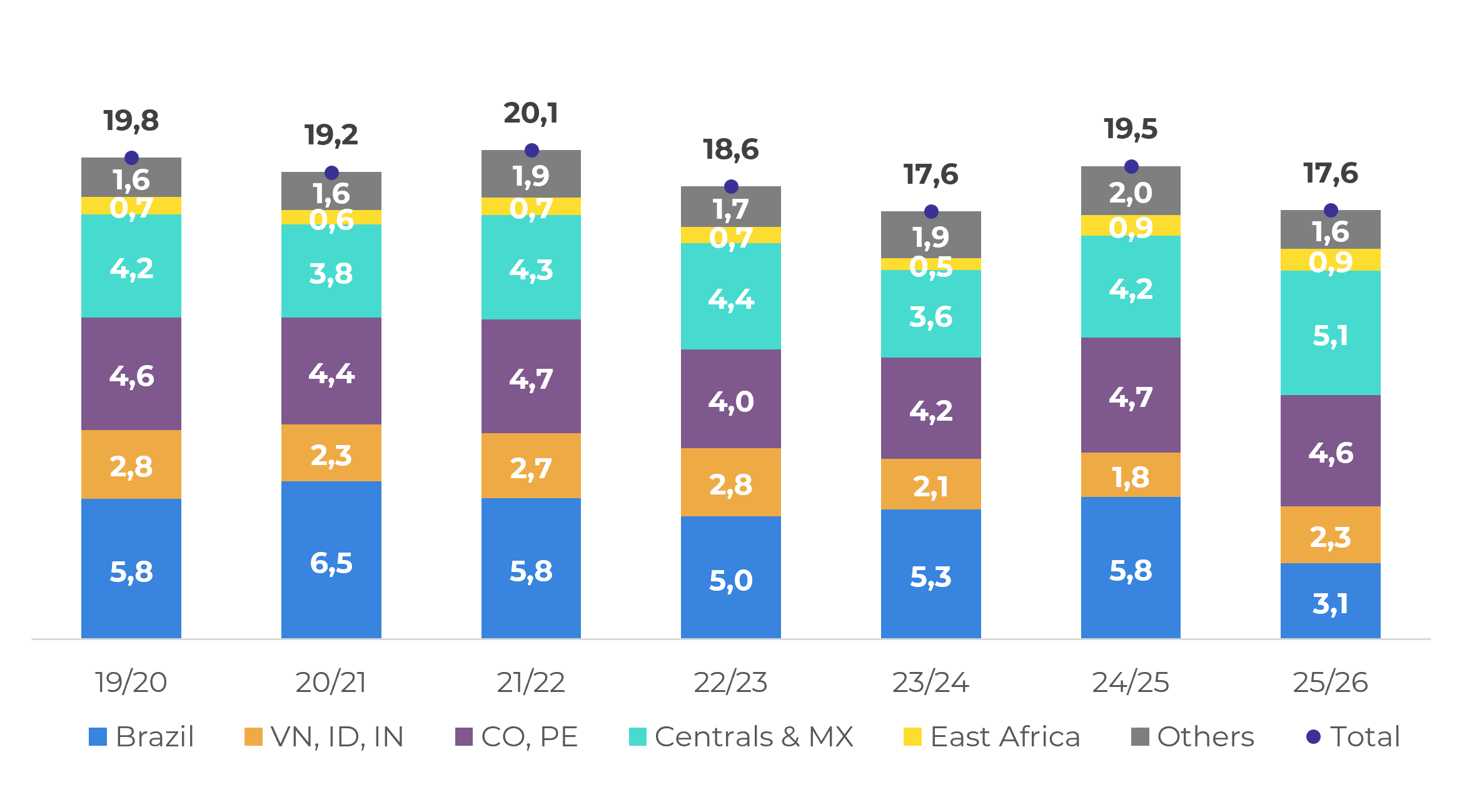
At the same time, imports into consuming countries have not increased and remain aligned with recent seasons, while inventories continue at extremely low levels. This suggests a growing tendency among buyers to import only what is strictly necessary, given the higher cost of carrying stocks. In the United States, this structural effect was intensified by a specific factor: the tariffs on Brazilian coffee imposed in mid-2025, which remained in effect until the end of that year for green coffee and until mid-2026 for instant/soluble coffee, reducing Brazil’s share of U.S. imports. Brazil’s share is among the lowest in the past 10 years, and no other origin (Vietnam, Indonesia, India, Central America) has been able to fully offset this loss.
U.S. Coffee Imports by Origin (M bags)
Source: US Trade Commission, Hedgepoint
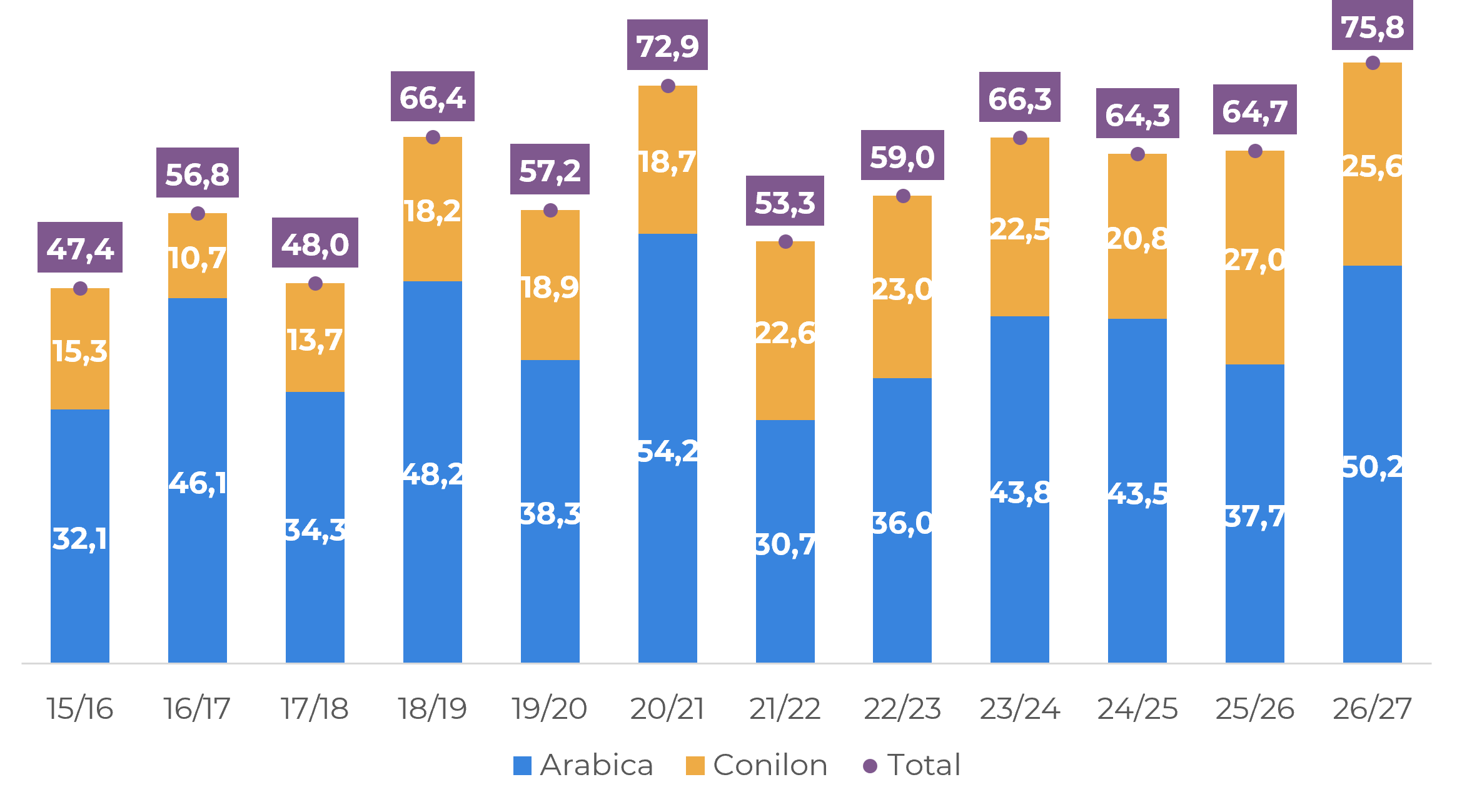
In Brazil, the world’s largest coffee-producing origin, delays in the 2026/27 harvest caused by late flowering in 2025 and June rainfall also contributed to market volatility. Although total production volume was not affected, with 50.2 M bags of Arabica and 25.6 M bags of Conilon for a total crop of 75.8 M bags, rainfall and uneven cherry maturation negatively affected the quality of part of the Arabica crop and may influence premiums for higher-grade coffees, even though exports of both varieties are expected to increase during the season.
Brazil Coffee Production (M bags)
Source: Hedgepoint
Producers, meanwhile, continue to hold back sales while awaiting the first flowering of the 2027/28 crop, particularly on the Arabica side. This behavior has also been reflected in export performance so far. During the first two months of the 2026/27 crop year (June and July), green Arabica shipments from Brazil remained below average levels. Conilon exports, however, increased, reflecting favorable Robusta arbitrage opportunities and Vietnam’s off-season period.
While Brazilian farmers continue to sell coffee at a relatively slow pace, climate-related risks remain elevated not only in Brazil but globally, helping sustain market volatility. The probability of a strong El Niño exceeds 75% between August and October 2026 and rises above 90% between October 2026 and January 2027. Risks are particularly significant for Southeast Asia’s Robusta crop during the 2026/27 and 2027/28 cycles, which could affect Arabica-Robusta arbitrage relationships, and remain moderate for Colombia’s Mitaca crop in 2026/27.
The earthquake that struck Colombia on August 10 also increased market sensitivity during the period. Although producing regions were not directly affected, infrastructure and logistics across Colombia's coffee supply chain were disrupted. Buenaventura Port, which handles most Colombian coffee exports, just returned to full operations at the end of August.
Despite these factors, the 2026/27 season is still expected to post a surplus of nearly 9 million bags, primarily due to Brazil’s record crop. In this context, the coffee market’s main challenge today is not supply availability, but rather the movement of coffee to destination markets within the current futures market structure. The market had already begun pricing in this surplus during the first half of 2026, when Arabica futures traded near 250 cents per pound. However, persistently low destination inventories, continued backwardation, delays in the Brazilian harvest, and increasing climate risks triggered a new wave of repricing during mid-year.
Global Coffee Supply and Demand (M bags)
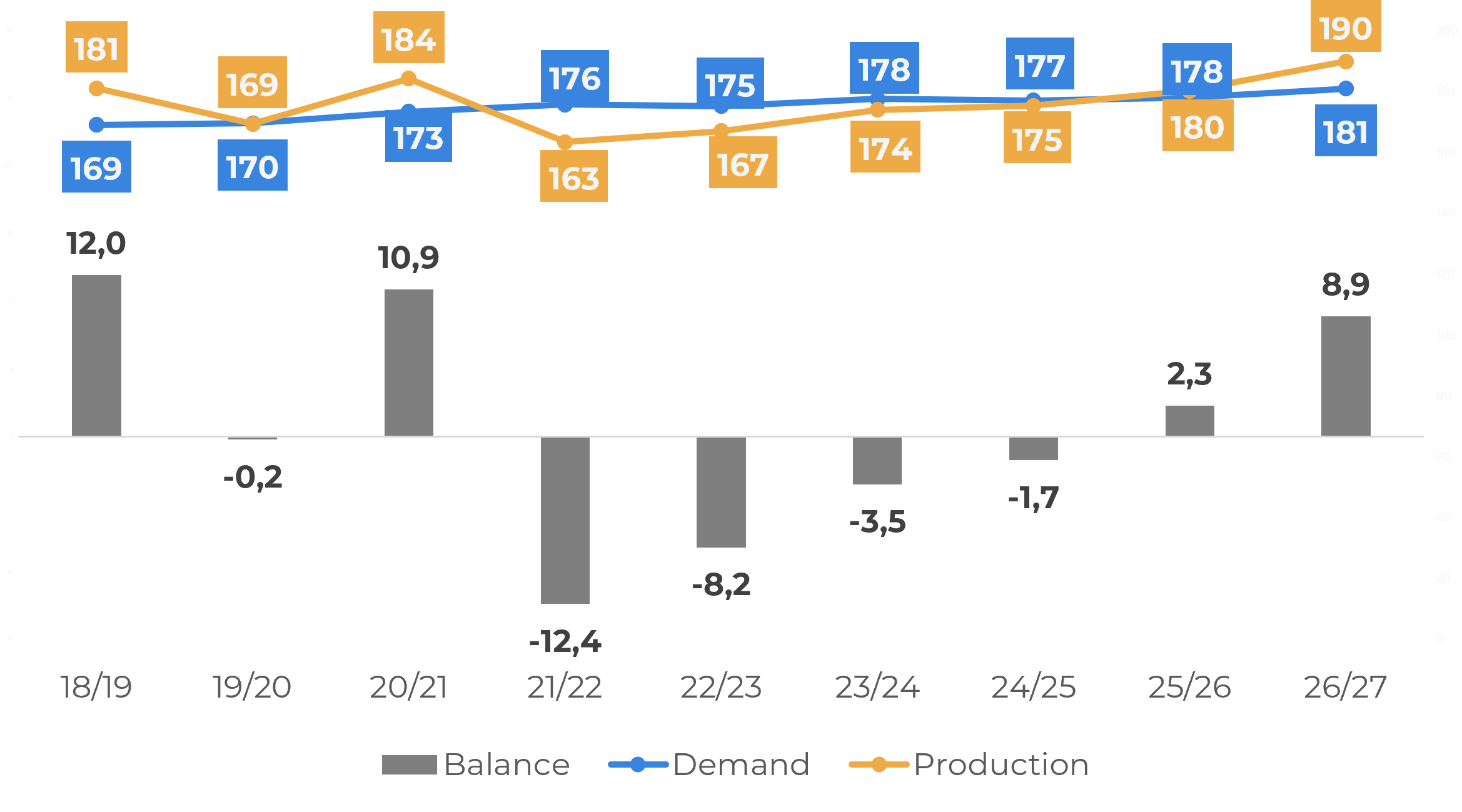
Source: Hedgepoint
The December-March and March-May spreads reached their highest levels in roughly a decade July, remaining elevated in the following weeks as the market absorbed the slower pace of producer selling in Brazil. ICE certified stocks also failed to ease market concerns, as they approached their lowest levels since April 1999. While certified stocks are not synonymous with total physical coffee inventories worldwide, their decline reflects the fact that Brazil, historically the largest provider of certified coffee stocks, has refrained from submitting coffee for certification because local differentials do not justify doing so, contributing to the retention of supply at origin.
Arabica: December-March Spread (c/lb)
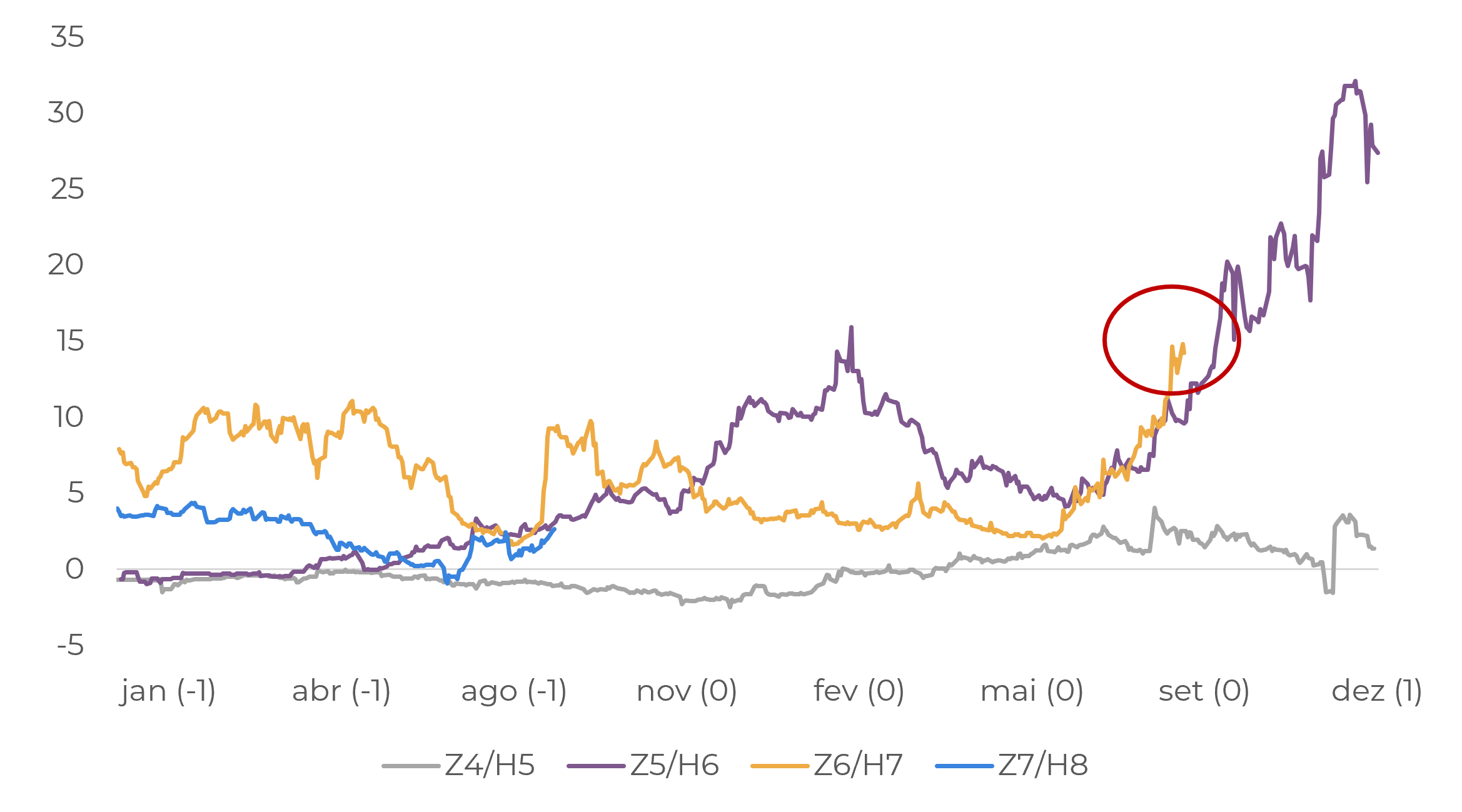
Source: LSEG
Furthermore, the composition of the futures market itself has amplified volatility. Over recent years, as many commercial participants exited the market following the historic price rallies of 2024 and 2025, open interest in New York declined significantly. This has allowed speculative funds to assume a proportionally larger role in price formation. In such a concentrated market, any signal related to supply can trigger disproportionately large price movements, a pattern that has been evident in recent months. Exchange margin requirements have also played a role. Since margin levels are based on perceived market risk, the sharp price fluctuations observed recently caused initial margin requirements to jump from approximately $5,000 to $20,000 per lot within a short period, ironically making the market even narrower and more reactive.
In Summary
Weekly Report — Coffee
laleska.moda@hedgepointglobal.com
livea.coda@hedgepointglobal.com
Disclaimer
This document has been prepared by Hedgepoint Schweiz AG and its affiliates (“Hedgepoint”) solely for informational and instructional purposes, without intending to create obligations or commitments to third parties. It is not intended to promote or solicit an offer for the sale or purchase of any securities, commodities interests, or investment products. Hedgepoint and its associates expressly disclaim any liability for the use of the information contained herein that directly or indirectly results in any kind of damages. Information is obtained from sources which we believe to be reliable, but we do not warrant or guarantee the timeliness or accuracy of this information. The trading of commodities interests, such as futures, options, and swaps, involves substantial risk of loss and may not be suitable for all investors. You should carefully consider wither such trading is suitable for you in light of your financial condition. Past performance is not necessarily indicative of future results. Customers should rely on their own independent judgment and/or consult advisors before entering into any transactions. Hedgepoint does not provide legal, tax or accounting advice and you are responsible for seeking any such advice separately. Hedgepoint Schweiz AG is organized, incorporated, and existing under the laws of Switzerland, is filiated to ARIF, the Association Romande des Intermédiaires Financiers, which is a FINMA-authorized Self-Regulatory Organization. Hedgepoint Commodities LLC is organized, incorporated, and existing under the laws of the USA, and is authorized and regulated by the Commodity Futures Trading Commission (CFTC) and a member of the National Futures Association (NFA) to act as an Introducing Broker and Commodity Trading Advisor. HedgePoint Global Markets Limited is Regulated by the Dubai Financial Services Authority. The content is directed at Professional Clients and not Retail Clients. Hedgepoint Global Markets PTE. Ltd is organized, incorporated, and existing under the laws of Singapore, exempted from obtaining a financial services license as per the Second Schedule of the Securities and Futures (Licensing and Conduct of Business) Act, by the Monetary Authority of Singapore (MAS). Hedgepoint Global Markets DTVM Ltda. is authorized and regulated in Brazil by the Central Bank of Brazil (BCB) and the Brazilian Securities Commission (CVM). Hedgepoint Serviços Ltda. is organized, incorporated, and existing under the laws of Brazil. Hedgepoint Global Markets S.A. is organized, incorporated, and existing under the laws of Uruguay. In case of questions not resolved by the first instance of customer contact (client.services@Hedgepointglobal.com), please contact internal ombudsman channel (ombudsman@hedgepointglobal.com – global or ouvidoria@hedgepointglobal.com – Brazil only) or call 0800-8788408 (Brazil only). Integrity, ethics, and transparency are values that guide our culture. To further strengthen our practices, Hedgepoint has a whistleblower channel for employees and third-parties by e-mail ethicline@hedgepointglobal.com or forms Ethic Line – Hedgepoint Global Markets. “HedgePoint” and the “HedgePoint” logo are marks for the exclusive use of HedgePoint and/or its affiliates. Use or reproduction is prohibited, unless expressly authorized by HedgePoint. Furthermore, the use of any other marks in this document has been authorized for identification purposes only. It does not, therefore, imply any rights of HedgePoint in these marks or imply endorsement, association or seal by the owners of these marks with HedgePoint or its affiliates.