
Coffee Market Remains Vulnerable to Supply-Side Risks
- Despite the current bearish trend, Arabica and Robusta prices found support around 280-90 c/lb in recent weeks, as worries about El Niño's impact on global coffee production grow and the macroeconomic outlook in the bean's largest supplier has shifted.
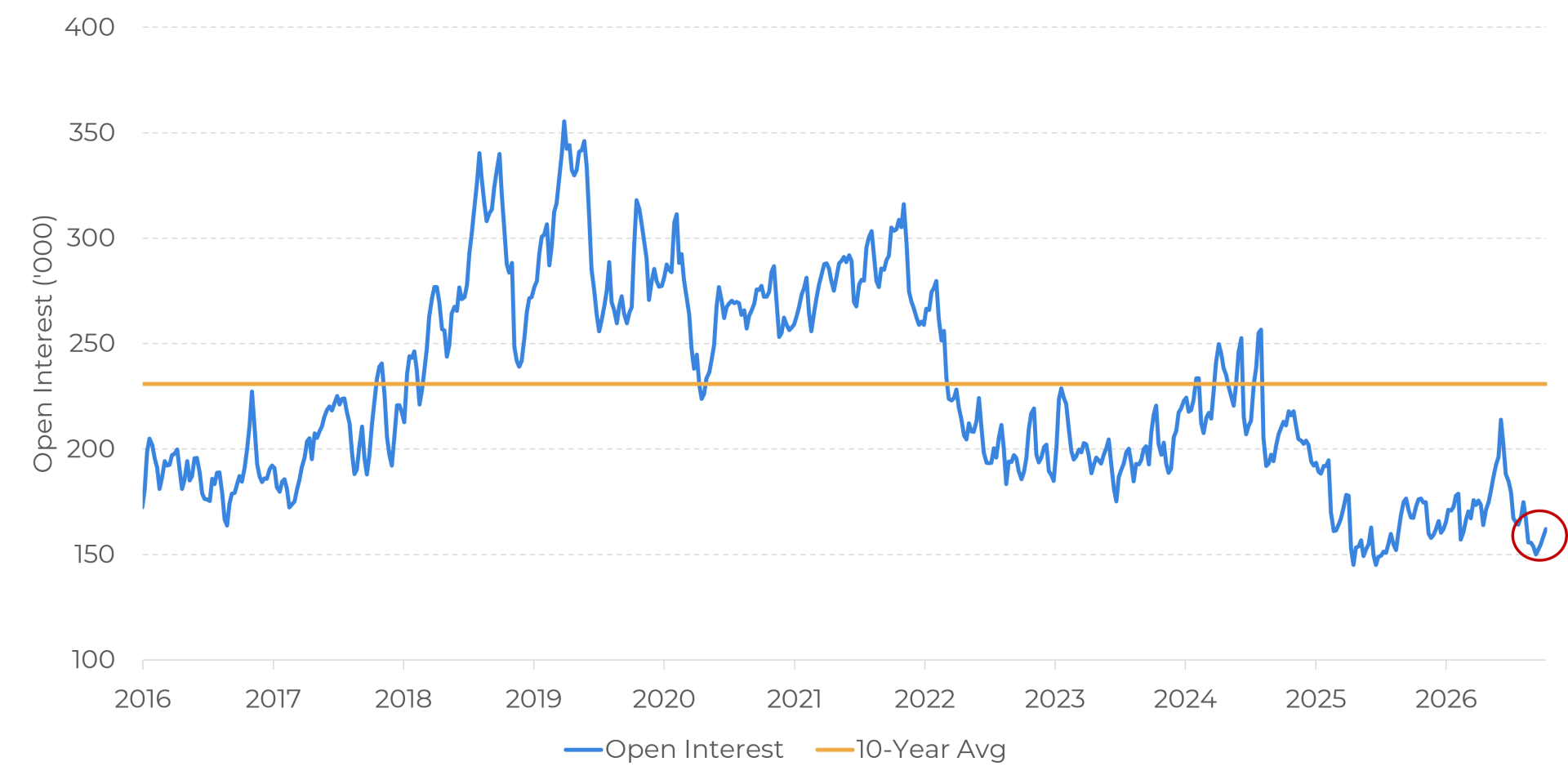
- Although supply is improving in Brazil - especially given export figures - the current market structure, especially given the sharp decrease in market size in recent years, makes coffee prices more sensitive to news, leading to stronger oscillations.
- El Niño’s risks are still present, with the phenomenon especially strong in Q4, amid the 2027/28 Brazilian crop development. Not only in Brazil, but weather has not been favorable in Southeast Asia, and there are increasing concerns over Colombia's outlook in the next months.
- The offseason in other origins also increases concerns over supply due to low stocks in destination, with differentials increasing in the past few days. Although the 2026/27 harvest is expected to gain pace in most Arabica and Robusta producers in the next weeks, the bulk of the crop normally arrives in the market between December and February.
- On the macroeconomic front, the Brazilian election period brought a new force to the BRL. As a stronger local currency tends to disincentivize coffee sales, prices have also gained support.
Coffee Market Remains Vulnerable to Supply-Side Risks
Meanwhile, the offseason in other origins also increases concerns over supply due to low stocks in destination, with differentials increasing in the past few weeks (see report here). Although the 2026/27 harvest is expected to gain pace in most Arabica and Robusta producers in the next weeks, the bulk of the crop normally arrives in the market between December and February.
Arabica NY Open Interest (000’)
Source: Bloomberg
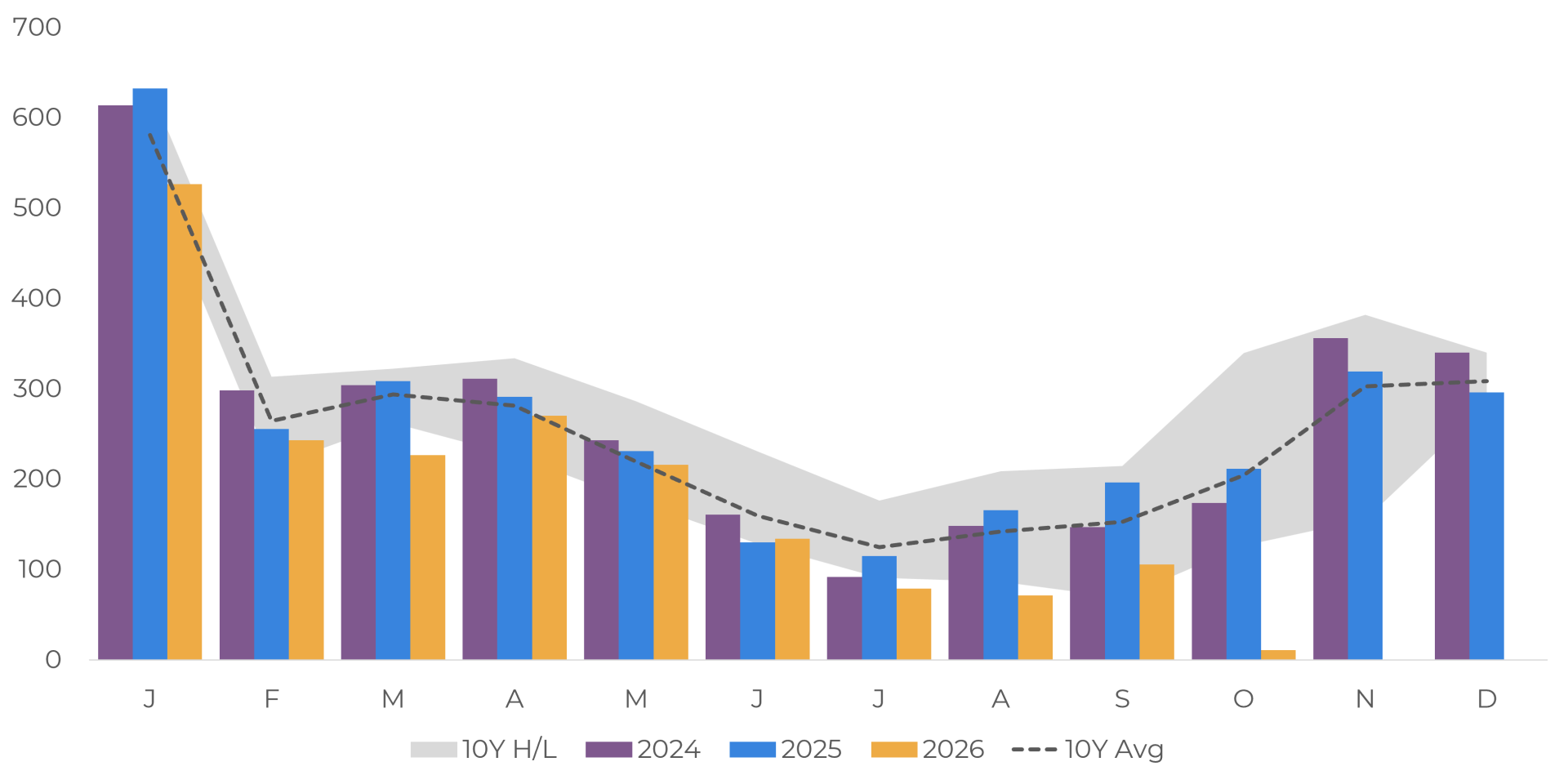
As discussed in previous analyses, El Niño could affect Southeast Asia, particularly during the 2026/27 and 2027/28 seasons, Colombia's 2026/27 Mitaca crop, and potentially the development of Brazil's 2027/28 crop. In Southeast Asia, the phenomenon is already influencing rainfall patterns in both Indonesia and Vietnam.
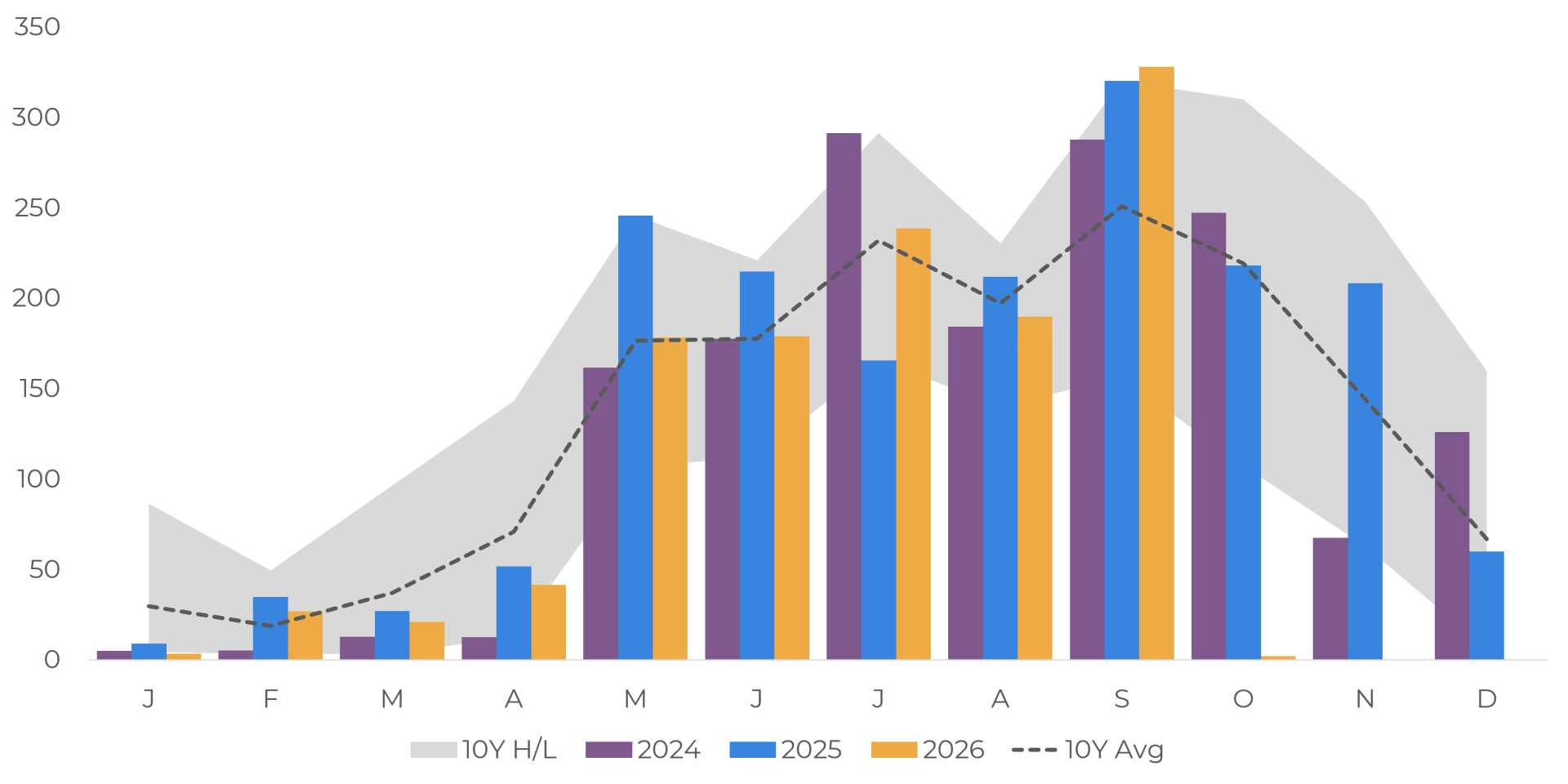
In Vietnam, the current dry conditions have supported harvest progress, although some producing areas experienced slight losses in the 2026/27 crop. Looking ahead, low reservoir levels and the potential extension of the dry season into 2027 could hinder the early development of the 2027/28 crop. In Indonesia, where the 2027/28 Robusta crop is already in its development stage, below-average rainfall is expected to negatively affect next year's production, increasing concerns about future supply availability.
Indonesia cumulative rainfall in coffee regions (mm)
Source: Google Earth, Copernicus, Hedgepoint
Vietnam cumulative rainfall in Central Highlands (mm)
Source: Google Earth, Copernicus, Hedgepoint
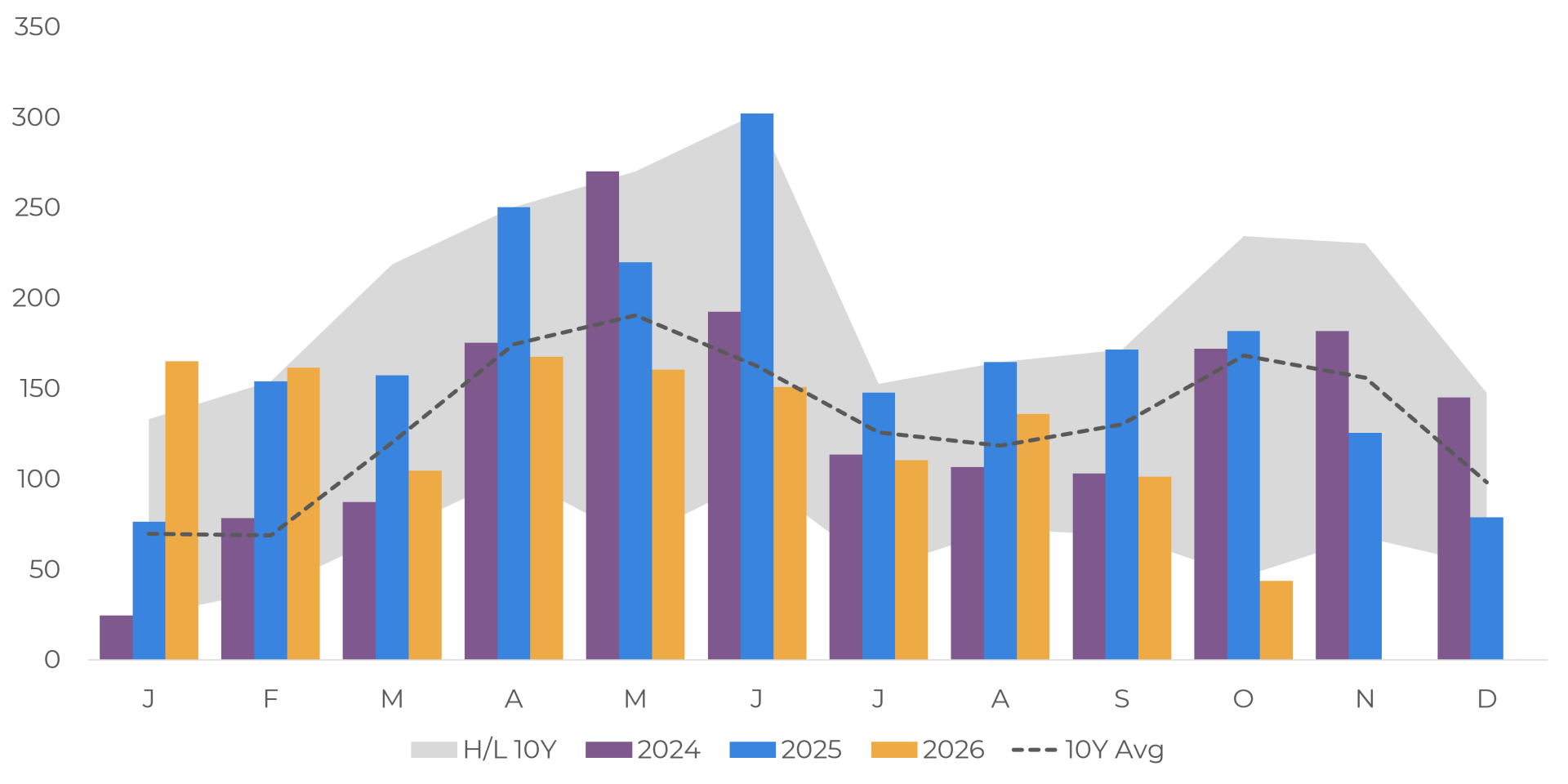
In Colombia, precipitation has been below average in recent months, although the development of the main 2026/27 crop has not been significantly affected so far. However, risks to the Mitaca crop are increasing, as trees will enter a critical development stage during the period when El Niño is expected to have its strongest impact. In Brazil, flowering for the 2027/28 crop has been strong, and weather conditions have remained favorable for crop development. Nevertheless, risks associated with dry spells ("veranicos") and heat waves between Q4 2026 and Q1 2027 remain, potentially affecting yields, particularly in Conilon-producing regions.
In the short term, however, the supply outlook continues to improve, supported not only by the positive start to the 2027/28 Brazilian crop cycle but also by expectations of increased bean availability from Brazil. After strong export volumes in August, government data released on October 6 indicated that green coffee exports reached 3.93 million bags in September, the highest level in 20 months.
On the other hand, Cecafé's official figures released over the weekend showed green coffee exports totaling 3.58 million bags in September, slightly below August levels but still 3.2% higher than a year earlier. Arabica shipments declined 7.1% year-on-year to 2.7 million bags, while Conilon exports surged 65.1% to 813.9 thousand bags. Total coffee exports, including green and processed coffee, reached 3.8 million bags, up 3.1% from September 2025. According to Cecafé, export performance continues to benefit from the recovery in shipments to the United States following the reduction of tariffs on green coffee in November 2025 and, more recently, on soluble coffee.
Colombia cumulative rainfall in coffee regions (mm)
Source: Gadas, Hedgepoint
Thus, while expectations for the 2027/28 crop and strong Brazilian export flows are adding bearish pressure to the market, weather will remain a key driver of price formation in the coming weeks, particularly as the first production estimates for the new Brazilian season begin to emerge. For now, there are no major concerns regarding flowering development in Brazil, with rainfall expected to remain abundant across coffee-growing regions through October, while temperatures are likely to stay slightly above average. Nevertheless, elevated temperatures during the bean-filling stage could still weigh on yields later in the cycle, with significant risks over the March 2027 Arabica contract.
Meanwhile, the effects of El Niño are already being felt in Southeast Asia and could negatively impact Robusta production in the 2027/28 season. This may provide support for coffee prices, particularly for nearby Robusta contracts and deferred positions that are more exposed to next year's supply outlook, including the January and March 2027 Robusta futures contracts.
It is also important to note that any reduction in Robusta output could lead to a narrowing of the Arabica-Robusta arbitrage, as tighter Robusta availability would likely increase demand for lower-quality Arabica coffees as substitutes. However, a return to the extreme arbitrage levels observed after the 2023/24 El Niño, during 2024 and early 2025, appears unlikely, given the significant expansion of Conilon production in Brazil over recent years, which has strengthened global Robusta supply fundamentals.
In Summary
Weekly Report — Coffee
laleska.moda@hedgepointglobal.com
thais.italiani@hedgepointglobal.com
Disclaimer
This document has been prepared by Hedgepoint Schweiz AG and its affiliates (“Hedgepoint”) solely for informational and instructional purposes, without intending to create obligations or commitments to third parties. It is not intended to promote or solicit an offer for the sale or purchase of any securities, commodities interests, or investment products. Hedgepoint and its associates expressly disclaim any liability for the use of the information contained herein that directly or indirectly results in any kind of damages. Information is obtained from sources which we believe to be reliable, but we do not warrant or guarantee the timeliness or accuracy of this information. The trading of commodities interests, such as futures, options, and swaps, involves substantial risk of loss and may not be suitable for all investors. You should carefully consider wither such trading is suitable for you in light of your financial condition. Past performance is not necessarily indicative of future results. Customers should rely on their own independent judgment and/or consult advisors before entering into any transactions. Hedgepoint does not provide legal, tax or accounting advice and you are responsible for seeking any such advice separately. Hedgepoint Schweiz AG is organized, incorporated, and existing under the laws of Switzerland, is filiated to ARIF, the Association Romande des Intermédiaires Financiers, which is a FINMA-authorized Self-Regulatory Organization. Hedgepoint Commodities LLC is organized, incorporated, and existing under the laws of the USA, and is authorized and regulated by the Commodity Futures Trading Commission (CFTC) and a member of the National Futures Association (NFA) to act as an Introducing Broker and Commodity Trading Advisor. HedgePoint Global Markets Limited is Regulated by the Dubai Financial Services Authority. The content is directed at Professional Clients and not Retail Clients. Hedgepoint Global Markets PTE. Ltd is organized, incorporated, and existing under the laws of Singapore, exempted from obtaining a financial services license as per the Second Schedule of the Securities and Futures (Licensing and Conduct of Business) Act, by the Monetary Authority of Singapore (MAS). Hedgepoint Global Markets DTVM Ltda. is authorized and regulated in Brazil by the Central Bank of Brazil (BCB) and the Brazilian Securities Commission (CVM). Hedgepoint Serviços Ltda. is organized, incorporated, and existing under the laws of Brazil. Hedgepoint Global Markets S.A. is organized, incorporated, and existing under the laws of Uruguay. In case of questions not resolved by the first instance of customer contact (client.services@Hedgepointglobal.com), please contact internal ombudsman channel (ombudsman@hedgepointglobal.com – global or ouvidoria@hedgepointglobal.com – Brazil only) or call 0800-8788408 (Brazil only). Integrity, ethics, and transparency are values that guide our culture. To further strengthen our practices, Hedgepoint has a whistleblower channel for employees and third-parties by e-mail ethicline@hedgepointglobal.com or forms Ethic Line – Hedgepoint Global Markets. “HedgePoint” and the “HedgePoint” logo are marks for the exclusive use of HedgePoint and/or its affiliates. Use or reproduction is prohibited, unless expressly authorized by HedgePoint. Furthermore, the use of any other marks in this document has been authorized for identification purposes only. It does not, therefore, imply any rights of HedgePoint in these marks or imply endorsement, association or seal by the owners of these marks with HedgePoint or its affiliates.