Live with Experts – Highlights from the Coffee Market
- In this analysis, we have compiled the main points discussed during the “Live with Experts” session held on October 21, which covered: the macroeconomic outlook, weather conditions and marketing in Brazil, El Niño in other producing regions, imports in consuming markets, market structure, and the global coffee balance. The full recording is available through the event link.
Macroeconomic Overview
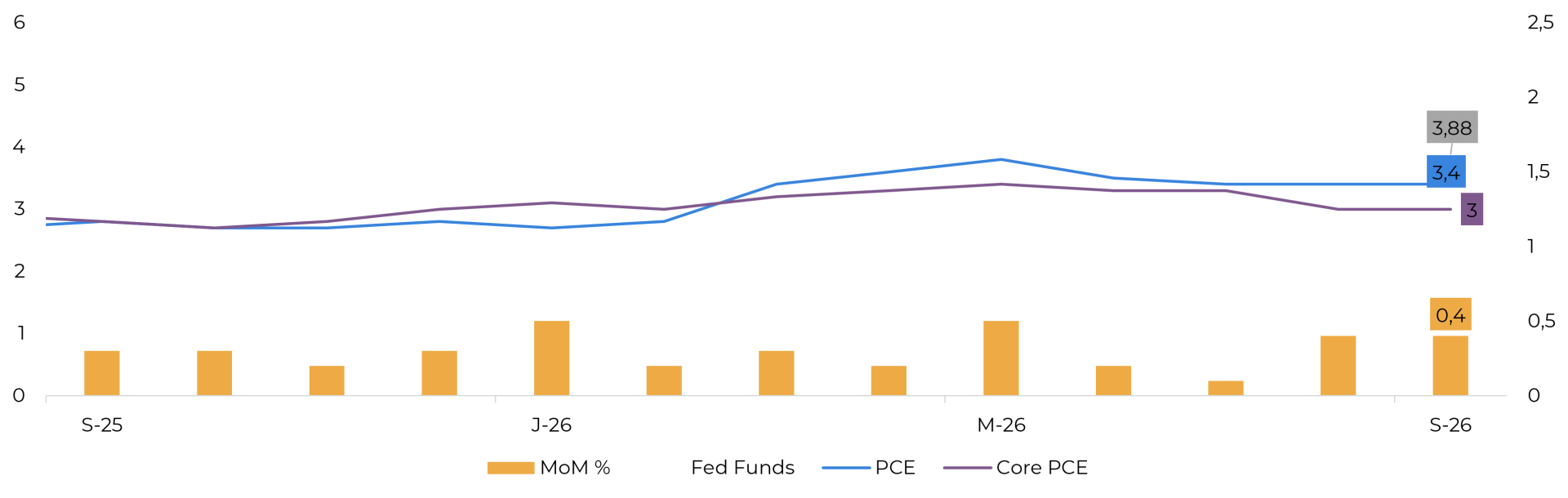
U.S.: PCE and Fed Interest Rates (%)
Source: Bloomberg
The conflict between Iran, the United States, and Israel has reignited inflationary pressures and reshaped interest rate expectations, keeping financing costs high — particularly in destination countries — which makes financing coffee inventories and trade more expensive. Furthermore, strong demand for credit from technology companies may keep these costs elevated for longer.
Brazil: Weather, Crop, and Sales
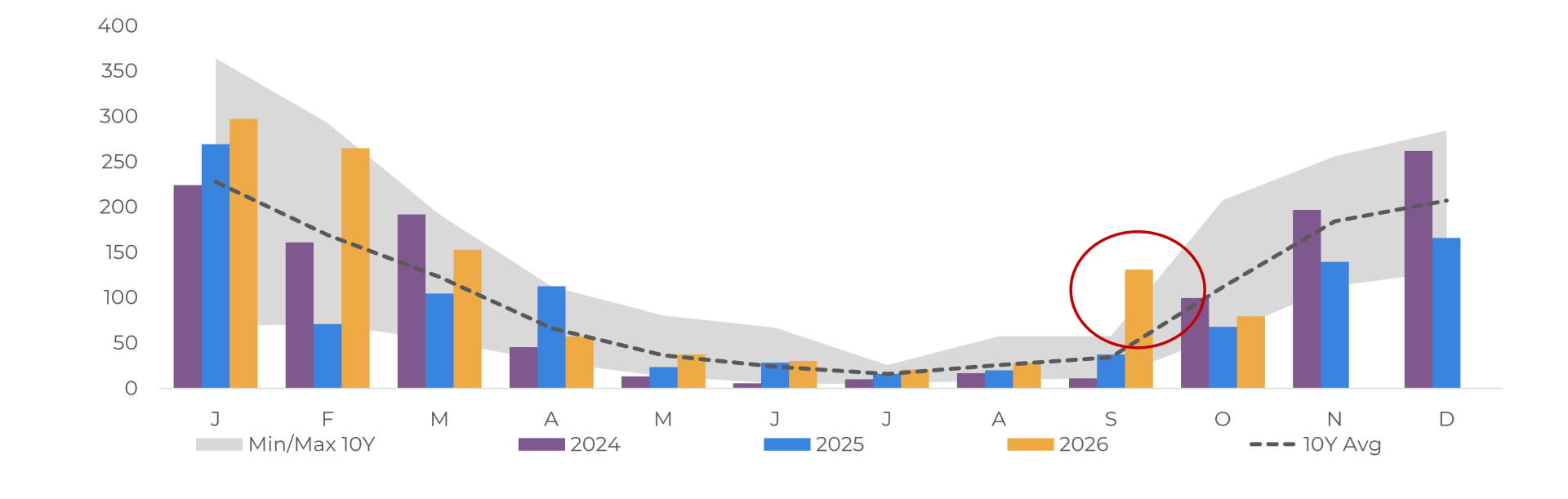
Weather conditions remain favorable for now. Rainfall has allowed for good flowering for the 2027/28 crop, although it has been more uneven than expected, and the increase in planted area in recent years bodes well for the next cycle. Due to the biennial cycle, Arabica production is expected to be lower than in 2026/27, while Conilon production may match or exceed current levels, depending on weather conditions.
The risk in the fourth quarter of 2026 lies in temperatures, which are expected to be between 0.6 °C and 2 °C above average, since rainfall to date — a result of El Niño — has contributed to improved water reserves. However, the greatest risk lies in the first quarter of 2027: if heat combines with less rain, screen size and yield could decline, affecting the size and quality of the next harvest.
For the 2026/27 crop year, Hedgepoint maintained its estimate of 75.8 million bags (M bags), comprising 50.2 M bags of Arabica and 25.6 M bags of Conilon. Sales, however, remain slow: producers are selling only what is necessary to cover costs and are waiting for greater clarity regarding the 2027/28 season, and futures trading is also moving slowly, as the spot price has been higher. On the other hand, price differentials indicate less concern about supply — close to average or even below average for the “good cup” 14/16 grade — and exports have picked up over the past two months, with the United States regaining the lead among destinations following the end of tariffs on Brazilian coffee beans. In the domestic market, the spread between Arabica and Conilon still favors the use of Conilon in blends, although it may narrow, given that production of lower-quality Arabica in 2026/27 was higher.
Cumulative rainfall in Brazil’s coffee-growing regions (mm)
Source: Somar, Bloomberg.
El Niño and Other Factors
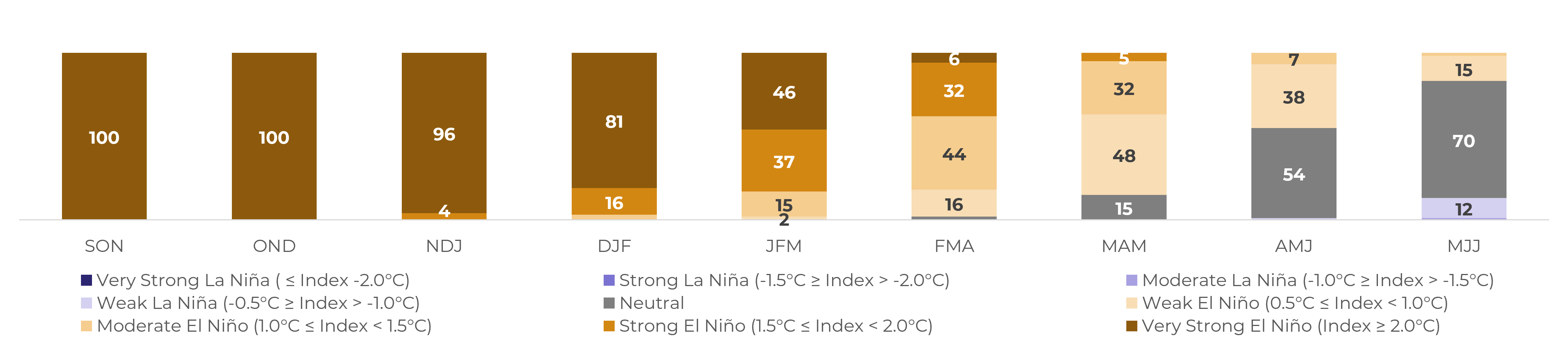
Probability of ENSO Strength (%) – October 2026
Major Impacts
Source: NOAA

In Vietnam, the 2026/27 harvest is picking up pace, and production is expected to reach 30.5 M scs, remaining virtually stable compared to 2025/26 thanks to a larger planted area, as some regions were affected by drier conditions. On the other hand, low rainfall is expected to accelerate the harvest pace, bringing beans to market as early as November and keeping exports high. The greatest risk lies in the 2027/28 season, especially if El Niño persists into 2027, as water reserves could dwindle and drought could strike during the flowering phase.
In Indonesia, dry weather is already threatening the 2027/28 crop, as Robusta trees are already in their dvelopment phase. Cumulative exports total 3.3 M scs, 21.5% below the previous cycle. With Vietnam, Uganda, and India at the start of the harvest and Indonesia in the off-season, Robusta price differentials remain high but may decline if the Vietnamese crop reaches the market earlier.
For Arabica, El Niño has not yet had a major impact, but Colombia’s intermediate crop (Mitaca) is currently developing and warrants attention, as it could be affected by higher temperatures and drought. Colombian exports total 10.6 M scs, 13.5% below the 2024/25 level, reflecting lower production and a stronger peso, while Central America and Mexico are maintaining a pace similar to that of the previous cycle. In East Africa, shipments are below 2024/25 levels but well above the recent average. Since most origins are at the start of the harvest, the bulk of the new coffee crop will not arrive until November and December, and the pullback by Colombian producers, along with logistical risks, is sustaining price differentials.
Imports in Destination Markets
In destination markets, imports remain sluggish, but inventories are declining. In the European Union, net imports total 38.5 M scs (-3.6% compared to 2024/25), reflecting buyer caution and higher financing costs, while inventories continue to fall, signaling that demand remains firm. In the United States, net imports totaled 20.2 M scs (-7.8%), a lingering effect of tariffs, but the resumption of Brazilian shipments suggests a recovery in the coming months. In Japan, imports are stable (4.7 M scs, -1.1%) and domestic inventories have declined, reflecting a scenario similar to that in the EU.
Overall, higher financing costs and coffee prices in recent years have led to a certain shift in buyer behavior, with slower pace of imports and tighter inventories. On the other hand, this new behavior also leaves room for greater price volatility, especially due to vulnerability on the supply side.
Market Structure and Prices
The coffee market is smaller. Open interest in Arabica is at its lowest level in over ten years, and while Robusta’s has recovered, it remains below average, which reduces liquidity and increases price sensitivity to large orders. At the same time, the participation of commercial funds has fallen — especially on the short side — due to high prices and financing costs, while speculators, at levels close to the average, have been increasing their short positions in light of current supply conditions, which may make their moves more influential on prices.
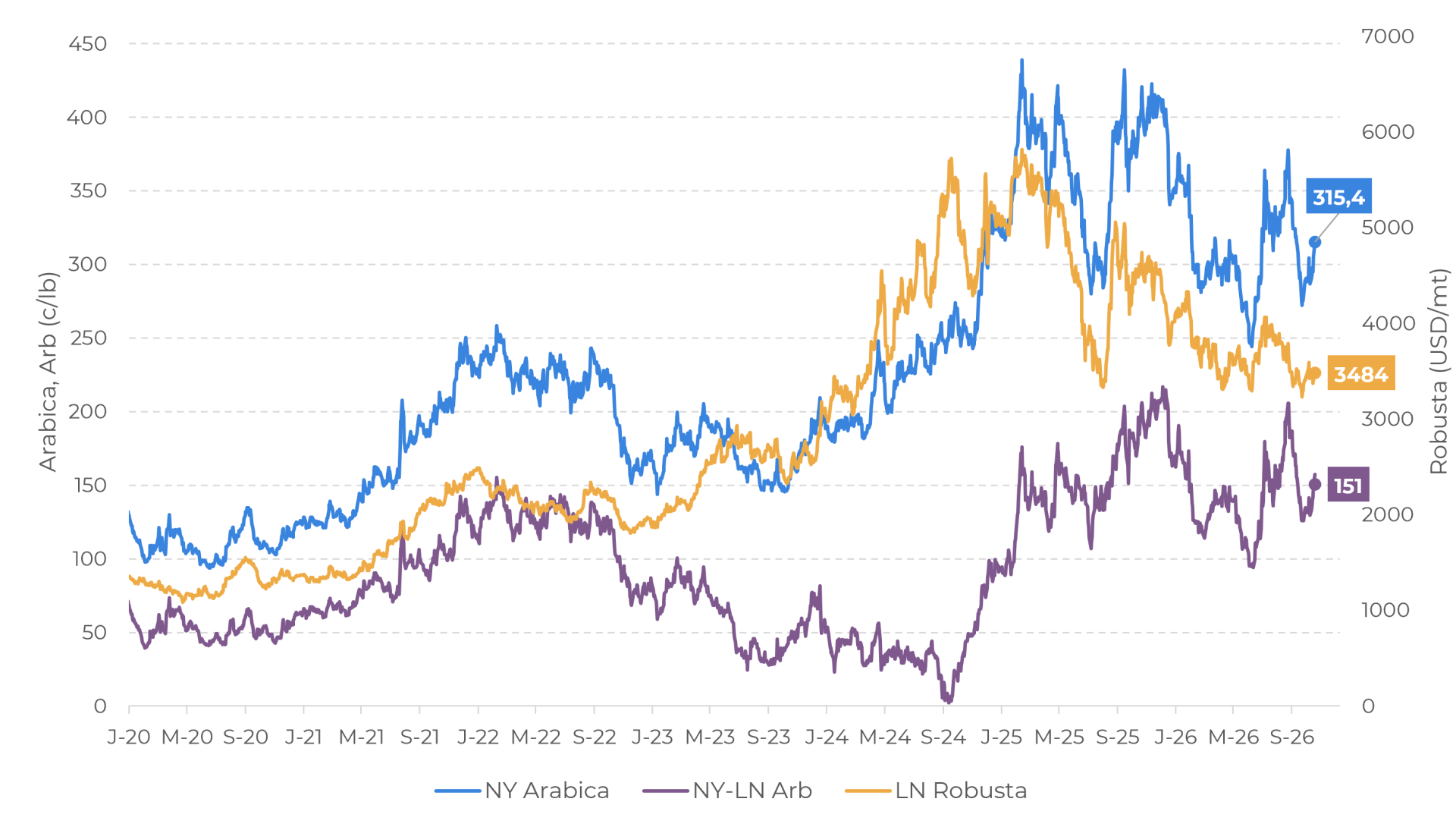
In the futures market, supply risk keeps the Arabica market inverted, with high short- and medium-term spreads due to El Niño, low inventories in destination markets, and slow sales in Brazil. For Robusta, spreads have narrowed due to the Vietnamese harvest and strong volumes in Brazil, but they remain positive and could rise — particularly the March-May spread — if El Niño affects Southeast Asia in 2027/28. Prices show a downward trend compared to 2025, with Arabica in New York around 315 c/lb and Robusta in London around US$ 3,484/t, but they remain vulnerable to supply until stocks in destination markets recover.
LN Robusta (USD/mt), NY Arabica, and Arbitrage (c/lb)
Source: LSEG
Global Balance
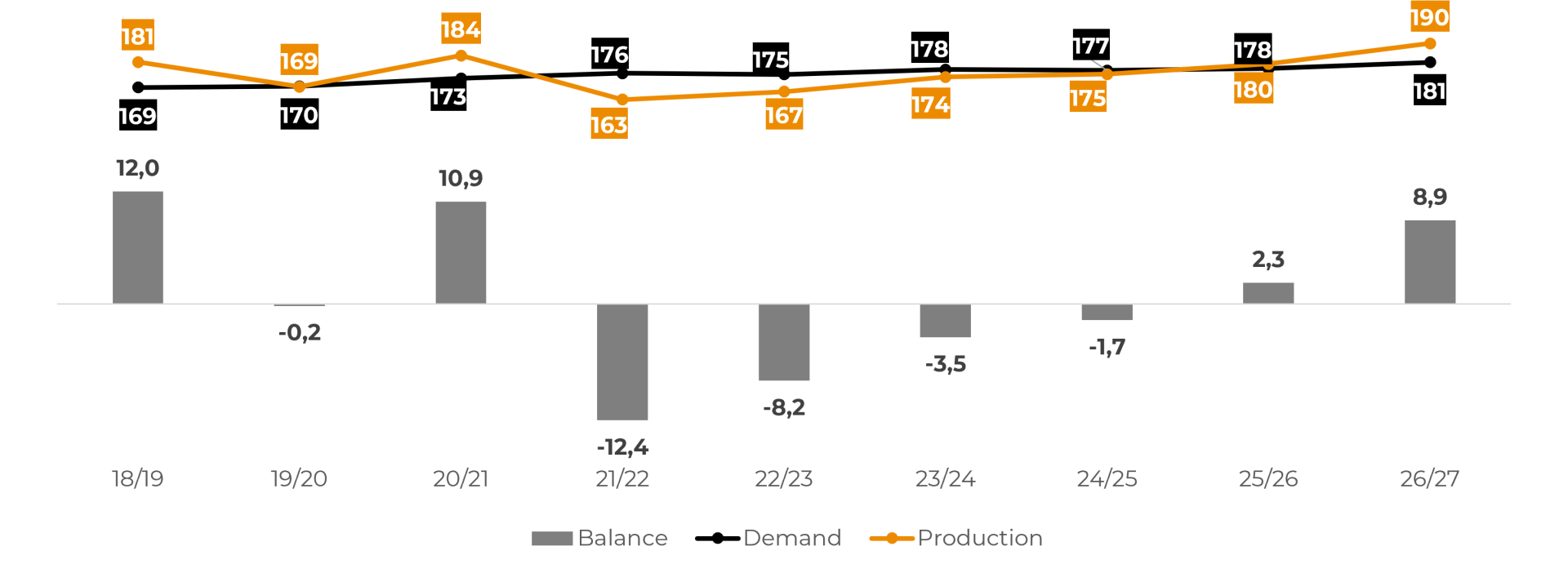
For 2026/27, we estimate global production of 190 M scs and consumption of 181 M scs, resulting in a surplus of 8.9 M scs (2.3 M scs in 2025/26), supported by a record harvest in Brazil and strong production in Vietnam and East Africa. Arabica production totals 104.4 M scs (+8.9%), and Robusta production, 83.5 M scs (-2.0%). For 2027/28, the outlook remains uncertain, but consumption is expected to rise slightly, driven by Asia, while supply may decline due to El Niño and the biennial cycle of Arabica in Brazil, which could tighten the balance.
Global Coffee Supply and Demand (M bags)
Source: Hedgepoint
In Summary
Weekly Report — Coffee
laleska.moda@hedgepointglobal.com
luiz.silverio@hedgepointglobal.com
Disclaimer
This document has been prepared by Hedgepoint Schweiz AG and its affiliates (“Hedgepoint”) solely for informational and instructional purposes, without intending to create obligations or commitments to third parties. It is not intended to promote or solicit an offer for the sale or purchase of any securities, commodities interests, or investment products. Hedgepoint and its associates expressly disclaim any liability for the use of the information contained herein that directly or indirectly results in any kind of damages. Information is obtained from sources which we believe to be reliable, but we do not warrant or guarantee the timeliness or accuracy of this information. The trading of commodities interests, such as futures, options, and swaps, involves substantial risk of loss and may not be suitable for all investors. You should carefully consider wither such trading is suitable for you in light of your financial condition. Past performance is not necessarily indicative of future results. Customers should rely on their own independent judgment and/or consult advisors before entering into any transactions. Hedgepoint does not provide legal, tax or accounting advice and you are responsible for seeking any such advice separately. Hedgepoint Schweiz AG is organized, incorporated, and existing under the laws of Switzerland, is filiated to ARIF, the Association Romande des Intermédiaires Financiers, which is a FINMA-authorized Self-Regulatory Organization. Hedgepoint Commodities LLC is organized, incorporated, and existing under the laws of the USA, and is authorized and regulated by the Commodity Futures Trading Commission (CFTC) and a member of the National Futures Association (NFA) to act as an Introducing Broker and Commodity Trading Advisor. HedgePoint Global Markets Limited is Regulated by the Dubai Financial Services Authority. The content is directed at Professional Clients and not Retail Clients. Hedgepoint Global Markets PTE. Ltd is organized, incorporated, and existing under the laws of Singapore, exempted from obtaining a financial services license as per the Second Schedule of the Securities and Futures (Licensing and Conduct of Business) Act, by the Monetary Authority of Singapore (MAS). Hedgepoint Global Markets DTVM Ltda. is authorized and regulated in Brazil by the Central Bank of Brazil (BCB) and the Brazilian Securities Commission (CVM). Hedgepoint Serviços Ltda. is organized, incorporated, and existing under the laws of Brazil. Hedgepoint Global Markets S.A. is organized, incorporated, and existing under the laws of Uruguay. In case of questions not resolved by the first instance of customer contact (client.services@Hedgepointglobal.com), please contact internal ombudsman channel (ombudsman@hedgepointglobal.com – global or ouvidoria@hedgepointglobal.com – Brazil only) or call 0800-8788408 (Brazil only). Integrity, ethics, and transparency are values that guide our culture. To further strengthen our practices, Hedgepoint has a whistleblower channel for employees and third-parties by e-mail ethicline@hedgepointglobal.com or forms Ethic Line – Hedgepoint Global Markets. “HedgePoint” and the “HedgePoint” logo are marks for the exclusive use of HedgePoint and/or its affiliates. Use or reproduction is prohibited, unless expressly authorized by HedgePoint. Furthermore, the use of any other marks in this document has been authorized for identification purposes only. It does not, therefore, imply any rights of HedgePoint in these marks or imply endorsement, association or seal by the owners of these marks with HedgePoint or its affiliates.