From Ballots to Beans: A Volatile Week for Coffee
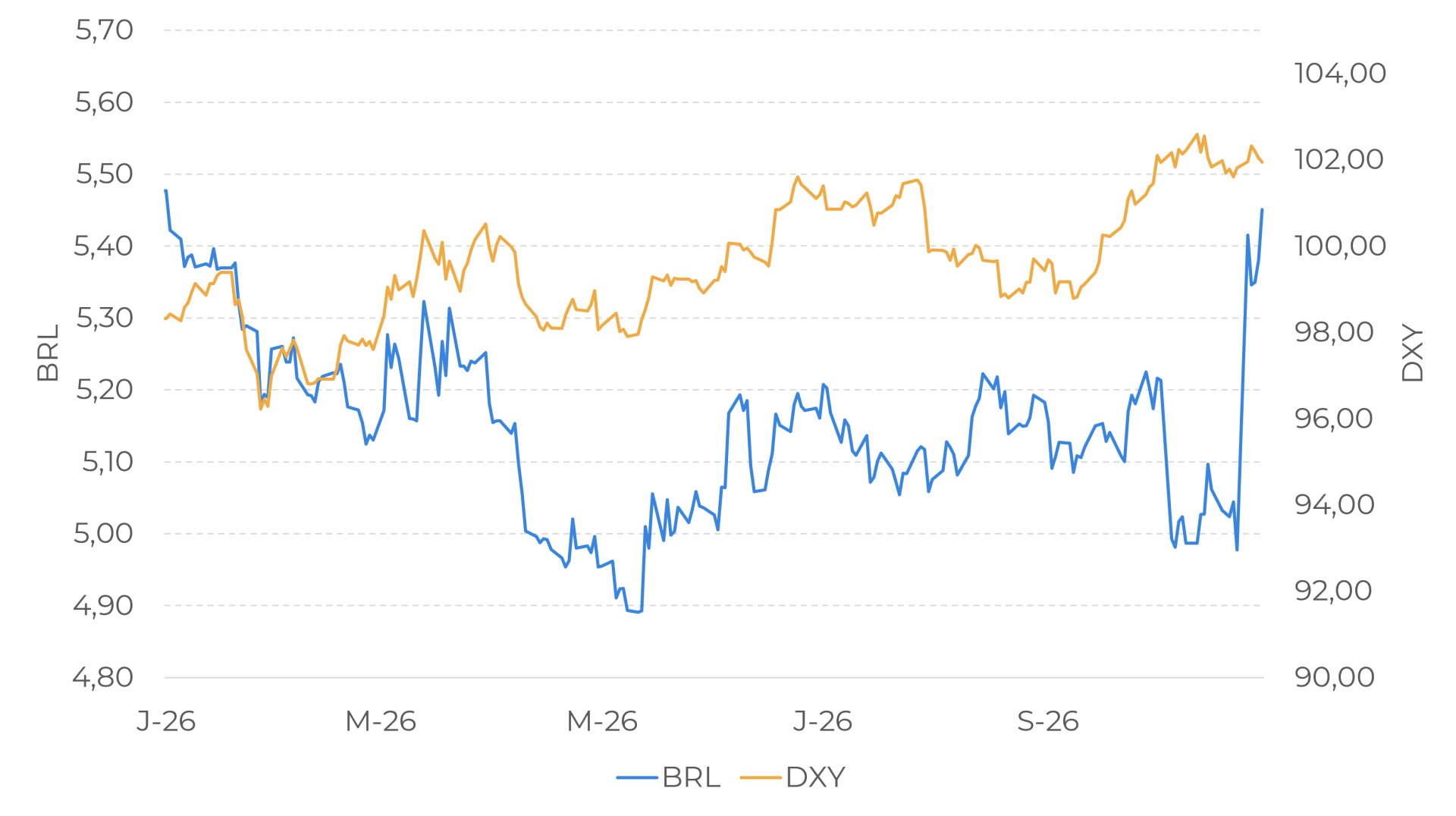
- As the left-wing candidate Lula made a surprising recovery and won the Brazilian election, the local market and the BRL reacted strongly on Monday, affecting global commodity prices, as the country is a key supplier of many products.
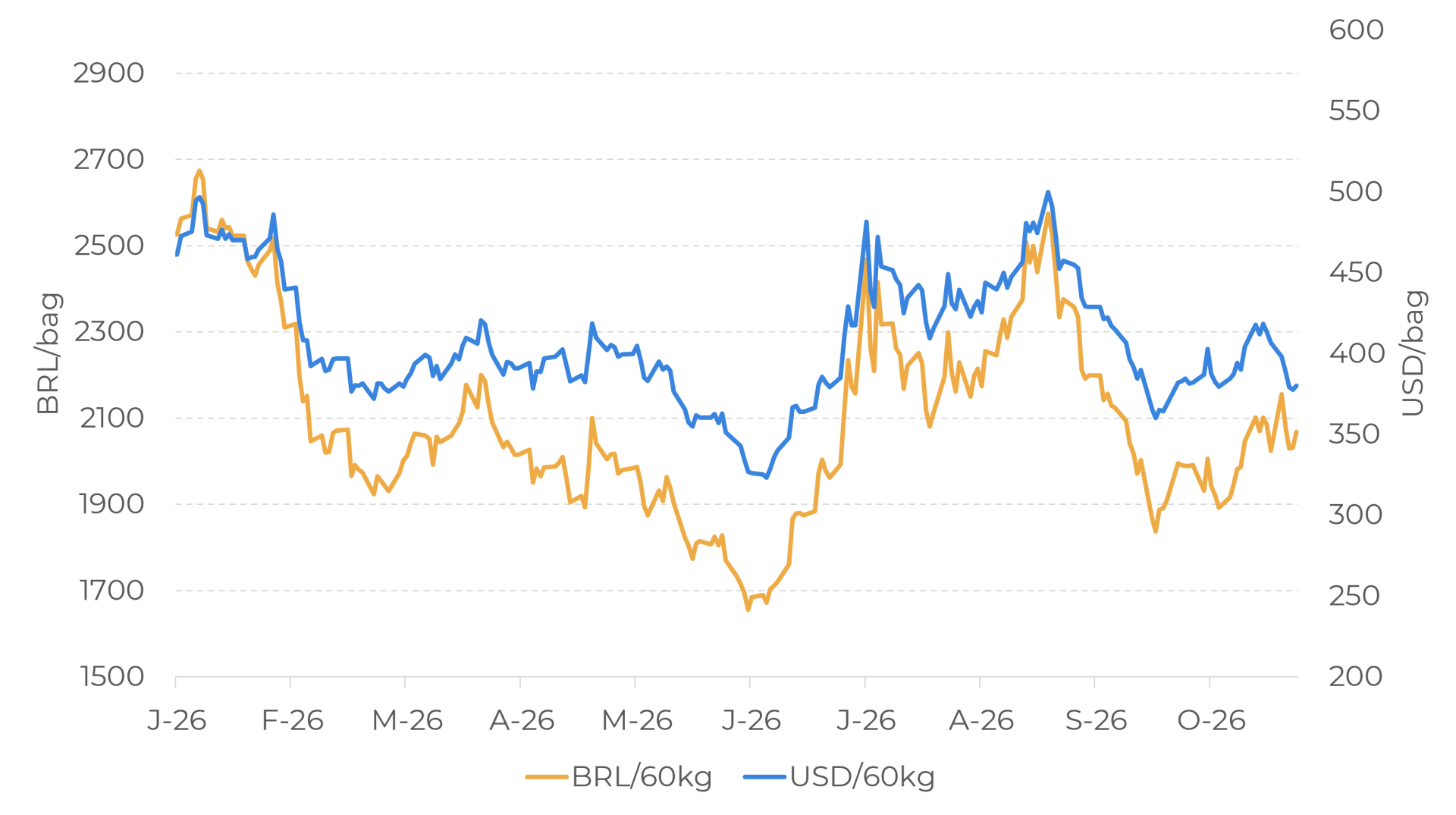
- In the coffee market, BRL depreciation pressured Arabica and Robusta futures prices but also stimulated new sales in Brazil. As commodities are traded in dollars, the appreciation of the American currency against the Brazilian one partially offset the drop in prices.
- However, broader fundamentals remain bearish and could continue to pressure prices downward. Weather remains favorable in Brazil’s coffee-producing regions, supporting the development of the 2027/28 crop. The country is also sending more coffee to ICE warehouses, and exports are expected to remain high in October.
- Other origins are also heading into the 2026/27 harvest, which could add to supply availability in the coming months. On the bullish side, weather in Indonesia remains dry and is expected to affect the 2027/28 crop.
From Ballots to Beans: A Volatile Week for Coffee
BRL and Dollar Index
Source: LSEG
Indonesia cumulative rainfall in coffee regions (mm)
Source: LSEG
As the market digested the election results, the BRL remained highly volatile throughout the week. While the new term brought greater uncertainty around government policies, particularly on the fiscal front, many market participants also gained some clarity on the outlook for Brazil-US relations. Besides Brazilian politics, the global landscape was also in focus this week, affecting currencies and commodity markets, with the Fed and ECB decisions, tech earnings, and the US midterms coming up in the next few days.
In the US, Fed Chair Kevin Warsh announced Wednesday that rates would remain unchanged at 3.75-4.00%, contrary to expectations of a hike given the strong economy and high inflation. The US GDP grew 3.4% during Q3 (against market expectations of 3.2%), supported by robust consumer spending (albeit with weaker consumer sentiment) and AI investment. Meanwhile, inflation rose 0.5% in September, which has amplified expectations of a rate increase this week. Markets now expect a hike at the December meeting, after the midterm elections. In this regard, Trump’s record-low approval has fueled expectations of a Democratic return to the House and a close fight for Senate seats, which would threaten his agenda. This could also spill over into the current deterioration of Brazil-US relations.
In Europe, the European Central Bank also left the Deposit facility rate unchanged at 2.5% on Thursday as inflation remained stable. However, with the energy crisis persisting and financial conditions tightening, pressure on inflation and growth could lead to higher rates ahead.
On the tech side, although the sector is not directly related to commodities, the recent turbulence matters for coffee through financial conditions and risk appetite. US tech stocks are teetering: Alphabet sank this week on disappointing core-business results and heavy cash burn, Meta sold off last week on AI spending concerns, and China’s AI stocks have also seen major selloffs, as the AI bubble appears to burst. At the same time, hyperscalers’ (companies running cloud infrastructure at massive scale) growing demand for credit could keep financing tight, adding pressure to a coffee sector already dealing with higher financial costs. A risk-off tone in equities can also reduce investors' appetite for commodity exposure.
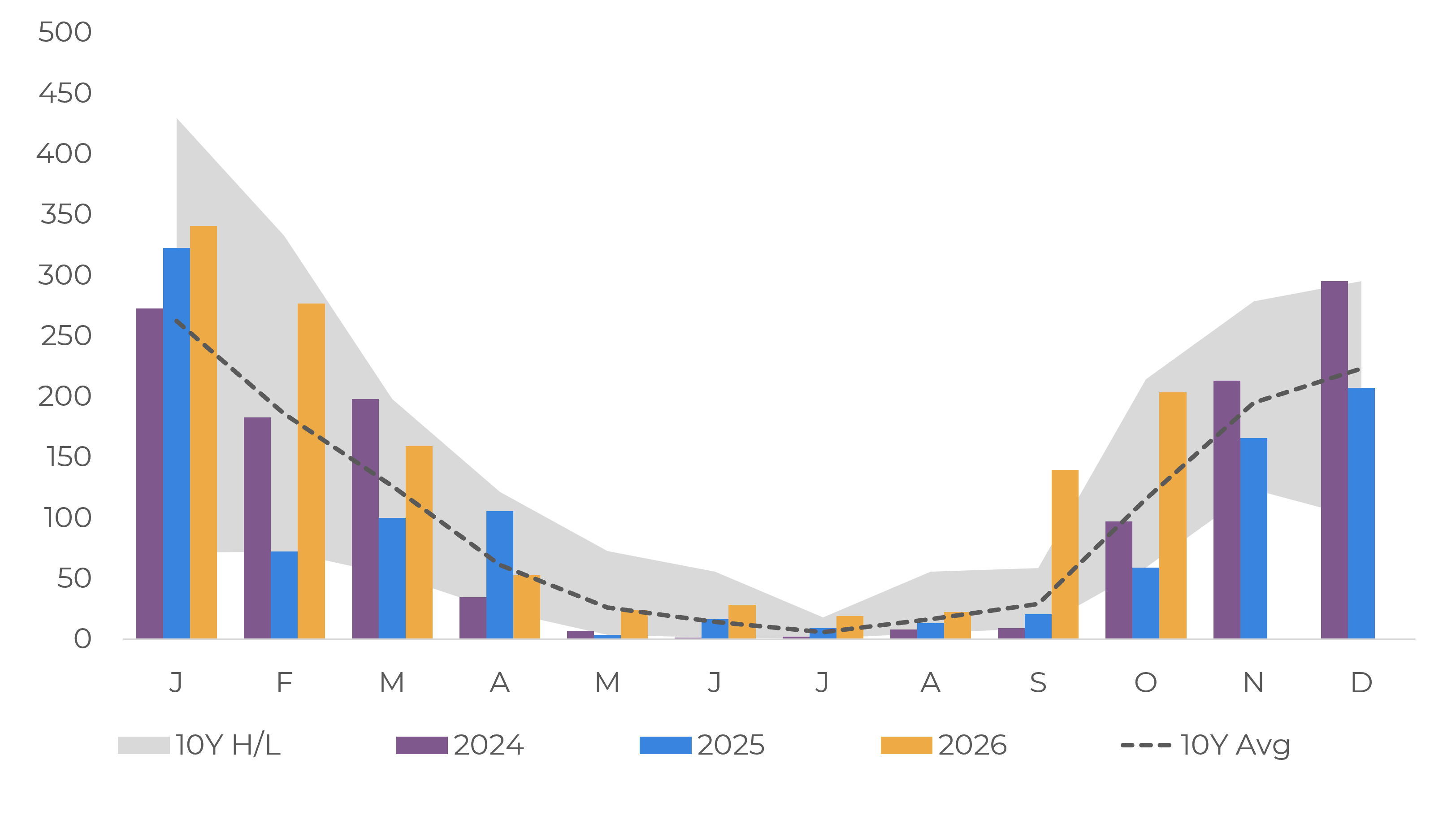
Beyond the macro scenario, the coffee market has also been pressured by its own fundamentals. Weather in Brazil remains highly favorable for the 27/28 crop development, in both Arabica and Conilon areas. Above-average rainfall was recorded throughout September and October, while temperatures remained mild, helping the flowering to set. Given the area expansion of the past three years, production is expected to remain elevated in the next cycle if the weather continues to cooperate. El Niño remains a risk, especially for Q1 2027, but for now expectations are good. Although Arabica output is expected to fall due to the biennial cycle, Conilon output is expected to increase in 27/28.
Brazil: Cumulative rainfall in Minas Gerais coffee regions (mm)
Source: Somar, Bloomberg
Brazil: Cumulative rainfall in Espírito Santo coffee regions (mm)
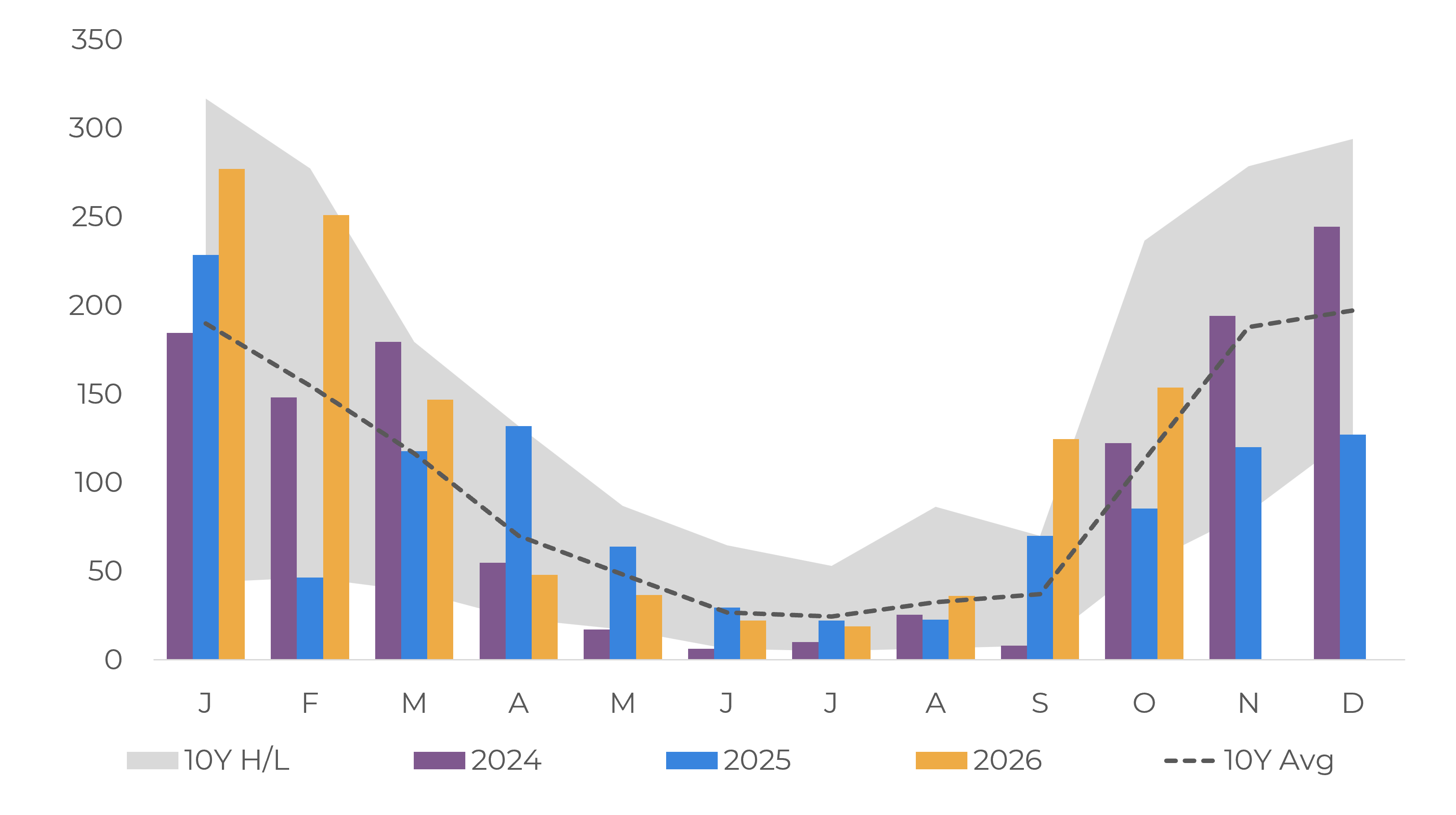
Source: Somar, Bloomberg
Besides the next crop, 26/27 exports are expected to gain momentum. August and September figures were already higher, and partial Cecafé data indicate that October exports could increase further: by the 29th, the Council had issued over 5 million bags, with 4.5 million already on board. Brazilian coffee has also been reaching ICE warehouses, with over 43 thousand Arabica bags pending grading. On the Robusta side, stocks have been rising over the past week as Brazil and Indonesia send more coffee.
Worldwide, while El Niño is already affecting Indonesia’s 27/28 season, other origins are now in their harvest period, with more coffee likely to reach the market from December onward, contributing to the current bearish trend. While we can’t discount impacts on global 27/28 supply from El Niño, the short-term expectation is for more comfortable supply, which is likely to keep pressure on prices, especially the December Arabica and January Robusta contracts.
In Summary
Weekly Report — Coffee
laleska.moda@hedgepointglobal.com
livea.coda@hedgepointglobal.com
Disclaimer
This document has been prepared by Hedgepoint Schweiz AG and its affiliates (“Hedgepoint”) solely for informational and instructional purposes, without intending to create obligations or commitments to third parties. It is not intended to promote or solicit an offer for the sale or purchase of any securities, commodities interests, or investment products. Hedgepoint and its associates expressly disclaim any liability for the use of the information contained herein that directly or indirectly results in any kind of damages. Information is obtained from sources which we believe to be reliable, but we do not warrant or guarantee the timeliness or accuracy of this information. The trading of commodities interests, such as futures, options, and swaps, involves substantial risk of loss and may not be suitable for all investors. You should carefully consider wither such trading is suitable for you in light of your financial condition. Past performance is not necessarily indicative of future results. Customers should rely on their own independent judgment and/or consult advisors before entering into any transactions. Hedgepoint does not provide legal, tax or accounting advice and you are responsible for seeking any such advice separately. Hedgepoint Schweiz AG is organized, incorporated, and existing under the laws of Switzerland, is filiated to ARIF, the Association Romande des Intermédiaires Financiers, which is a FINMA-authorized Self-Regulatory Organization. Hedgepoint Commodities LLC is organized, incorporated, and existing under the laws of the USA, and is authorized and regulated by the Commodity Futures Trading Commission (CFTC) and a member of the National Futures Association (NFA) to act as an Introducing Broker and Commodity Trading Advisor. HedgePoint Global Markets Limited is Regulated by the Dubai Financial Services Authority. The content is directed at Professional Clients and not Retail Clients. Hedgepoint Global Markets PTE. Ltd is organized, incorporated, and existing under the laws of Singapore, exempted from obtaining a financial services license as per the Second Schedule of the Securities and Futures (Licensing and Conduct of Business) Act, by the Monetary Authority of Singapore (MAS). Hedgepoint Global Markets DTVM Ltda. is authorized and regulated in Brazil by the Central Bank of Brazil (BCB) and the Brazilian Securities Commission (CVM). Hedgepoint Serviços Ltda. is organized, incorporated, and existing under the laws of Brazil. Hedgepoint Global Markets S.A. is organized, incorporated, and existing under the laws of Uruguay. In case of questions not resolved by the first instance of customer contact (client.services@Hedgepointglobal.com), please contact internal ombudsman channel (ombudsman@hedgepointglobal.com – global or ouvidoria@hedgepointglobal.com – Brazil only) or call 0800-8788408 (Brazil only). Integrity, ethics, and transparency are values that guide our culture. To further strengthen our practices, Hedgepoint has a whistleblower channel for employees and third-parties by e-mail ethicline@hedgepointglobal.com or forms Ethic Line – Hedgepoint Global Markets. “HedgePoint” and the “HedgePoint” logo are marks for the exclusive use of HedgePoint and/or its affiliates. Use or reproduction is prohibited, unless expressly authorized by HedgePoint. Furthermore, the use of any other marks in this document has been authorized for identification purposes only. It does not, therefore, imply any rights of HedgePoint in these marks or imply endorsement, association or seal by the owners of these marks with HedgePoint or its affiliates.