
Crop Forecast: Corn Brazil - 2026/27
Hedgepoint estimates Brazil’s corn crop at 146.5 million tons for the 2026/27 season, a new record
With increases in planted area and yield, the Brazilian corn crop is expected to set a new record in 2026/27
Hedgepoint’s first estimate for the Brazilian corn crop in the 2026/27 season points to a new record crop, with a production potential of 146.5 million tons.
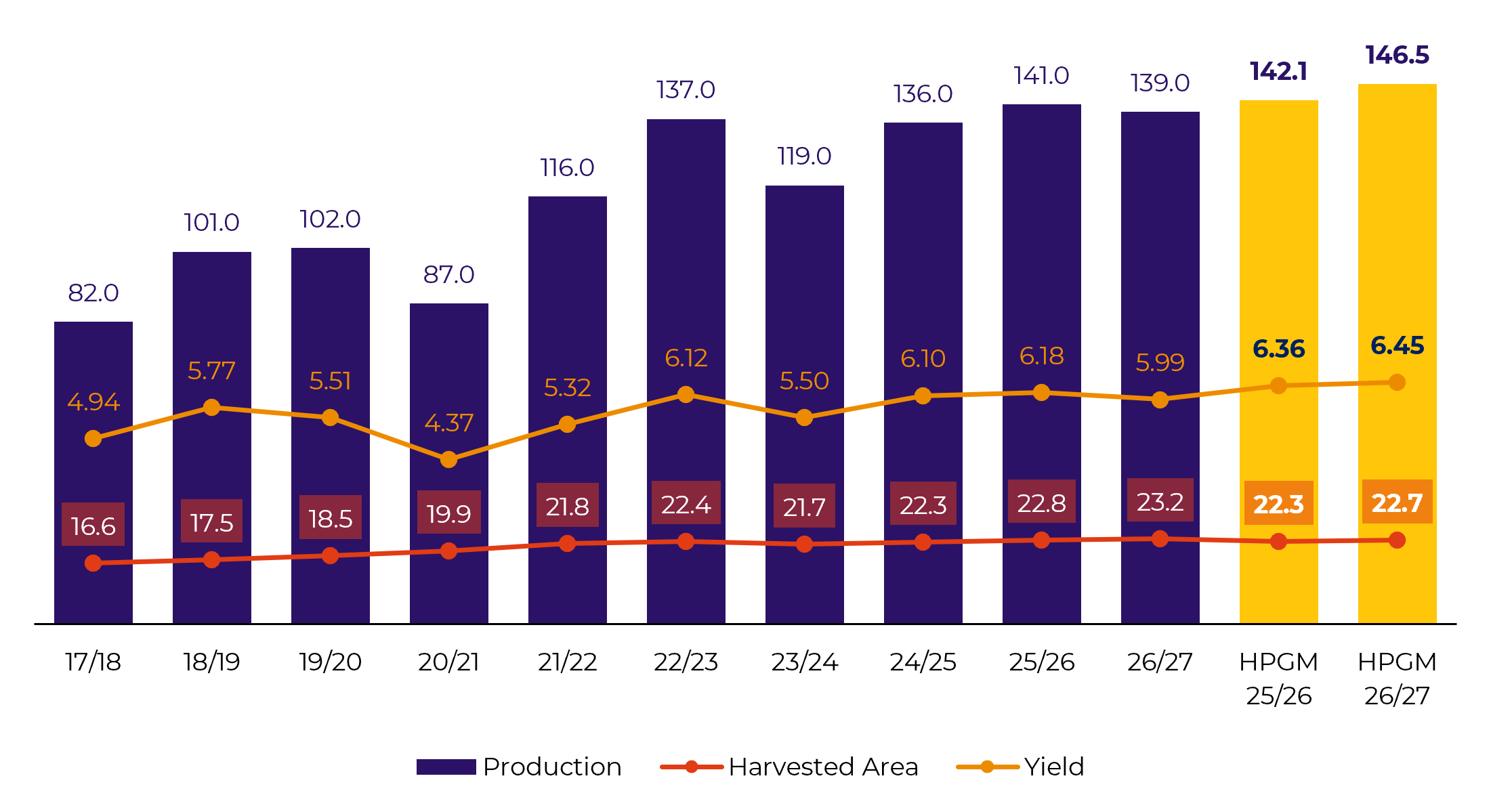
The increase in production is expected to stem mainly from an expansion in planted area regarding the 2025/26 season, with the area rising from 22.343 million hectares (2025/26) to 22.712 million hectares in 2026/27 (+1.7%).
Meanwhile, the average yield of corn crops is expected to rise from 6,361 kilograms per hectare (2025/26) to 6,452 kilograms per hectare in 2026/27 (+1.4%), with this increase supported primarily by likely recoveries in the average yields of the second crop in the states of Goiás and Minas Gerais.
If confirmed, Brazilian corn production is expected to set a record, exceeding the 142.1 million tons produced in the 2025/26 season by 3.1%.
2026/27 Crop vs. 2025/26 Crop
Planted Area: 22.712 M ha (+1.7%, 22.343 M ha)
Yield: 6.452 tons/ha (+1.4%, 6.361 tons/ha)
Production: 146.538 M tons (3.1%, 142.131 M tons)
Brazilian Corn | Production (M tons), Yield (tons/ha), and Harvested Area (M ha)
Source: USDA, Hedgepoint
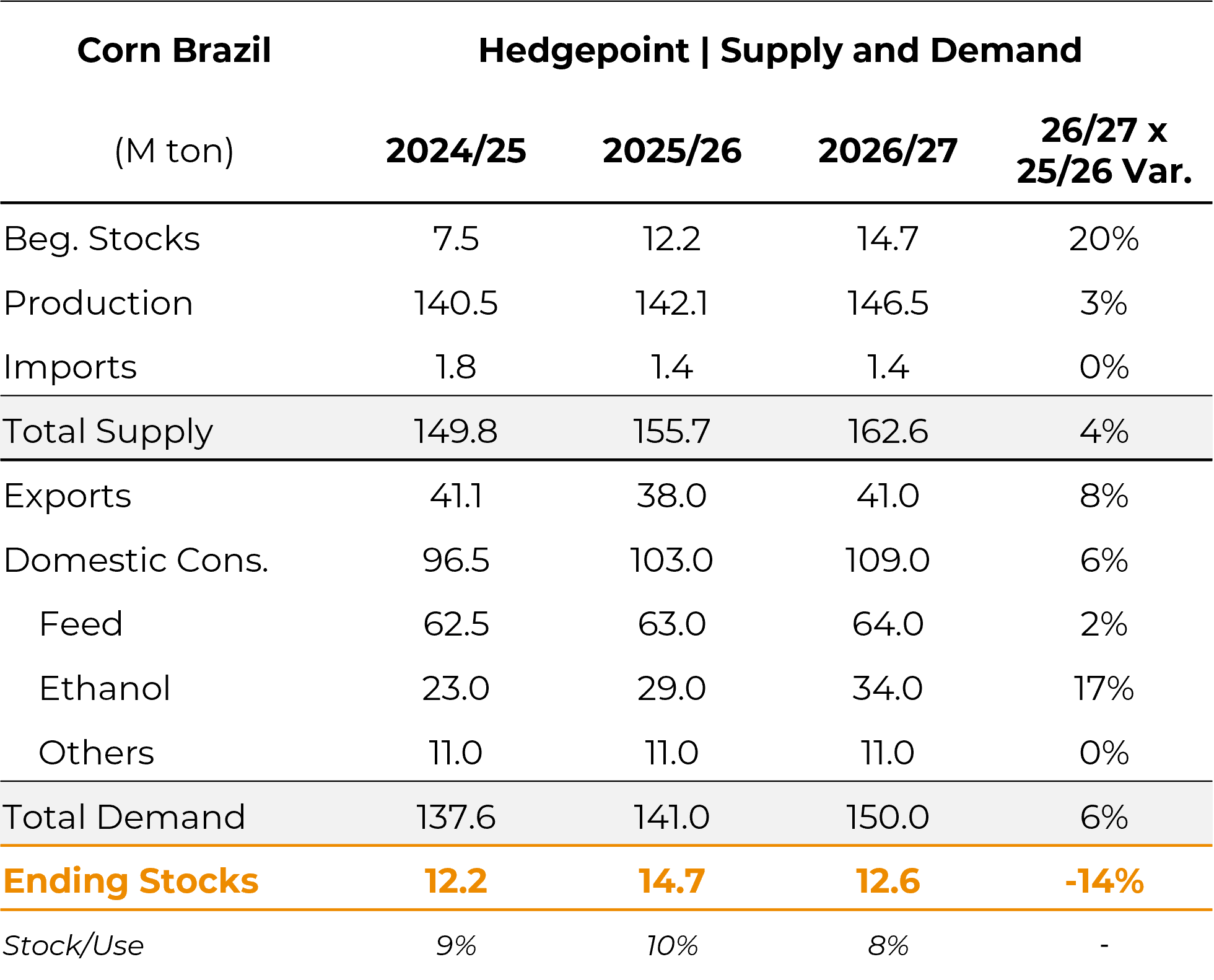
On the demand side, the highlight is the expected strong expansion in consumption for ethanol production, with new plants coming online across the country in the coming months and throughout 2027. Corn demand for ethanol is estimated to rise from 29 million tons in 2025/26 to 34 million tons in 2026/27 (+17%), further consolidating growth in this sector.
The increase in the mandatory blend to E32 is a key factor driving production expansion, although, for now, the new percentage is still in effect on a provisional basis (180 days starting August 1). However, it is likely that the blend requirement will be extended for another 180 days and may even be declared permanent as early as the first half of 2027.
Corn | Brazil | Supply and Demand | Hedgepoint
Source: Hedgepoint
On the export front, the estimate points to an increase in overseas shipments during the 2026/27 season, indicating a recovery compared to the 2025/26 season. Exports are expected to grow from 38 million tons in 2025/26 to 41 million tons in 2026/27 (+8%).
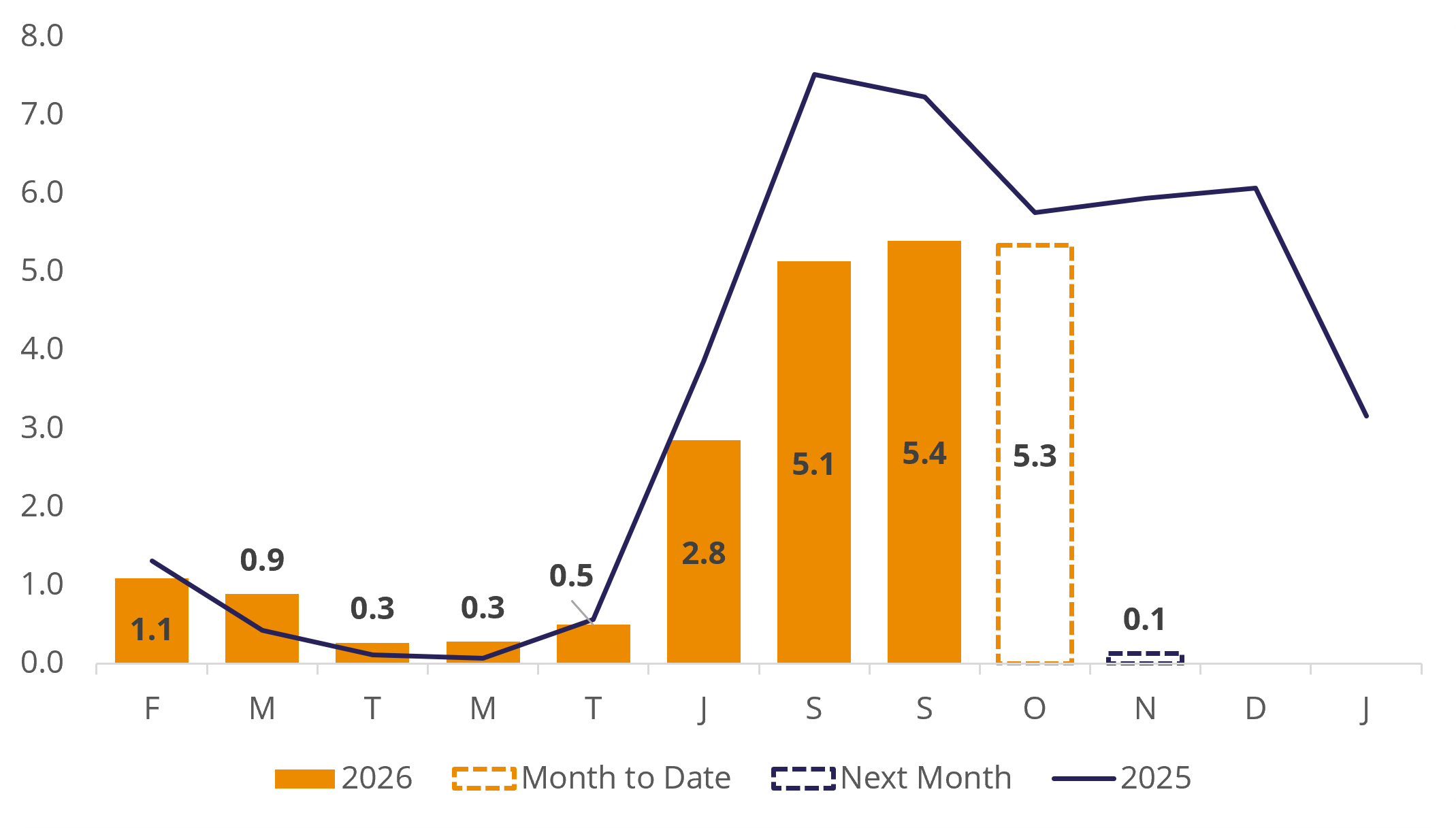
In this regard, it is important to note that the export estimate for the 2025/26 season was recently revised downward from 41 million tons to 38 million tons. This was due to the slower pace of shipments so far, which is a direct result of fiercer competition with Argentina—which harvested a record crop and is offering more competitive prices—and lower Iranian demand due to the conflict with the United States. It is also important to note that Iran plays a significant role in Brazil’s corn exports, having been the largest buyer of Brazilian corn in 2025, with approximately 9 million tons.
Corn | Brazil | Export Lineup – Monthly
Source: Maritimes Agencies, Hedgepoint
Thus, if the conflict persists, the reduction in Iranian purchases is likely to have a significant impact on Brazil’s export volumes in 2026, resulting in higher ending stocks for the current season. The current estimate points to stocks of 14.7 million tons in 2025/26, a 20.5% increase compared to the 2024/25 season.
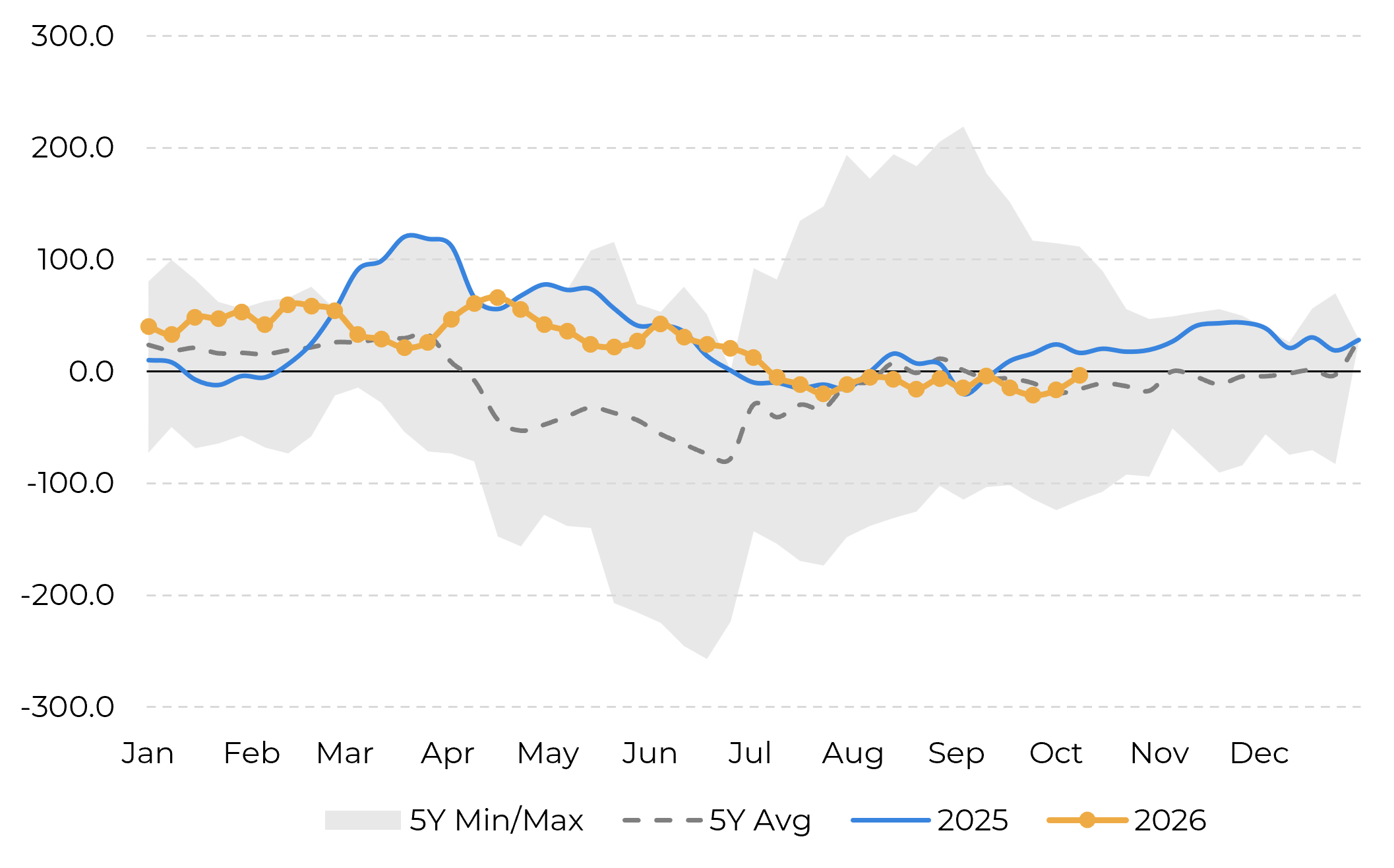
With higher stocks indicating a fairly comfortable supply-demand balance in the current season, we caution of possible downward pressure on Brazilian corn prices in the final months of 2026, as the slower pace of exports is expected to lead to greater corn availability in the domestic market, potentially putting downward pressure on “basis” prices in the main origin markets.
Corn Basis | Brazil | Rio Verde, GO (USDc/bushel)
Source: Hedgepoint, CME, ESALQ
When we look at the ending stocks for the new season, the estimate points to a decline, with stocks falling from 14.7 million tons in 2025/26 to 12.6 million tons in 2026/27 (-14%).
In any case, the ending stock levels for 2026/27 will depend, among other factors, on export performance, which is a variable highly sensitive to factors related to competition and geopolitics. Furthermore, monitoring weather conditions will be essential for determining production levels, which will also be a key factor in understanding the trajectory of stocks in the new season.