The soybean and corn markets continue to be influenced by a combination of macroeconomic, geopolitical, and weather factors, as well as factors directly linked to supply and demand. The current scenario is characterized by the arrival of the U.S. crop, the start of planting in South America, ongoing global geopolitical tensions, and the strengthening of El Niño, which is now the main risk factor for the upcoming South American crop.
At the same time, demand continues to show robust performance, especially for soybeans, supported by Chinese purchases and growth in the biofuel industry, preventing the increase in global production from resulting in a significant rise in stocks.
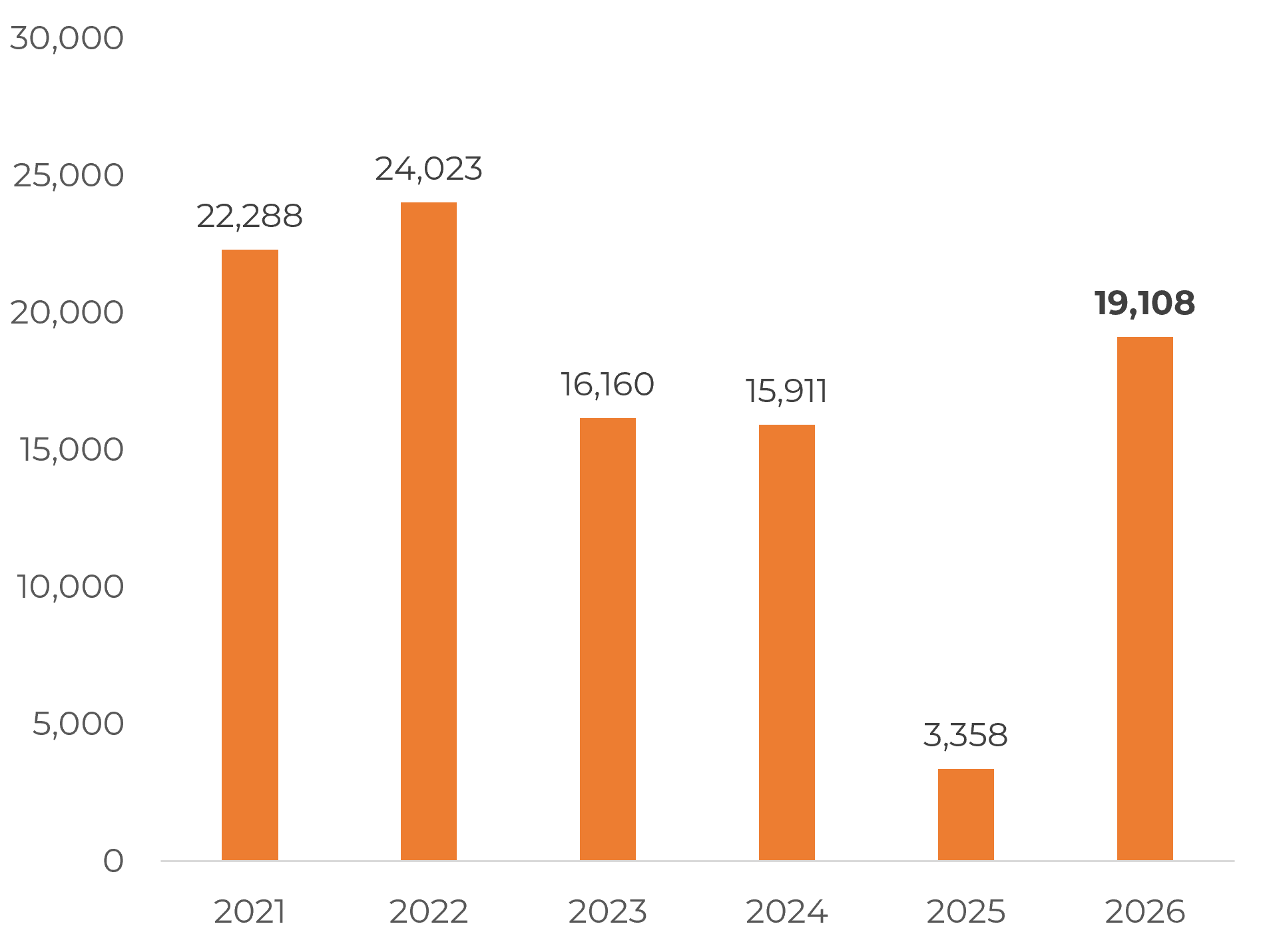
One of the key macroeconomic issues affecting grains remains the relationship regarding trade between the United States and China. The trade truce has been extended through January 2027, and the Chinese appear to be continuing their efforts to fulfill their commitment to purchase U.S. soybeans. To date, purchases of approximately 19.1 M tons have been recorded for the 2026/27 season, approaching the annual target of 25 M tons. Soybeans remain an important bargaining chip between the two powers.
In the Black Sea region, the escalation of attacks between Russia and Ukraine has once again disrupted the international flow of grains. The impacts are particularly significant for corn and wheat, given Ukraine’s importance as a corn exporter and Russia’s as a wheat exporter. The temporary reduction in shipments has contributed to an environment supportive of international prices.
Furthermore, the lack of a definitive agreement in the conflict between the U.S. and Iran continues to create uncertainty, and potential new U.S. attacks could once again lead to greater volatility.
As a result, international conflicts continue to underpin energy markets. Oil, diesel, and other fuels and raw materials remain at high levels, fueling concerns about global inflation and the possibility of higher interest rates persisting for longer in major economies. This scenario continues to provide indirect support to agricultural markets and biofuels.
In Brazil, the combination of a wider interest rate differential in favor of the United States and increased domestic uncertainty following the presidential elections has led to the dollar’s appreciation against the real. A weaker exchange rate boosts the competitiveness of Brazilian soybean and corn exports, although it also puts pressure on input costs and may reduce producers’ margins in future crops.
El Niño remains the main risk factor for the South American crop. The phenomenon is well established and is classified as strong to very strong. Despite this, the impacts on the Brazilian crop are not yet visible at this time, and planting has been proceeding under favorable conditions in most of the country.
The expected weather pattern remains as follows:
• Above-average rainfall in southern South America.
• Below-average rainfall in north-central Brazil.
The greatest concerns are concentrated between November and February, a period when weather maps begin to indicate a pattern more typical of El Niño, especially for Mato Grosso, Goiás, Bahia, and other states of north-central Brazil.
Particular attention is being paid to Mato Grosso and Goiás, two of the country’s largest soybean producers, which historically experience yield losses during years of intense El Niño. At this time, however, there is no evidence of yield declines, and the crop’s initial development is considered positive.
Planting in Brazil is progressing at a faster pace than the historical average, especially in Mato Grosso, reinforcing the assessment that initial conditions remain favorable.
The global soybean market enters the fourth quarter of 2026 during a transition period between the U.S. harvest and the development of the South American crop. Despite prospects for a record crop in the major producing countries, demand continues to show considerable resilience, driven primarily by growth in soybean crushing, the biofuel industry, and China’s continued high levels of imports. As a result, even with the increase in supply, global stocks are not expanding significantly, maintaining a supportive environment for prices. At the same time, the strengthening of El Niño introduces new climate risks for the South American crop, especially for producing regions in north-central Brazil.
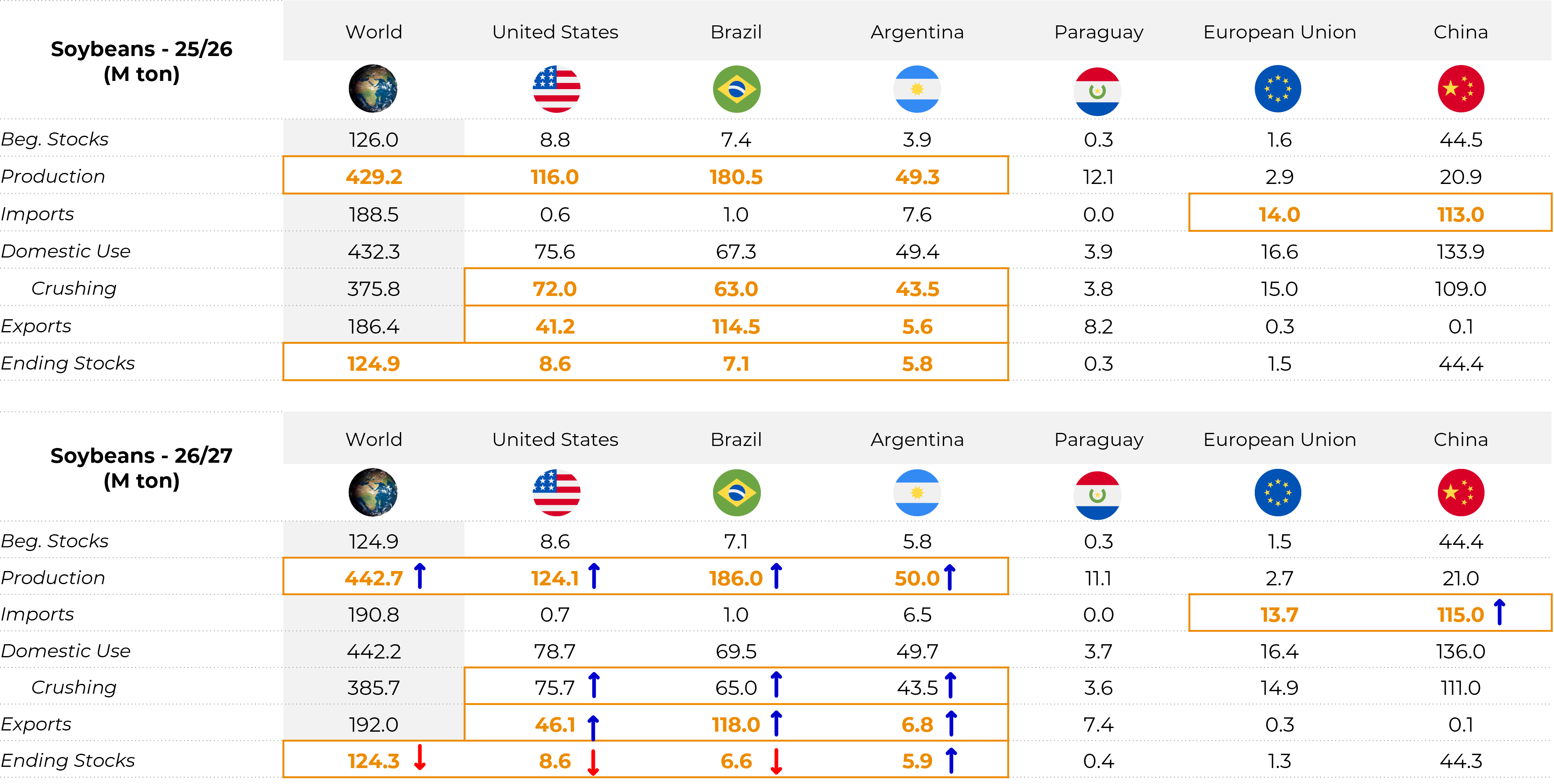
China’s strategy remains focused on maintaining high soybean stocks. The country has held stocks exceeding 40 M tons for several seasons and continues to prioritize food security and strategic stockpiling.
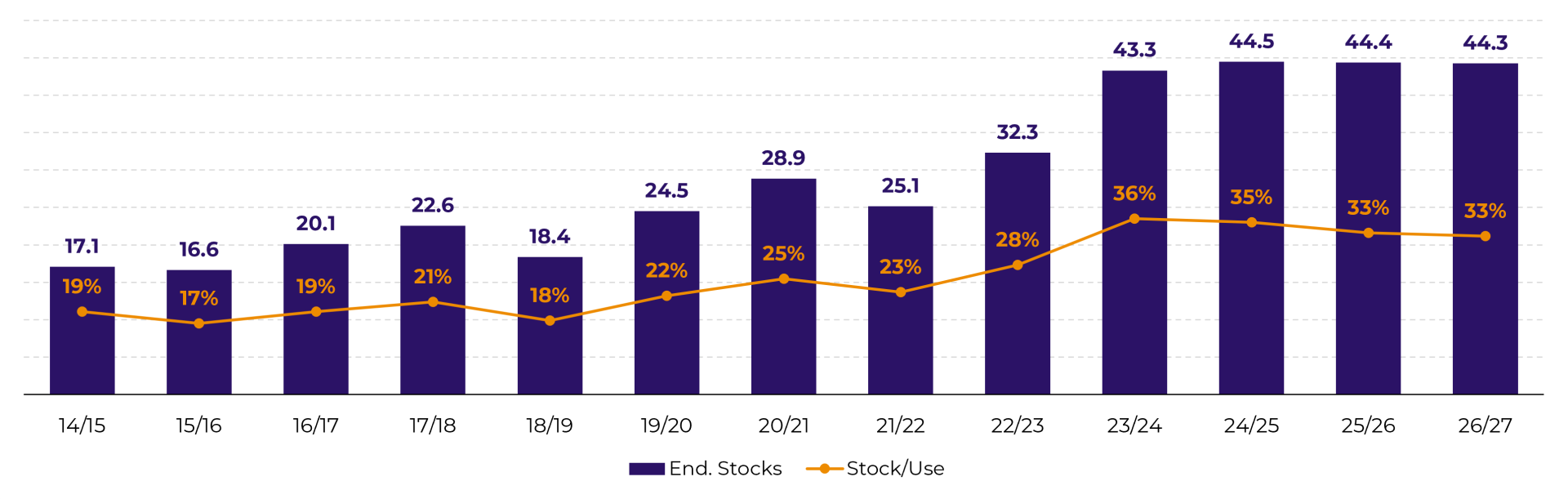
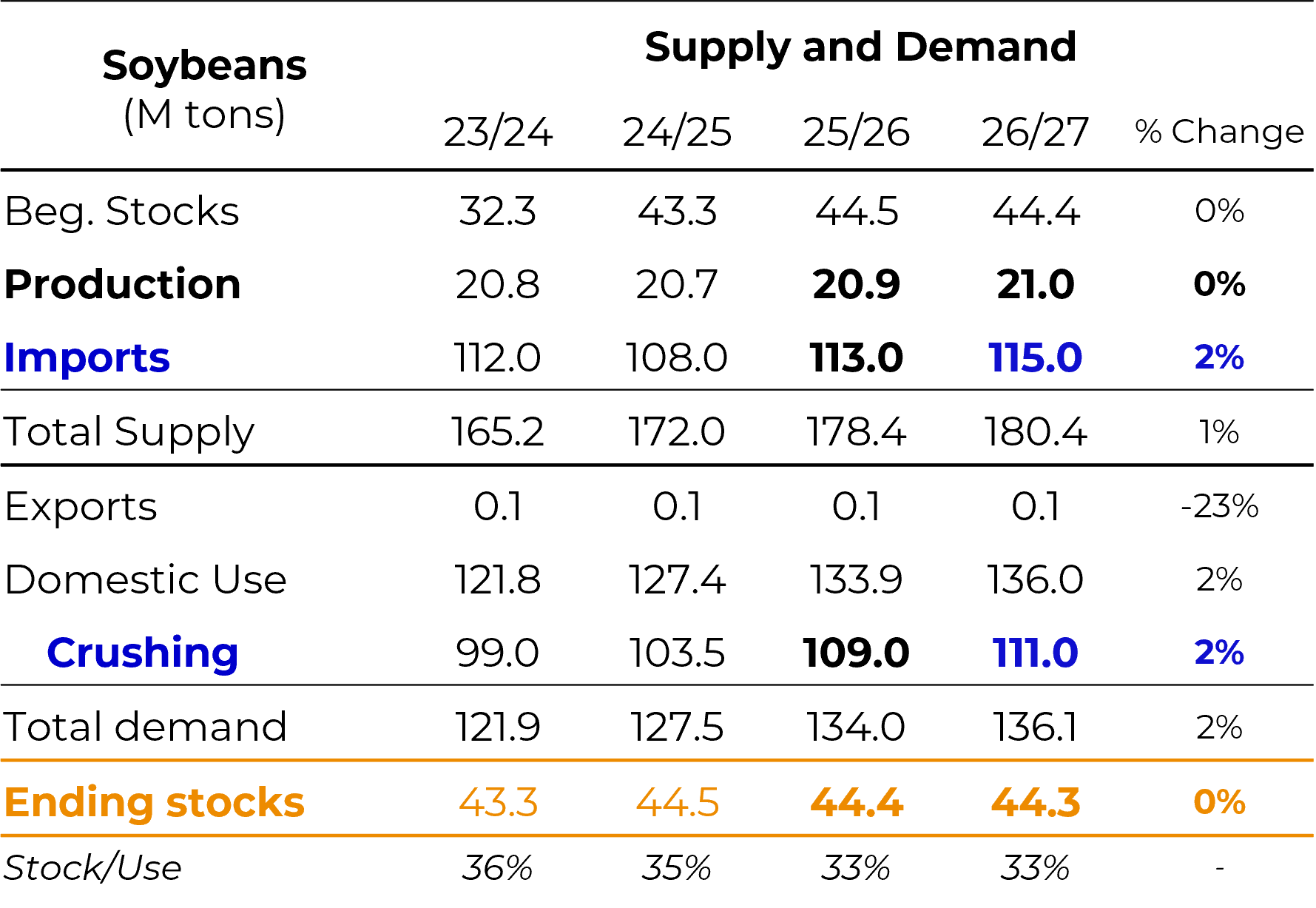
Imports could reach approximately 115 M tons in 2026/27, setting a new record. Brazil and the United States remain the main suppliers.
However, some indicators suggest caution regarding future demand growth:
• Pig farmers’ margins remain negative.
• The Chinese government plans to reduce the breeding herd.
• Crushing margins remain near zero.
• Port stocks remain high.
Thus, although imports are expected to grow in 2026/27, there is a possibility of a more moderate pace in the coming years.
The U.S. crop is on track to set a new record. The USDA raised its estimate to approximately 124.1 M tons, exceeding previous market expectations.
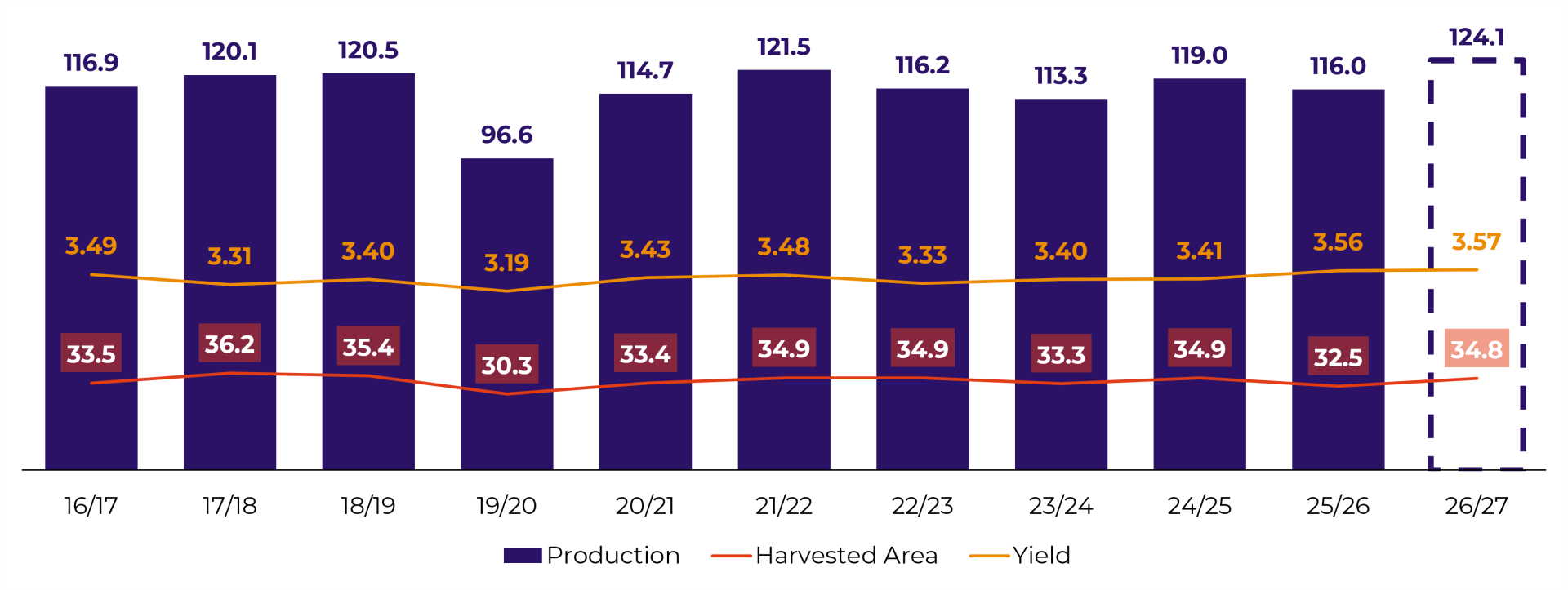
The harvest faced delays early in the season, but drier weather conditions allowed for a rapid recovery in fieldwork, which is now progressing at a rate above the historical average.
Despite record production, U.S. stocks remain relatively stable due to strong demand:
• Exports remain strong.
• Crushing continues to grow.
• The biodiesel mandate has significantly boosted demand for soybean oil.
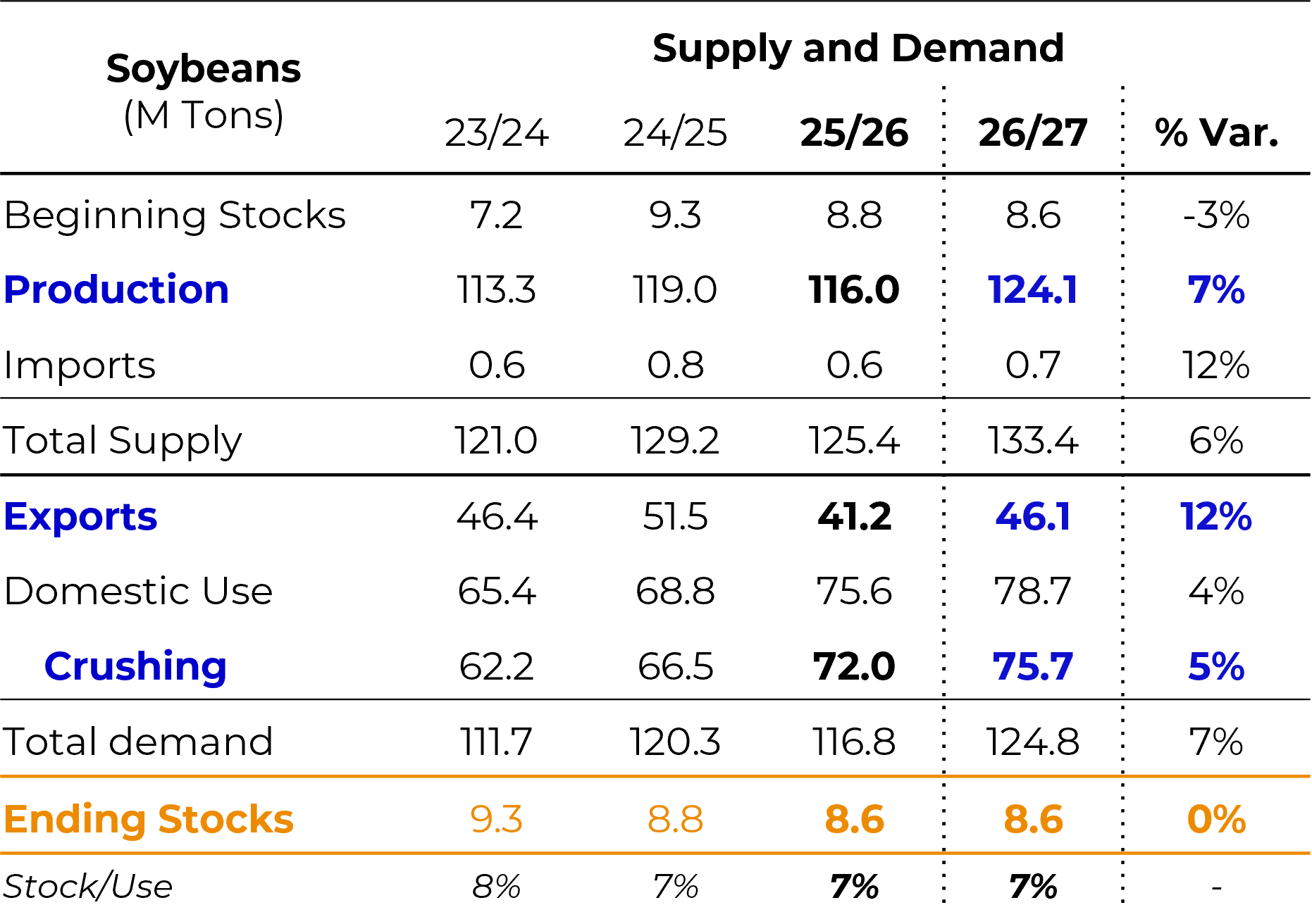
Soybean oil continues to play a major role in processing profitability, maintaining high margins for the industry and encouraging the expansion of crushing capacity.
Another key factor is the resumption of Chinese purchases. Sales commitments to China have already surpassed the levels seen over the past three years, reinforcing the current strength of U.S. demand.
The first Hedgepoint's scenario projects corn production of approximately 181.7 M tons in 2026/27, with growth driven primarily by a moderate expansion in planted area.
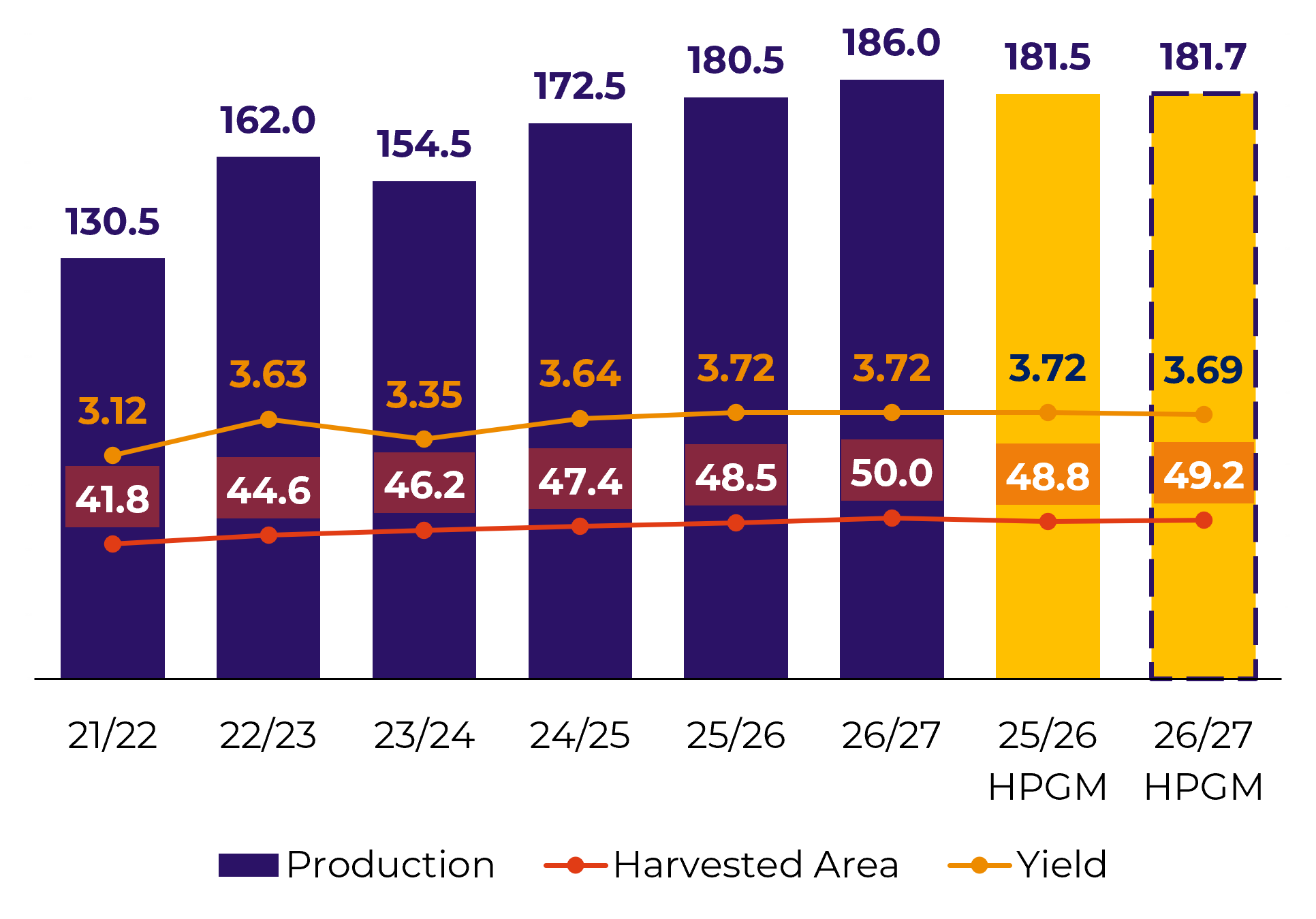
The main uncertainty remains the weather. If El Niño causes yield losses in the country’s Central-Northern region, stocks could become significantly tighter. On the other hand, favorable weather could push production closer to 184 to 185 M tons.
Another important factor is domestic demand linked to biodiesel. Changes in the mandatory biodiesel blend ratio could significantly alter estimates for crush volume and stocks.
Brazilian exports continue at a record pace:
• More than 107 M tons have already been booked for shipment through October.
• Potential to reach between 114 and 116 M tons in the marketing year.
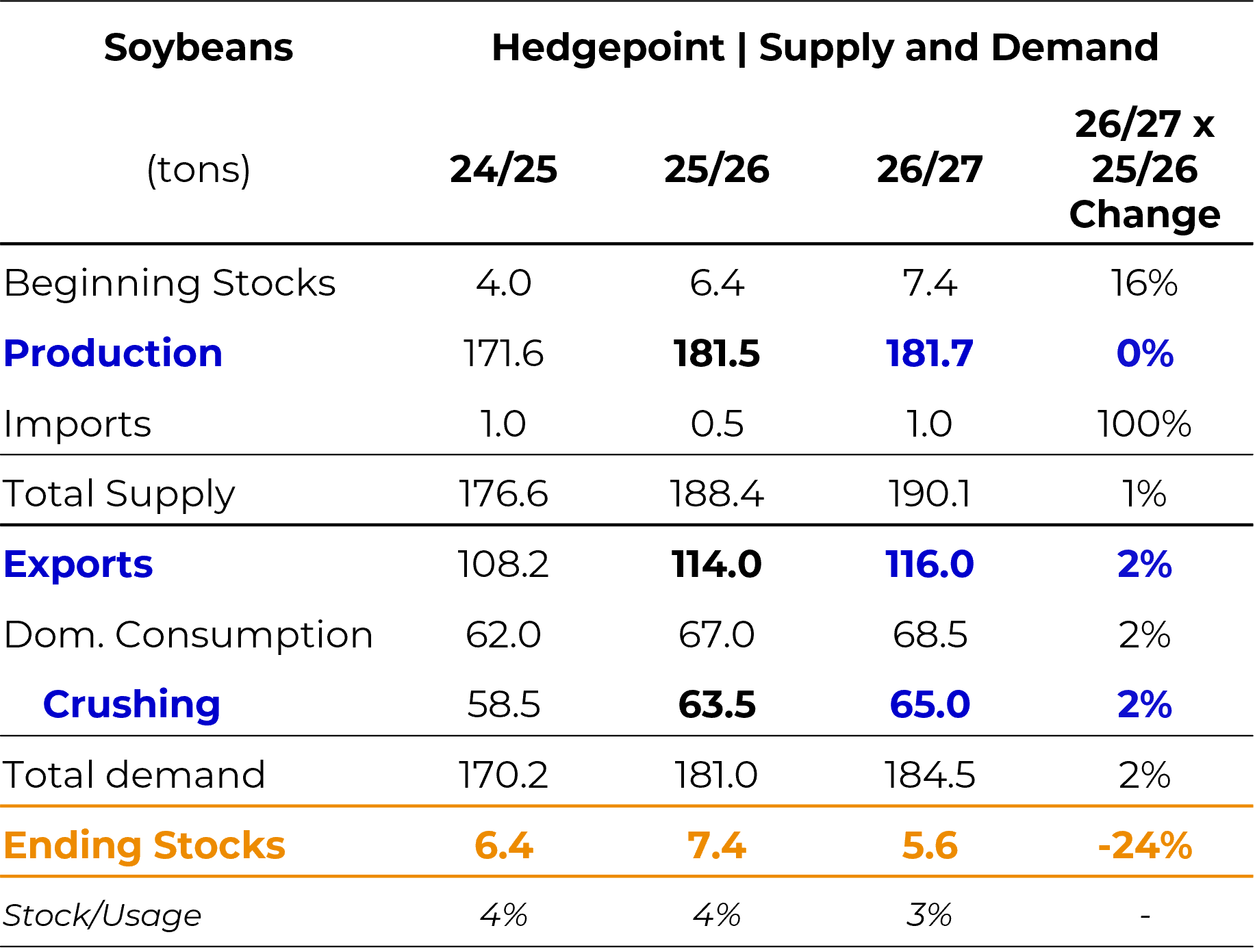
However, with the arrival of the U.S. crop, export premiums are beginning to lose steam, a trend that could be exacerbated by the dollar’s appreciation against the real.
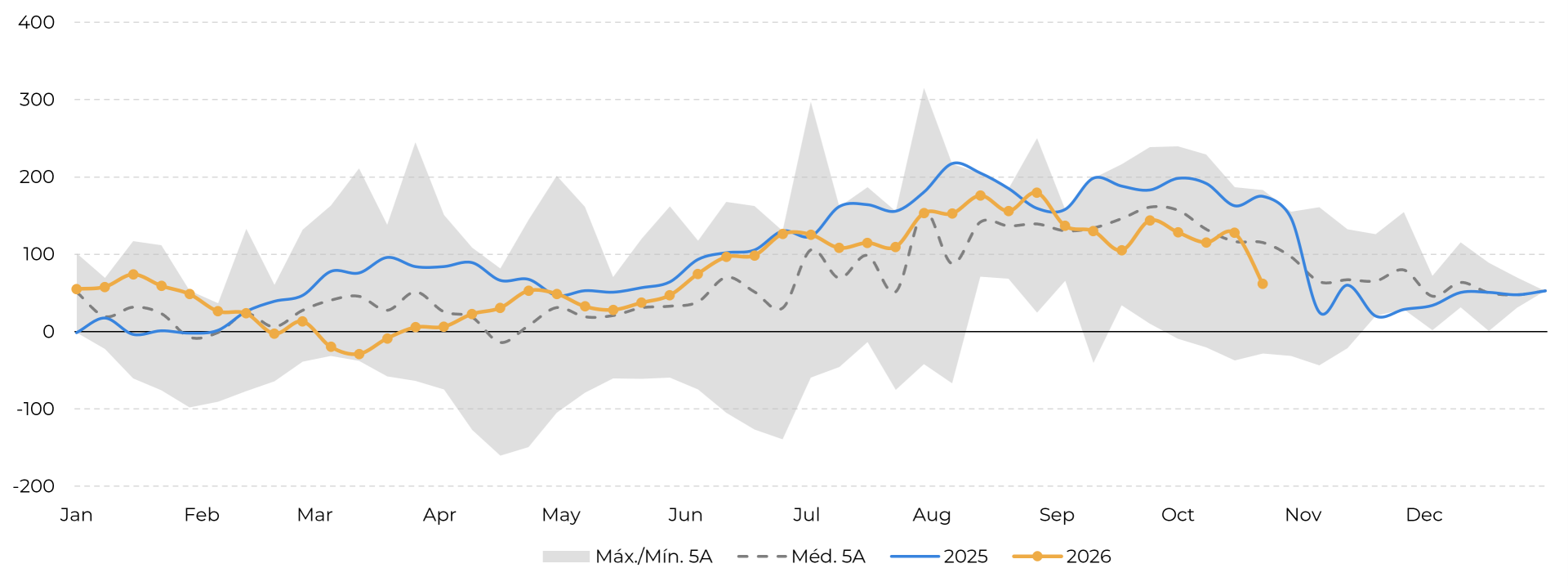
Source: CME, LSEG, ESALQ, Hedgepoint
Argentina is expected to record a crop slightly larger than the previous season’s, but without major structural changes.
The main change observed was a reduction in Argentine soybean exports as a result of China’s resumption of purchases of U.S. soybeans. Consequently, Argentine shipments are gradually returning to a level closer to historical norms.
The elections scheduled for next year and possible changes in the withholding tax policy remain key factors to watch regarding the country’s competitiveness in the international market.
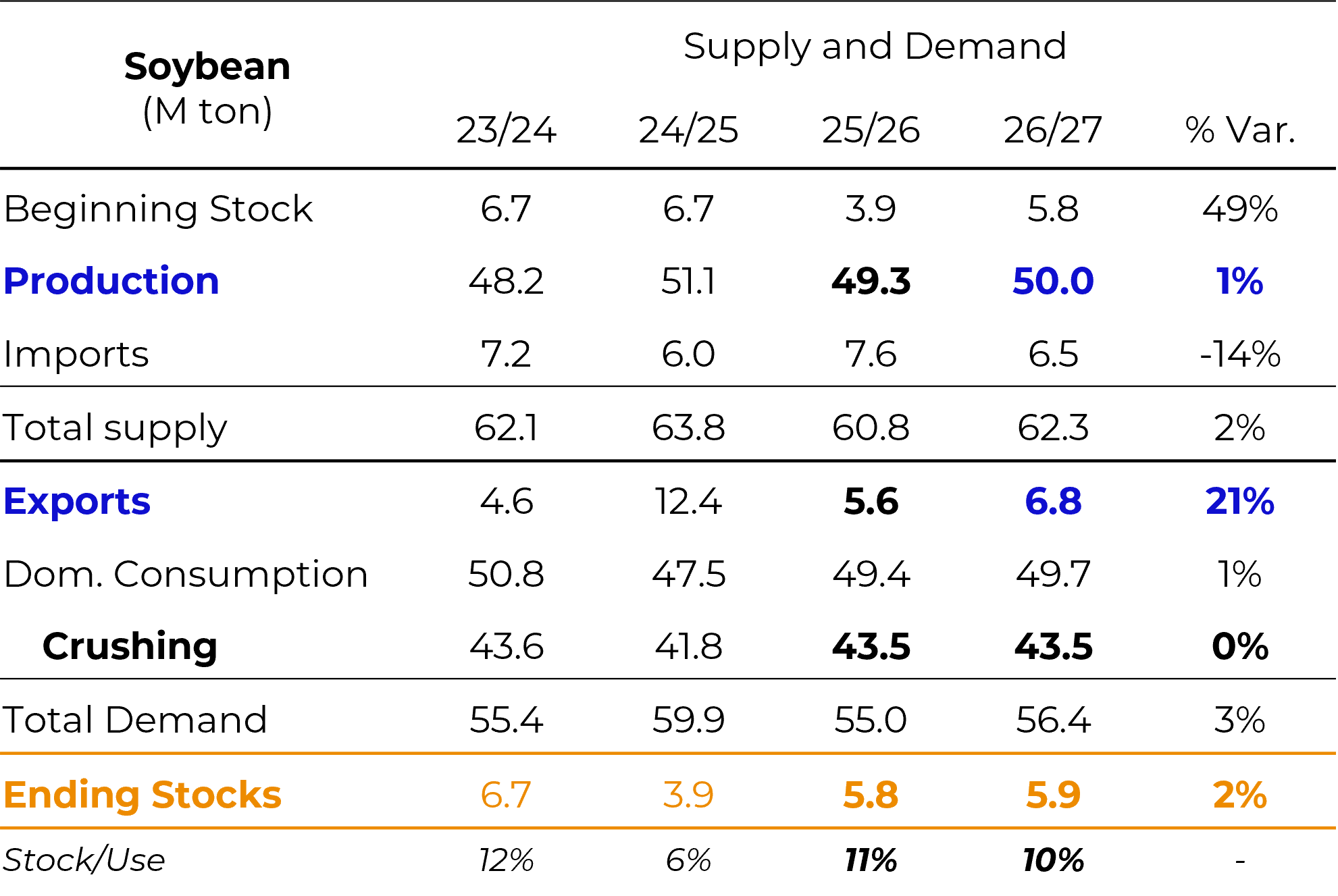
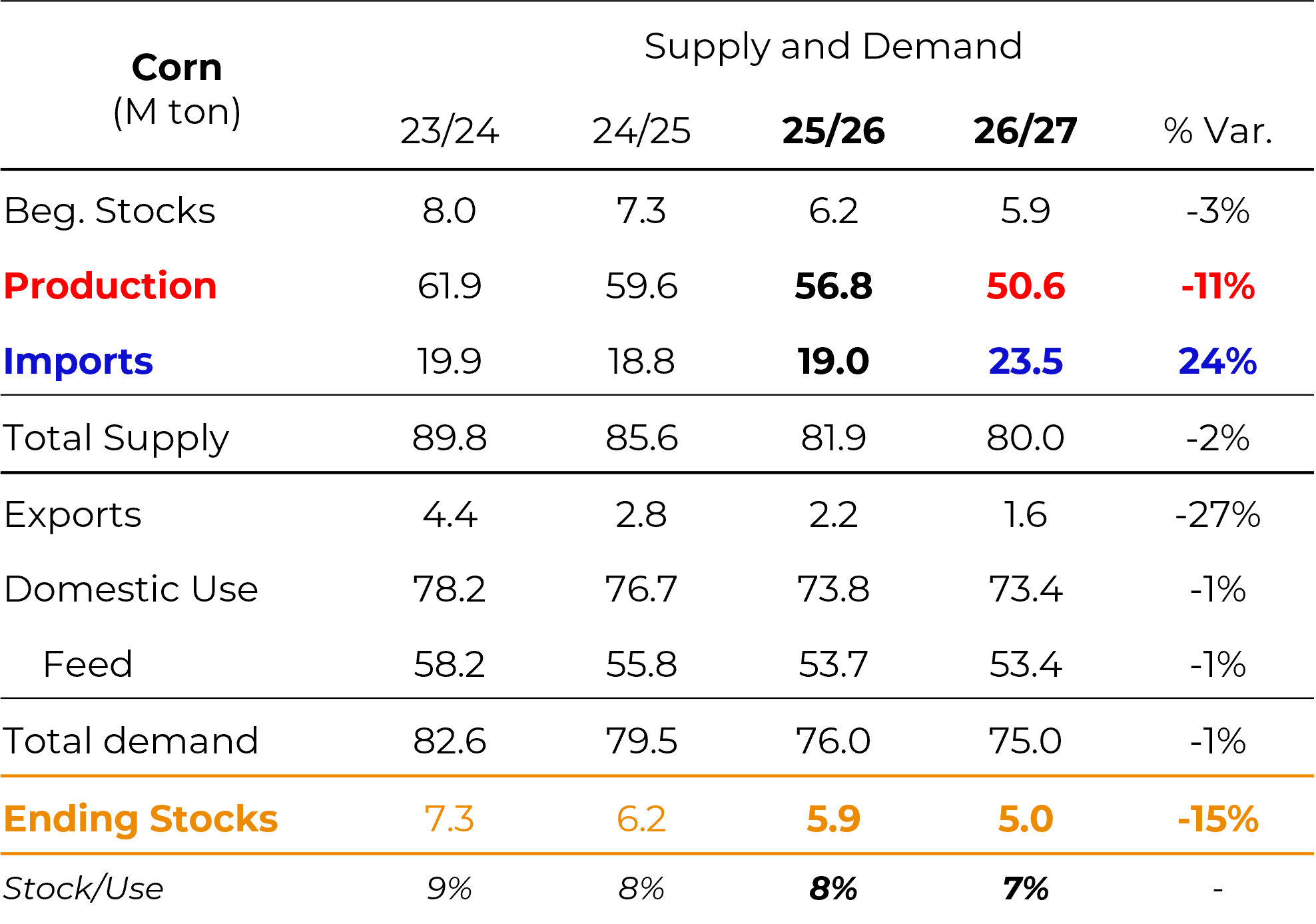
The global corn market exhibits dynamics distinct from those observed in the soybean market. While soybeans are driven primarily by expanding demand, corn finds support in declining global stocks and lower-than-expected corn production among some of the world’s leading producers. The market is closely monitoring the U.S. harvest, planting progress in South America, and developments in exports from the Black Sea region. Additionally, the structural growth in demand for corn ethanol in Brazil and the European Union’s potential need for increased imports are emerging as key factors supporting prices in the coming months.
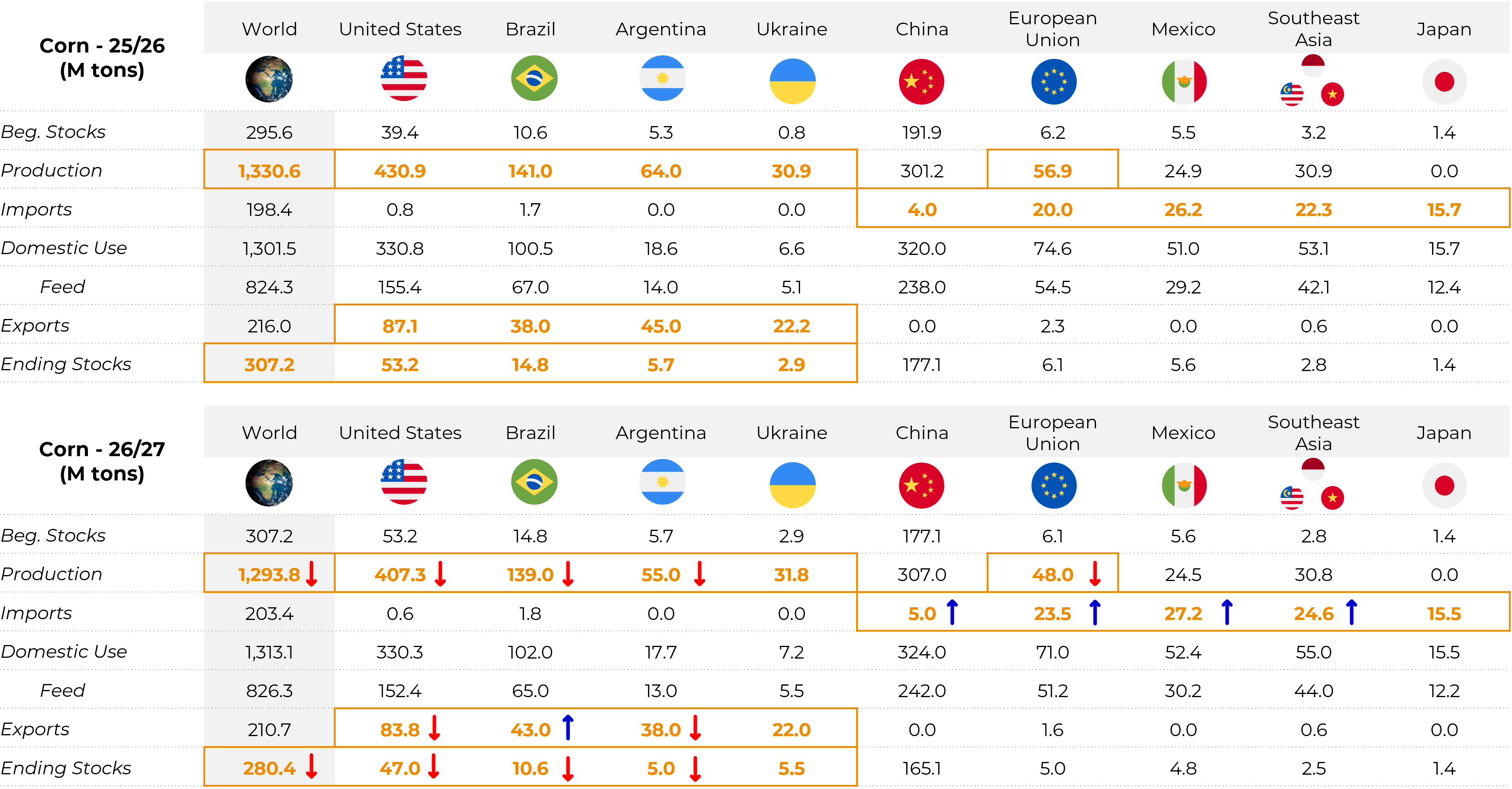
Unlike soybeans, China’s strategy for corn remains the gradual reduction of stocks.
Even with successive record crops, China has been consistently drawing down its stocks. As a result, the stock-to-use ratio has fallen significantly in recent years.
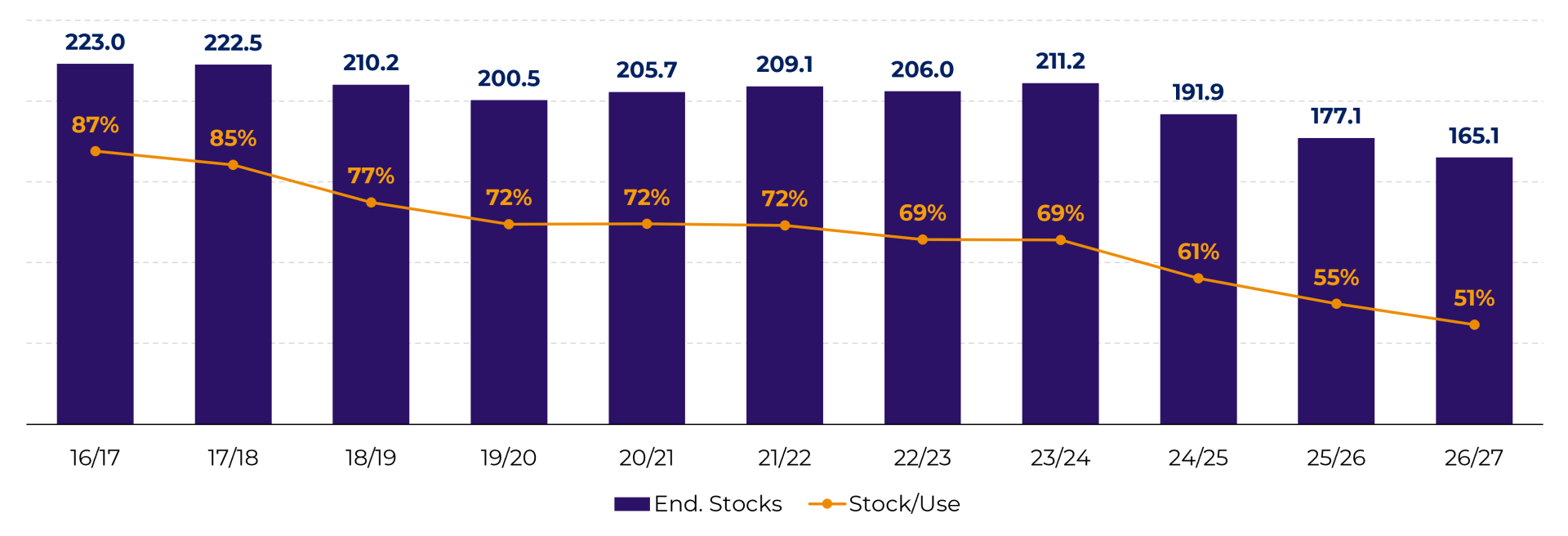
Imports remain low in the short term, but the market is beginning to monitor the possibility of China’s return to the international market in the coming years, as stocks continue to decline.
This is a potentially significant factor for Brazil, which was one of the biggest beneficiaries during China’s last cycle of high imports.
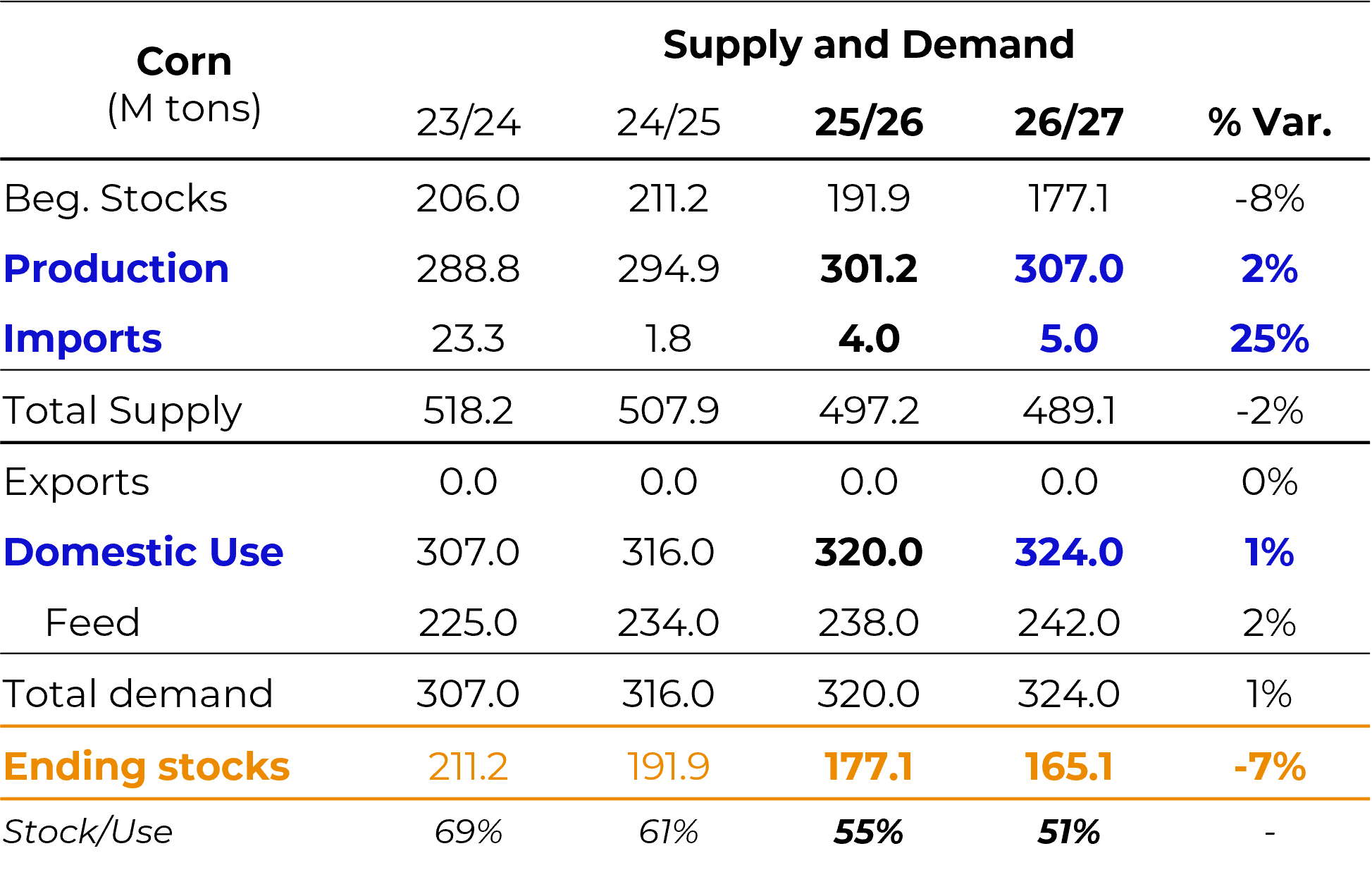
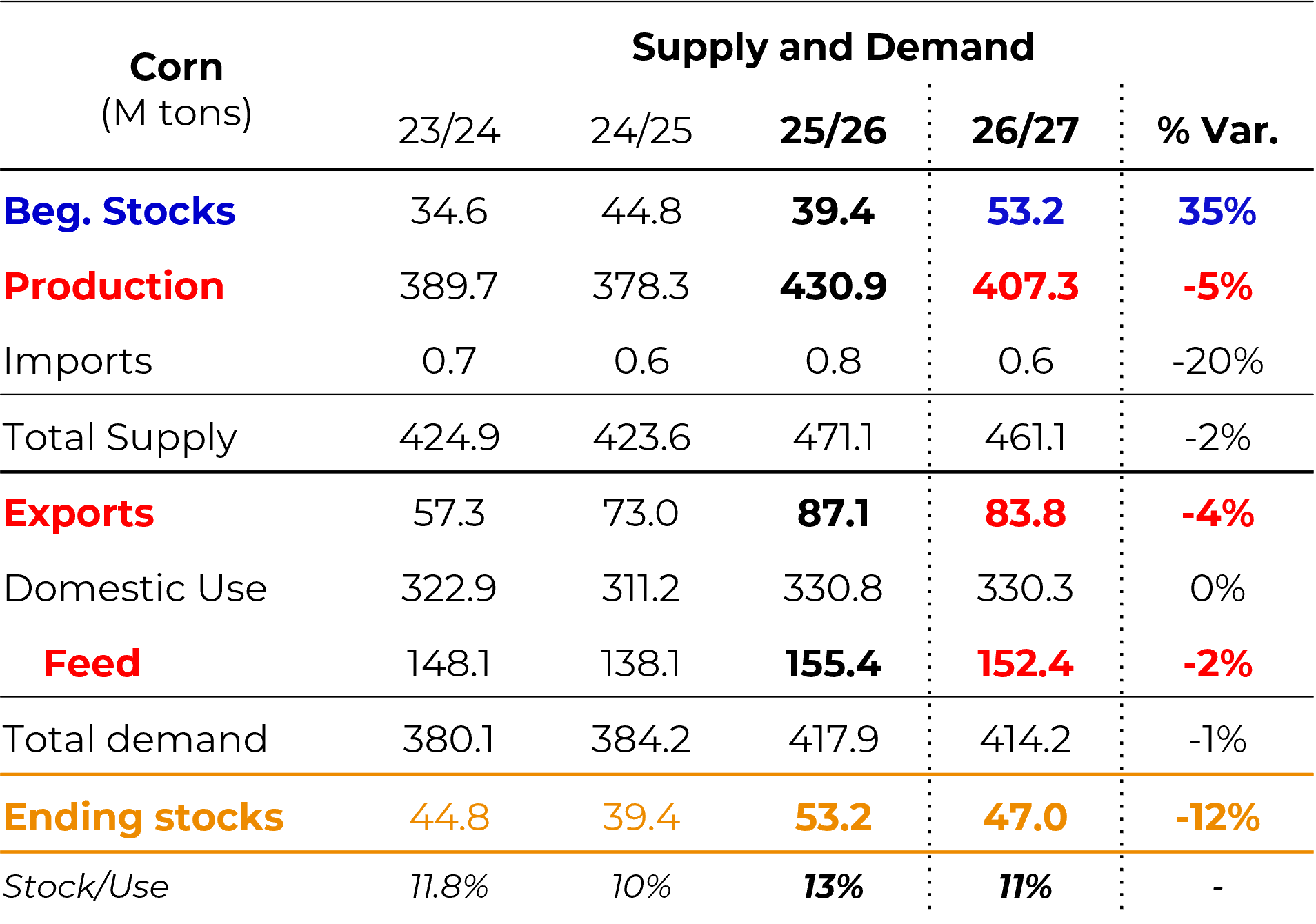
U.S. production is estimated at 407.3 M tons, representing the second-largest crop in history, although it falls short of the previous record.
Stocks remain relatively comfortable, but lower than those of the previous cycle. U.S. corn remains competitive in the international market, boosting exports.
The start of the crop and upward revisions to production estimates have triggered recent price corrections, as well as position liquidations by investment funds.
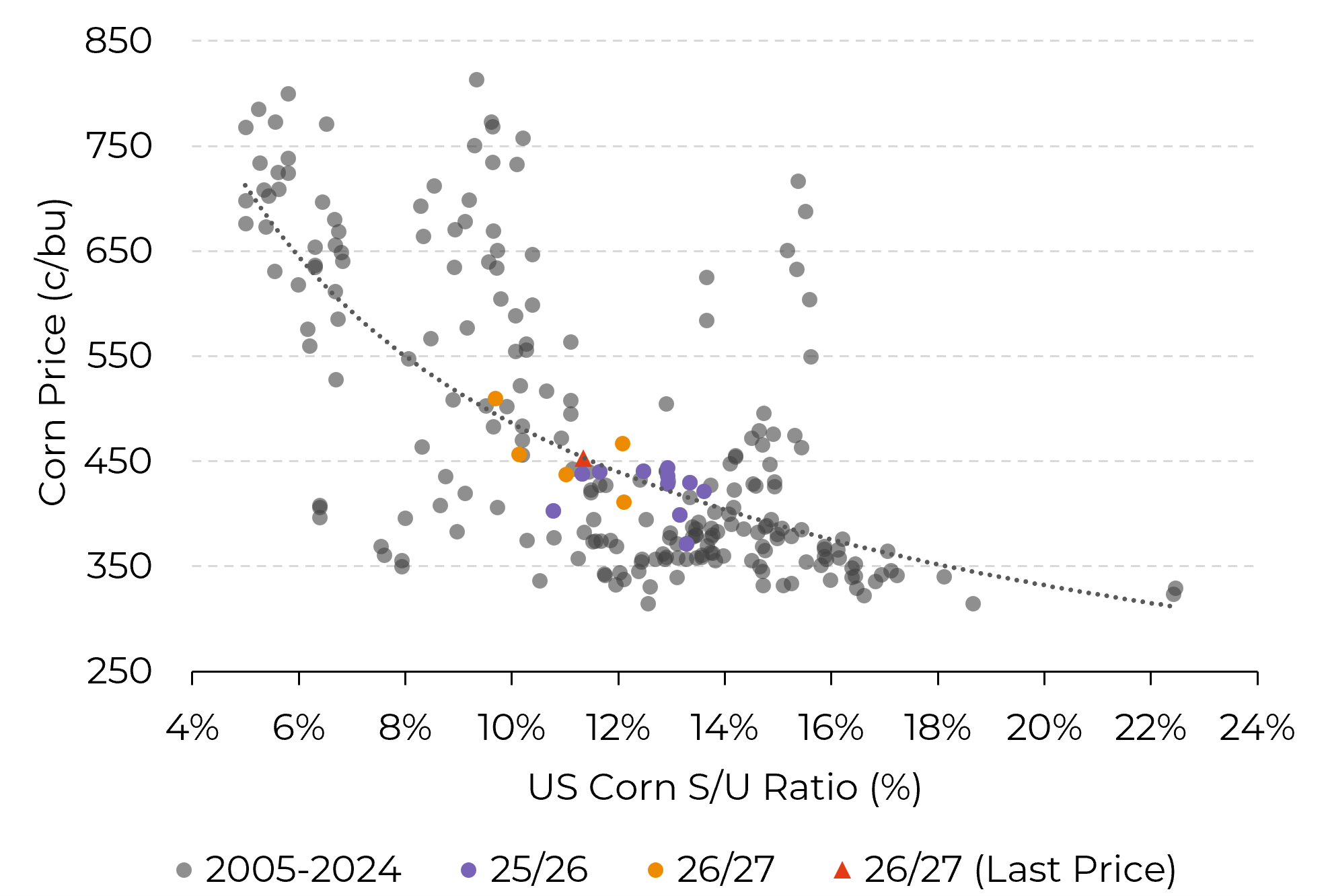
Source: USDA, CME, Hedgepoint
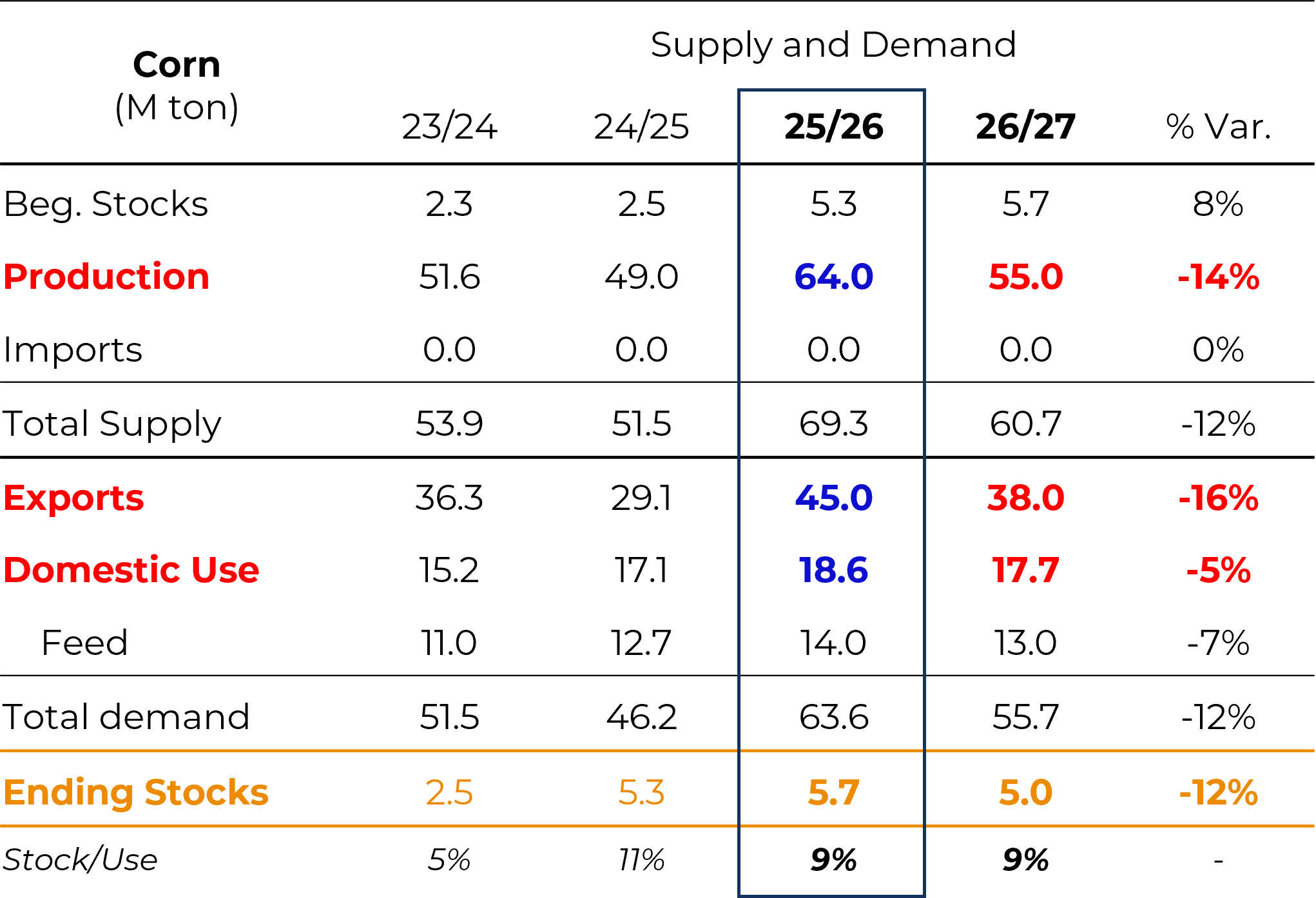
Hedgepoint’s estimates point to corn production of approximately 146.5 M tons in 2026/27, above the USDA’s official projections.
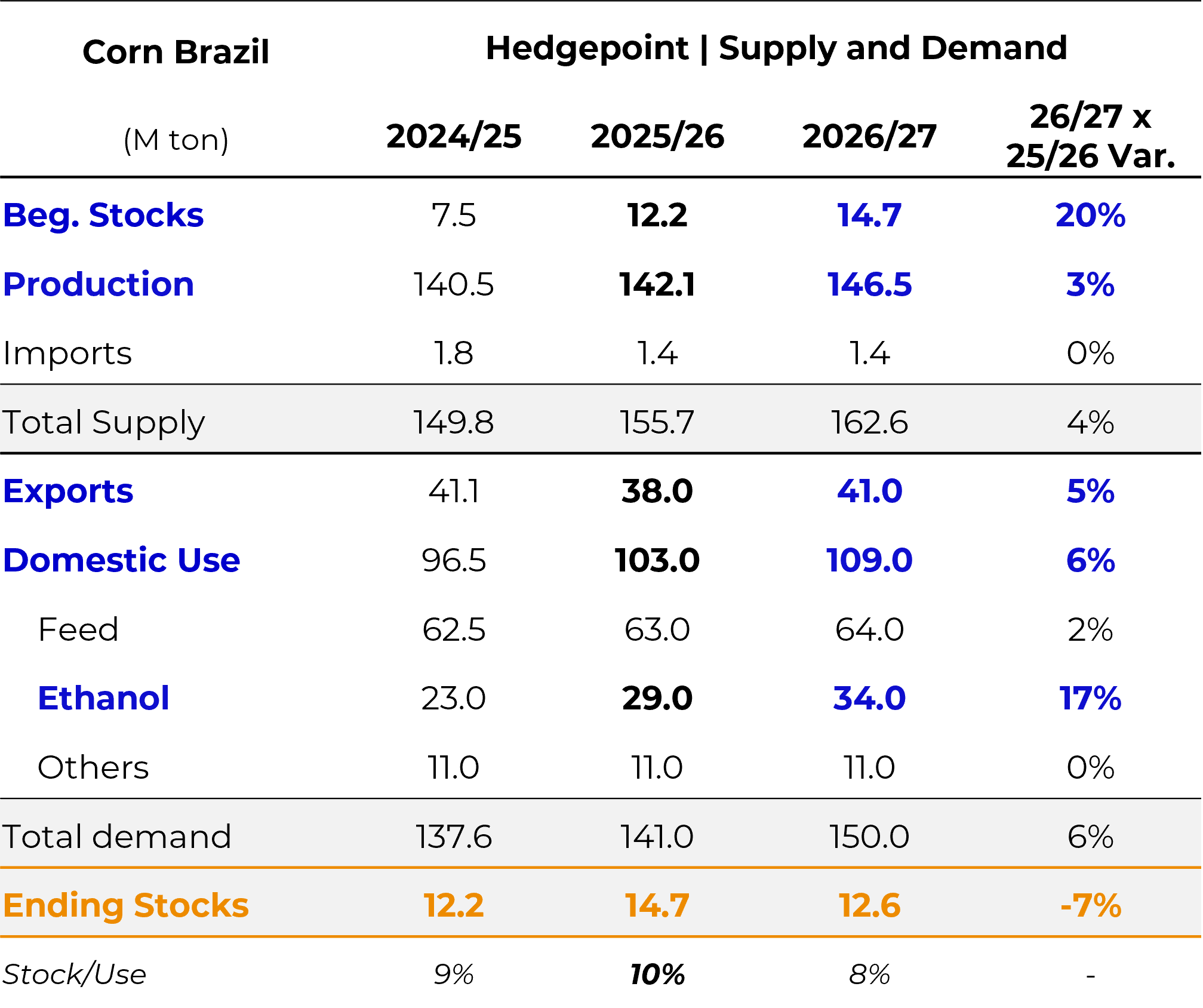
The main recent change has occurred on the export front. Shipments have been performing below expectations, leading to a revision of projections to approximately 38 M tons.
These lower exports reduce the risk of domestic supply tightness and support a scenario of more moderate prices in the domestic market.
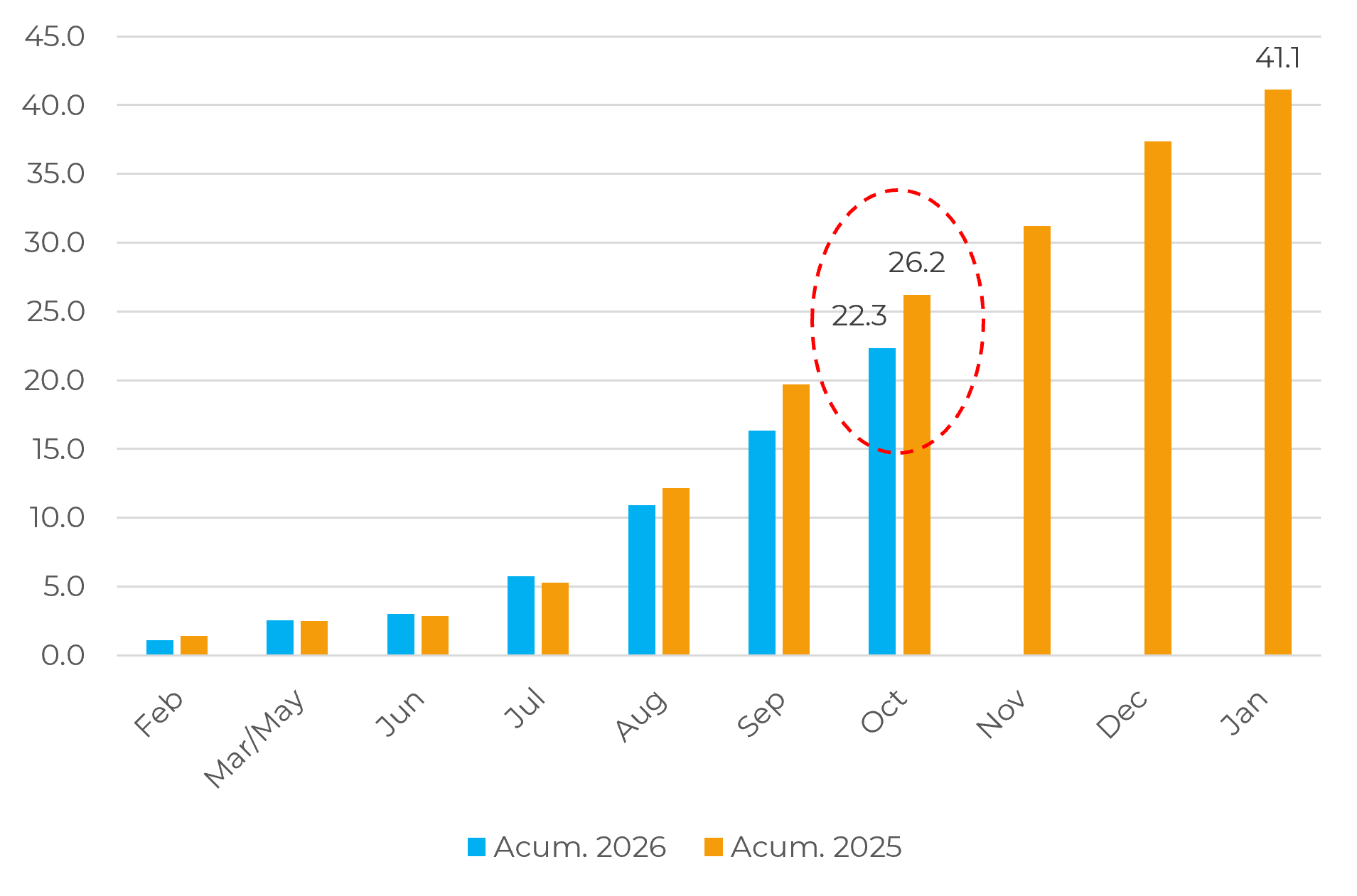
Source: Secex, Maritime Agencies, Hedgepoint
On the other hand, domestic demand continues to grow rapidly due to the expansion of corn-based ethanol.
Highlights:
• Ethanol consumption could reach 34 M tons in 2026/27.
• 29 mills in operation.
• 13 plants authorized for construction.
• 14 additional projects in the development phase.
Argentina harvested the largest corn crop in its history, with estimates ranging from 64 to over 70 M tons.
Argentine exports could reach about 45 M tons, far surpassing Brazilian shipments and significantly increasing competition in international markets.
This strong Argentine presence is one of the main reasons for the relatively weak performance of Brazilian exports this season.
The European Union has become a major bullish factor for corn in 2026.
An intense heat wave reduced European production, especially in France. As a result, the need for imports is expected to increase, creating opportunities for exporters such as Brazil and the United States, particularly given the logistical challenges faced by Ukraine.
• Global consumption is growing steadily.
• Chinese purchases of U.S. soybeans are rebounding strongly.
• Strong growth in soybean crushing in the U.S.
• Biodiesel expansion and strong demand for soybean oil.
• Possible negative impact of El Niño on the Brazilian crop.
• Decline in global stocks.
• Rapid growth in corn consumption for ethanol in Brazil.
• Potential future increase in Chinese imports.
• Increased import needs by the European Union.
• Lower exportable supply in the Black Sea region.
• Energy and oil prices remaining at high levels.
• Ongoing geopolitical conflicts.
• A weaker real, favoring Brazilian exports.
• Record U.S. crop.
• Seasonal influx of U.S. production putting pressure on Chicago.
• Possible slowdown in Chinese demand due to negative margins in the crushing and hog sectors.
• Funds liquidating positions.
• U.S. crop still very high.
• Brazilian exports below expectations.
• Strong competition from Argentina.
• Slower pace of Iranian purchases of Brazilian corn.
The current outlook remains positive for agricultural markets, mainly because growth in global consumption is preventing a more significant rebuilding of stocks, even in the face of large crops in the United States and expectations of high production in South America. Soybeans are finding support in demand for crushing, biodiesel, and Chinese purchases, while corn is supported by declining global stocks, the expansion of corn-based ethanol in Brazil, and the potential increase in European demand.
For the coming months, the key issues to monitor are the evolution of El Niño between November and February, the continuation of Chinese purchases of U.S. soybeans, the performance of Brazilian corn exports, the intensity of competition from Argentina, and the developments in geopolitical conflicts in the Black Sea and the Middle East. These factors will be decisive in determining the direction of prices and volatility until the South American crop is consolidated.
To watch the full October's Live with Experts on the Corn and Soy Complex markets,
click on this link.