Feb 2 / Lívea Coda

Brazilian Center-South 2026/2027 preliminary view

  • Sugar prices have remained range‑bound at 14-15¢/lb, reflecting expectations of a surplus in 2025/26 balance and heavy trade flows.
  • Brazil is the main driver of the oversupply, with strong Center‑South output in 2025/26 and early signs pointing to another solid 2026/27 crop.
  • Under a max‑sugar scenario (50.6% mix), production could reach 42.4 Mt, generating a ~4 Mt surplus in global trade flows.
  • Reducing the sugar mix to ~46% would rebalance sugar but require lower hydrous prices to absorb excess ethanol, implying a ~13.5¢/lb sugar floor.
  • A more realistic 48% sugar mix reduces, but does not eliminate, the surplus, keeping prices bearish and drifting toward the seasonal floor.

Brazilian Center-South 2026/2027 preliminary view

The sugar market has remained stable within a relatively low trading range for an extended period, between 14 to 15c/lb. Prices have failed to recover, largely reflecting market consensus around a surplus in the supply-demand balance for the 2025/26 (Oct–Sep) season, besides an also over-supplied trade flow.

A significant share of this surplus comes from another strong performance in Brazil, alongside improving results across the Northern Hemisphere. The Brazilian Center South 2025/26 crop year is approaching its end, signaling a strong sugar output. We currently estimate crushing at approximately 610 Mt of cane – moving closer to our first estimate, with a 50.6% sugar mix, resulting in around 40.5 Mt of sugar production.

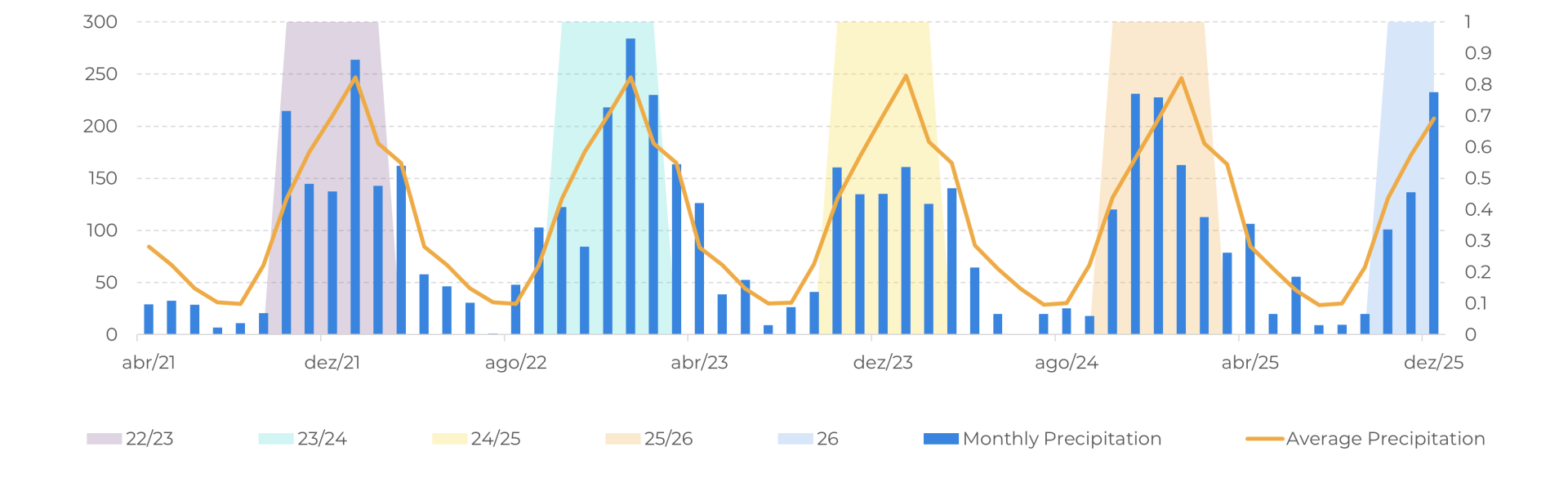
Adding to the bearish global outlook is the early view of the 2026/27 Brazilian season. While it remains early to draw firm conclusions, early rainfall patterns and favorable Vegetation Health Index (VHI) point to the potential for another year of solid production, reinforcing expectations of continued ample global supply. Our preliminary estimates suggest that, despite incomplete realized data, considering that the critical development window for sugarcane falls between October and February, it is possible to reach up to 630 Mt of cane. At that raw material availability level, price direction will largely depend on the sugar mix. Therefore, in this report, we will work on some scenarios.

Rainfall in CS x cane development period (mm)
Source: UNICA, Hedgepoint

As common assumptions across all scenarios, we consider 630 Mt of cane crush, 139.5 kg/t of TRS, 11 billion liters of corn ethanol production, and Otto‑cycle growth of 2.5% over the season.

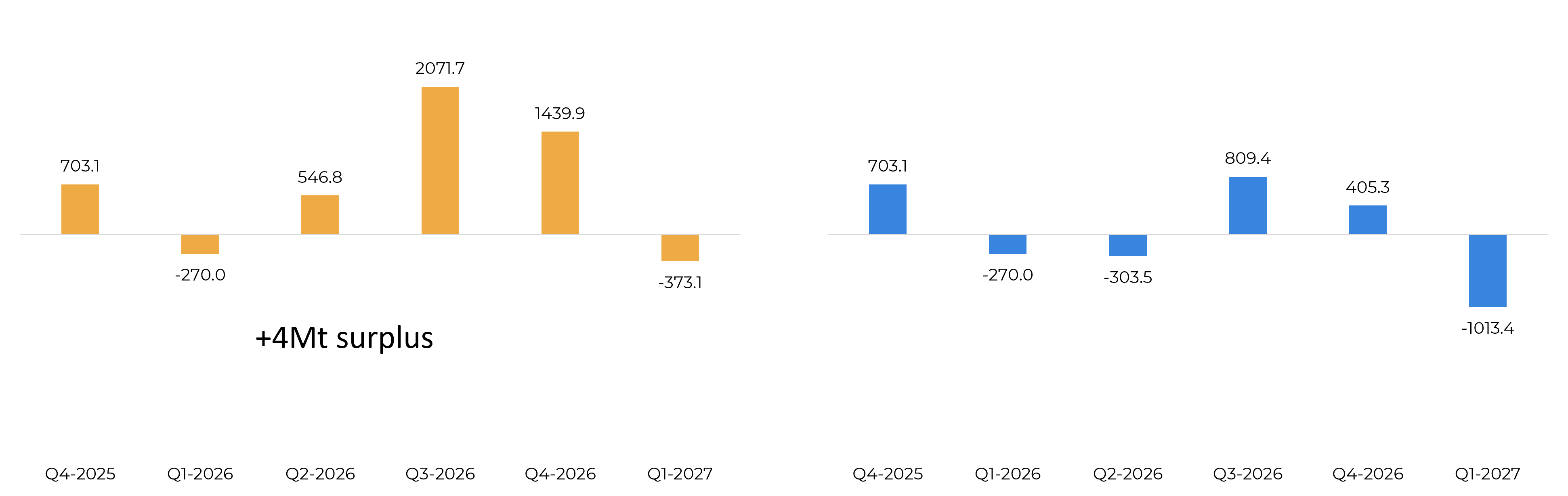
For the first scenario, let us assume that mills could continue maximizing sugar output, maintaining the same operating pace observed in the 2025/26 season and achieving a 50.6% sugar mix. Under this exercise, total sugar production would reach approximately 42.4 Mt, with exports from the Center‑South estimated at around 33.5 Mt. In this context, global trade flows would adjust accordingly, resulting in the accumulation of an estimated 4 Mt sugar surplus between Q4‑2025 and Q1‑2027, reinforcing an oversupplied outlook and limiting upside potential for prices. This scenario is unlikely, as it implies a sustained expansion of sugar output despite both an already oversupplied situation and relative price signals that currently favor ethanol over sugar in Brazilian production decisions.

What sugar mix would be required to smooth these trade flows, and what price level would that imply? These are the key questions addressed in our second scenario.

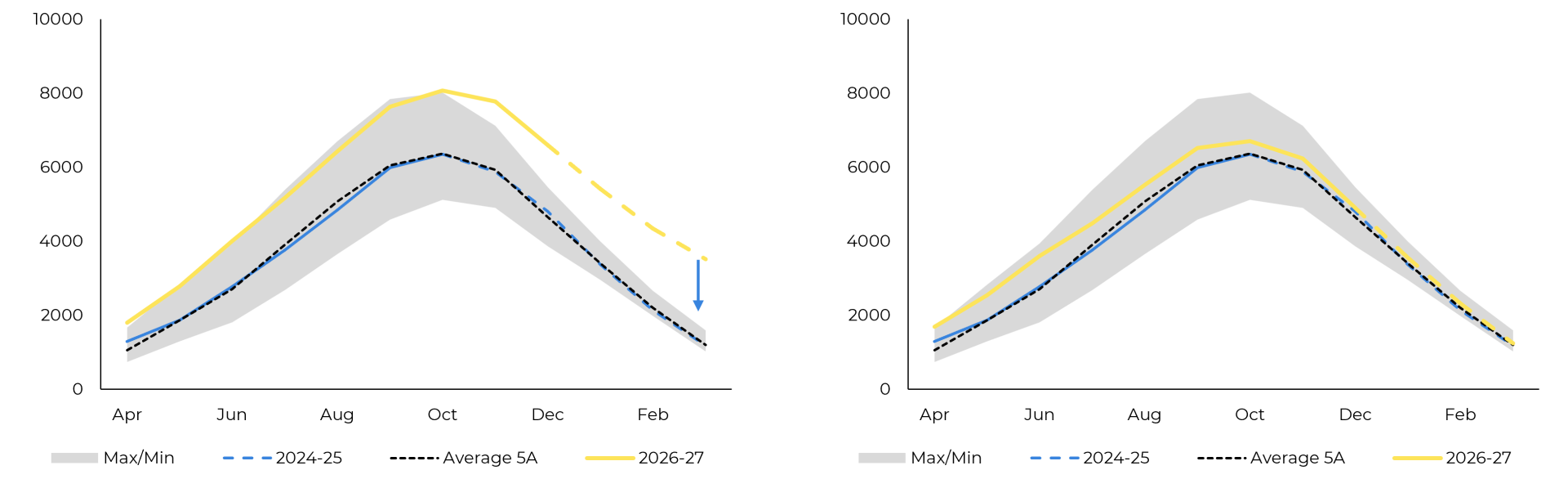
To offset 4 Mt of sugar production, the sugar mix would need to decline to approximately 46%. However, such a shift would inevitably lead to a build‑up of ethanol stocks.

Trade flow -  Sugar mix 50.6% (left) and 46.2% (right) in '000t tq
Source: Hedgepoint

The most straightforward and least costly way to rebalance this equation would be a reduction in hydrous ethanol prices, encouraging a switch in pump demand away from gasoline C toward hydrous. Under this scenario, the hydrous share of total fuel demand in the CS (percentage of the actual volume not in energetic equivalence) would increase from around 36% to approximately 39.3%. In the North and Northeast (NNE), hydrous participation would also rise, from 13.2% to about 14.2%.

This adjustment would effectively absorb the excess availability of raw material, but it would require pump parity to shift in favor of hydrous ethanol across most, if not all, states to prompt them to consume as much as the maximum amount done in the past 20 years.

Hydrous Stock un ‘000 m³ - before (left) and after (right)
Source: UNICA, SECEX, ANP, Hedgepoint

Using São Paulo as a proxy, a simplified estimate suggests that ex‑mill hydrous prices would need to decline from roughly BRL 3.00/liter to a range of BRL 2.3–2.5/liter to enable this demand reallocation at the pump. In sugar‑equivalent terms, such pricing implies a floor of approximately 13.5 ¢/lb. Considering that Brazil is at an election year, adding to this already explicit bearish scenario, government might pressure for some gasoline price-cuts from Petrobras, which would push pump prices to lower levels and thus, strengthen the trend.

As a result, the seasonal price bias is expected to remain bearish for the sweetener, with limited upside unless some tail events occur regarding weather or geopolitics.

As a final scenario, it is important to recognize that a full and rapid shift toward lower sugar mix levels is difficult to execute in practice. Structural friction in both the sugar and fuel markets can prevent the system from reaching a 46% sugar mix. These include already sold and priced sugar volumes that cannot be easily reversed, as well as gradual and imperfect adjustments in fuel demand, which limit the speed and magnitude of ethanol absorption.

Given these real‑world constraints, the transition from Scenario One to Scenario Two may prove challenging. We therefore introduce a third scenario, which we view as having a higher probability, centered on an intermediate sugar mix of approximately 48.6%.

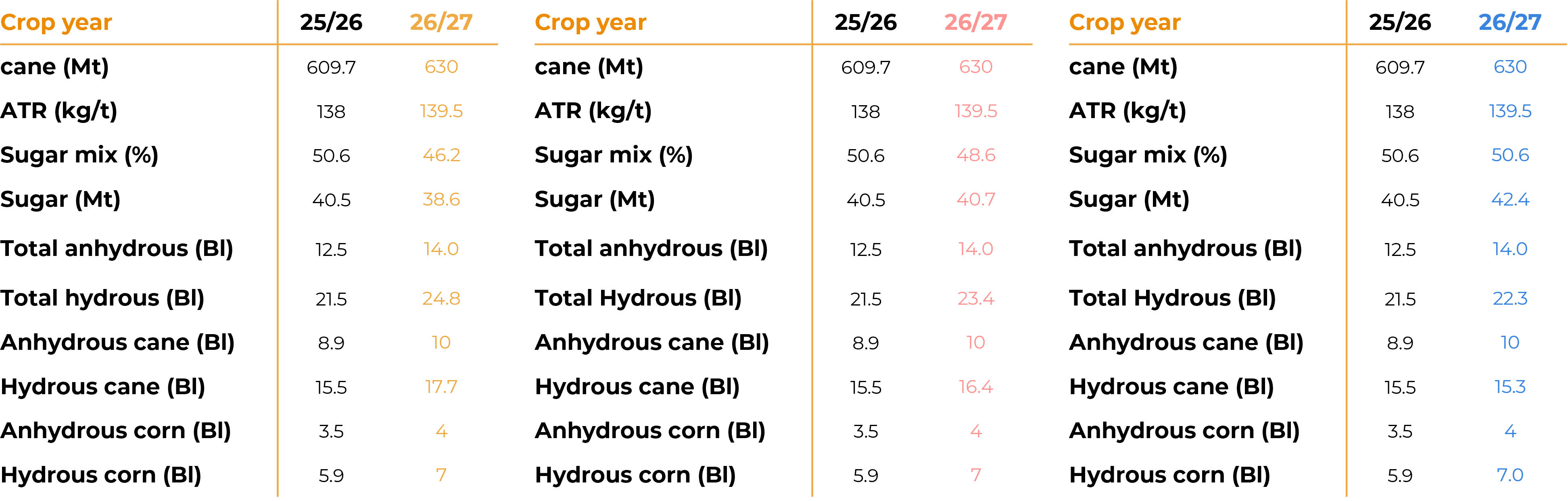
Crop estimate considering a sugar mix of 46.2% (left), 48.6% (middle) and 50.6% (right)
Source: UNICA, Hedgepoint
Note: both 46.2% and 48.6% scenarios would need prices to induce higher hydrous consumption to stabilize stocks. 

Under this configuration, the surplus in global sugar trade flows would be reduced but not fully eliminated, implying that prices would continue to trend toward the floor for the season. While still bearish in direction, this outcome may better reflect operational realities and market frictions.

Summary

The sugar market remains structurally oversupplied, with Brazil at the center of both current and forward looking bearish pressure. Even under more conservative assumptions on the sugar ethanol mix, global trade flows are unlikely to fully rebalance, limiting upside potential for prices. While aggressive ethanol demand reallocation could theoretically clear the surplus, operational frictions and pricing constraints make a partial adjustment more likely. 


Weekly Report — Sugar

Written by Lívea Coda
livea.coda@hedgepointglobal.com


Reviewed by Laleska Moda
laleska.moda@hedgepointglobal.com

Disclaimer

This document has been prepared by Hedgepoint Schweiz AG and its affiliates (“Hedgepoint”) solely for informational and instructional purposes, without intending to create obligations or commitments to third parties. It is not intended to promote or solicit an offer for the sale or purchase of any securities, commodities interests, or investment products.


Hedgepoint and its associates expressly disclaim any liability for the use of the information contained herein that directly or indirectly results in any kind of damages. Information is obtained from sources which we believe to be reliable, but we do not warrant or guarantee the timeliness or accuracy of this information.
The trading of commodities interests, such as futures, options, and swaps, involves substantial risk of loss and may not be suitable for all investors. You should carefully consider wither such trading is suitable for you in light of your financial condition. Past performance is not necessarily indicative of future results. Customers should rely on their own independent judgment and/or consult advisors before entering into any transactions.
Hedgepoint does not provide legal, tax or accounting advice and you are responsible for seeking any such advice separately.
Hedgepoint Schweiz AG is organized, incorporated, and existing under the laws of Switzerland, is filiated to ARIF, the Association Romande des Intermédiaires Financiers, which is a FINMA-authorized Self-Regulatory Organization. Hedgepoint Commodities LLC is organized, incorporated, and existing under the laws of the USA, and is authorized and regulated by the Commodity Futures Trading Commission (CFTC) and a member of the National Futures Association (NFA) to act as an Introducing Broker and Commodity Trading Advisor. HedgePoint Global Markets Limited is Regulated by the Dubai Financial Services Authority. The content is directed at Professional Clients and not Retail Clients. Hedgepoint Global Markets PTE. Ltd is organized, incorporated, and existing under the laws of Singapore, exempted from obtaining a financial services license as per the Second Schedule of the Securities and Futures (Licensing and Conduct of Business) Act, by the Monetary Authority of Singapore (MAS). Hedgepoint Global Markets DTVM Ltda. is authorized and regulated in Brazil by the Central Bank of Brazil (BCB) and the Brazilian Securities Commission (CVM). Hedgepoint Serviços Ltda. is organized, incorporated, and existing under the laws of Brazil. Hedgepoint Global Markets S.A. is organized, incorporated, and existing under the laws of Uruguay. In case of questions not resolved by the first instance of customer contact (client.services@Hedgepointglobal.com), please contact internal ombudsman channel (ombudsman@hedgepointglobal.com – global or ouvidoria@hedgepointglobal.com – Brazil only) or call 0800-8788408 (Brazil only).
Integrity, ethics, and transparency are values that guide our culture. To further strengthen our practices, Hedgepoint has a whistleblower channel for employees and third-parties by e-mail ethicline@hedgepointglobal.com or forms Ethic Line – Hedgepoint Global Markets.
“HedgePoint” and the “HedgePoint” logo are marks for the exclusive use of HedgePoint and/or its affiliates. Use or reproduction is prohibited, unless expressly authorized by HedgePoint.
Furthermore, the use of any other marks in this document has been authorized for identification purposes only. It does not, therefore, imply any rights of HedgePoint in these marks or imply endorsement, association or seal by the owners of these marks with HedgePoint or its affiliates.

To access this report, you need to be a subscriber.