
Brazil is not the only one to blame
- Production recoveries across the Northern Hemisphere - particularly in India, Thailand, Pakistan, China, and Mexico - have added additional supply, reinforcing the current surplus.
- In Southeast Asia, India and Thailand delivered stronger outputs, but rising El Niño risks and weaker monsoon expectations are increasing uncertainty for the 26/27 season and limiting export visibility.
- Pakistan’s growing surplus and China’s higher-than-expected production could weigh on future market dynamics.
- Weather risks linked to El Niño are increasingly being priced into forward structures, although Brazil’s resilience and supply flexibility are expected to offset potential disruptions and limit sustained bullish momentum.
Brazil is not the only one to blame
Over recent months, significant attention has focused on Brazil’s Center-South region and its central role as a bearish driver in the sugar market. With a fourth consecutive season of cane availability exceeding 600 million tonnes, the region has effectively flooded the market with sugar, to the point where lower international prices have already prompted a reduction in its sugar mix.
However, Brazil has not been the sole force shaping price dynamics. The Northern Hemisphere has partially recovered from a sequence of adverse seasons marked by crop failures, with some countries exceeding expectations on the upside during 25/26. In this report, we briefly assess these recoveries and outline expectations for the upcoming season.
For instance, in Southeast Asia, although outcomes remained below initial expectations, India managed to increase its sugar production from 26 Mt in 24/25 to around 28 Mt in 25/26.This 2 Mt expansion, combined with another year of consumption contraction driven by higher inflation, allowed the country to maintain a modest presence in the international market, exporting roughly 750 kt.
However, with an increasing probability of El Niño and an already below-average monsoon outlook, the Indian government moved to ban further exports, proactively addressing the risk of tighter availability in the 26/27 season.
Thailand, in turn, entered the season with a positive outlook but initially unsettled the market amid rumors of cane diseases and lower yields. These concerns ultimately proved unfounded, as the country delivered its strongest result in six years. With sugar production reaching around 12 Mt, Thailand is well positioned to expand exports, thereby reinforcing the current bearish trend.
Sugar Balance - Thailand (Mt Dec-Nov)
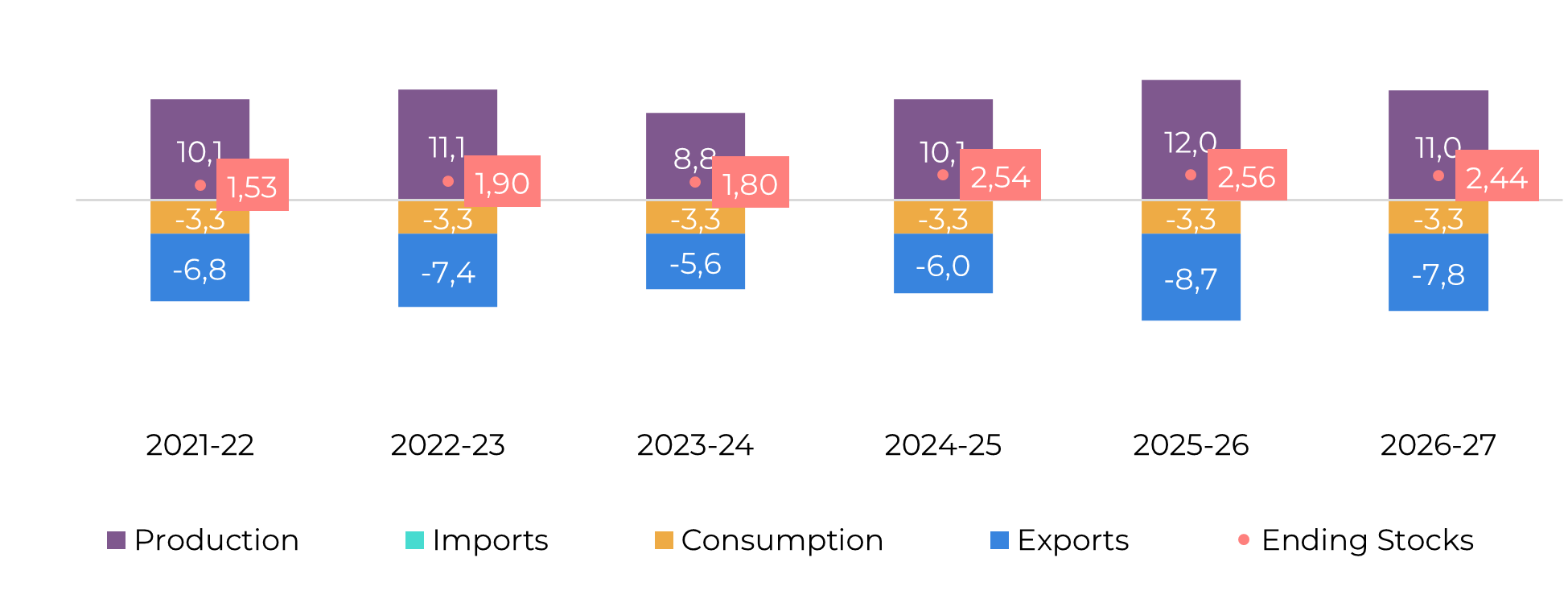
Source: Thai Sugar Millers, Sugarzone, Hedgepoint
Nevertheless, El Niño remains a key factor for the region’s next crop. As such, it is a risk worth closely monitoring, given its potential to tighten supply and lend support to the contract most exposed to Northern Hemisphere dynamics – namely, the March 2027 contract.
Pakistan and China also surprised on the upside, although the full impact is not yet reflected in the physical market.
In Pakistan, the PSMA is seeking export approvals amid a growing surplus. Stocks increased on 25/26 and, with another strong crop expected in 26/27, the oversupply is set to widen, adding pressure on the domestic market.
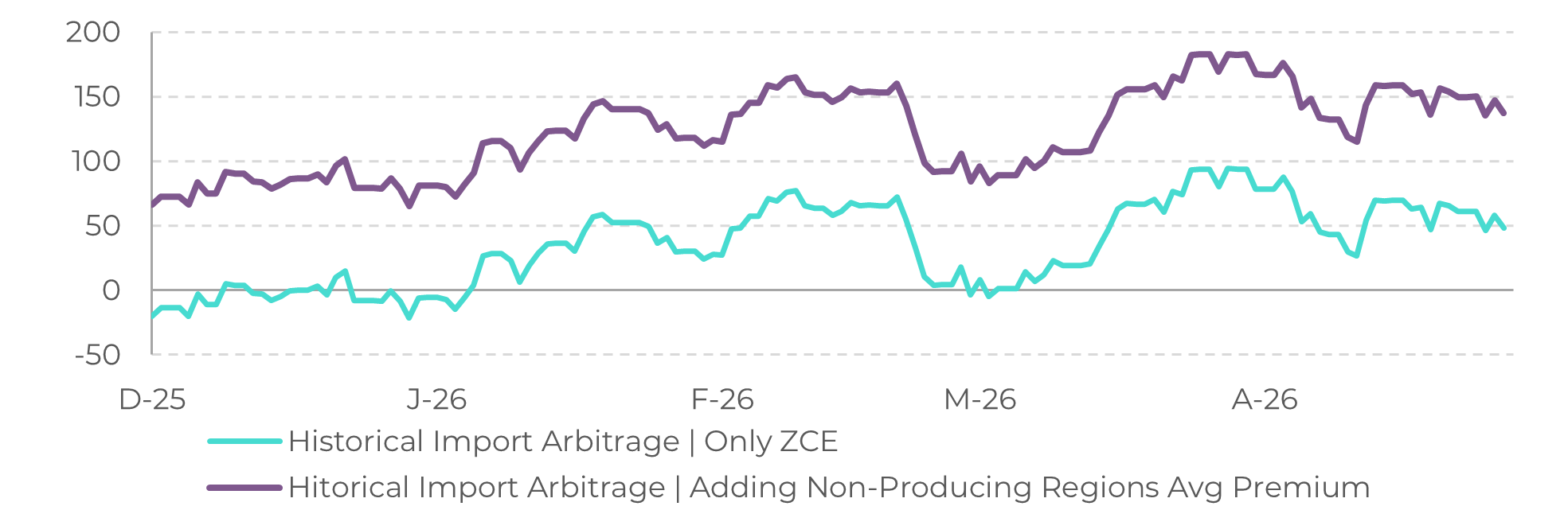
In China, production exceeded expectations, surpassing 12 Mt versus an initial estimate of 11.2 Mt. Despite this, imports remained firm, supported by open arbitrage, with the China Sugar Association maintaining its 5 Mt import outlook. While this has limited immediate impact, higher domestic availability may cap future international price gains, as the country can quickly scale back imports if the market tightens.
Estimated historical import parity (USD/t)
Source: Bloomberg, msweet, yntw, Hedgepoint
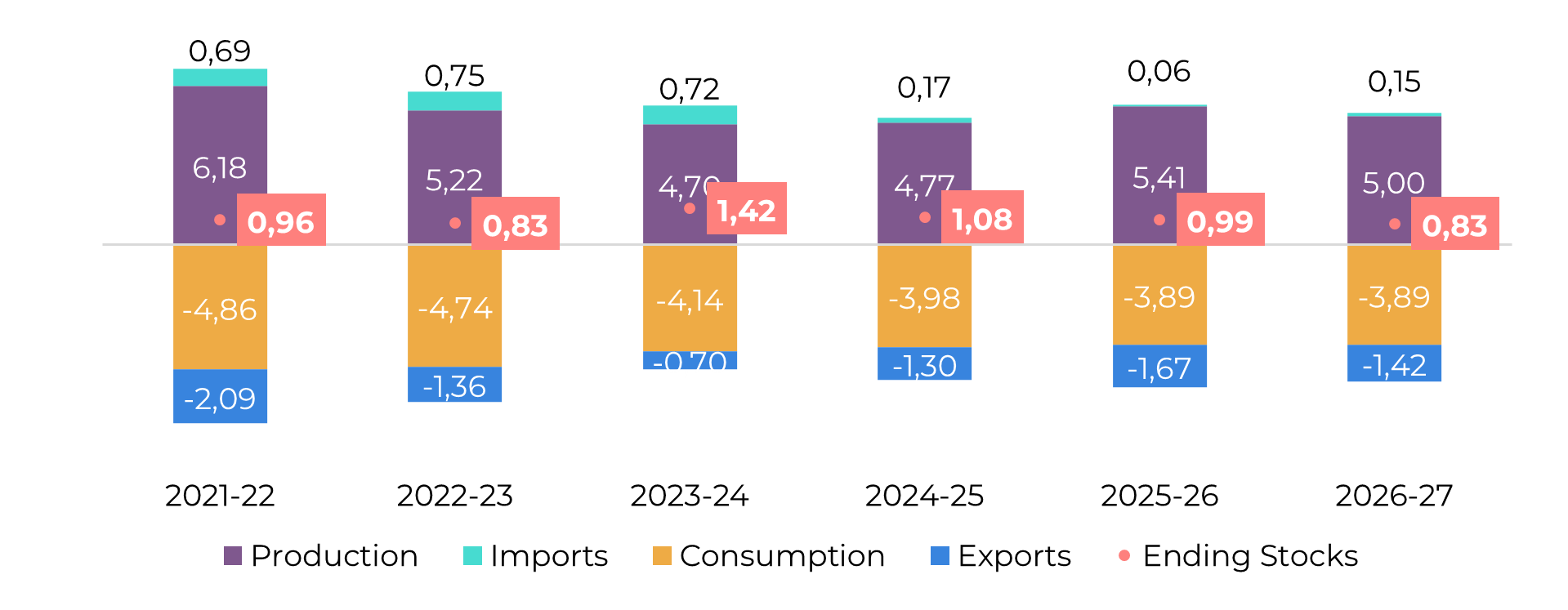
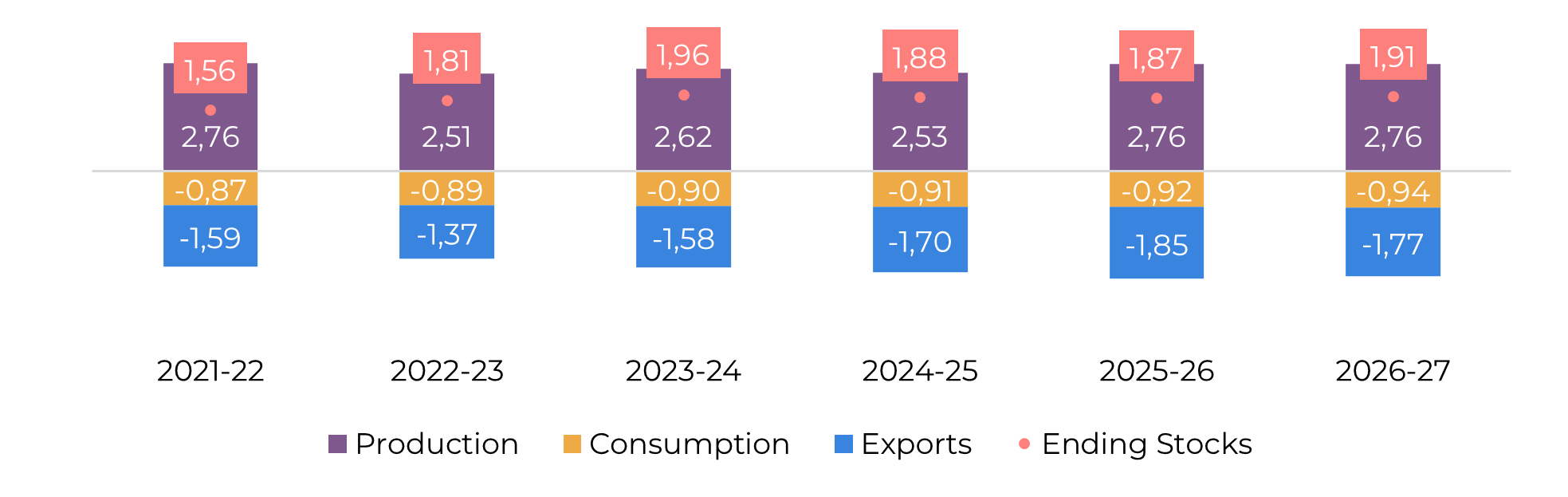
In Central and North America, several producers have reported improved results. Guatemala and El Salvador posted production gains, while Mexico not only delivered strong crushing figures so far but also saw its official estimate revised up by 500 kt by CONADESUCA. As a result, 25/26 output is now expected closer to 5.5 Mt, the highest since 2021/22, reinforcing the region’s export capacity and adding to the bearish market tone.
Sugar Balance - Mexico (Mt Dec-Nov)
Source: Conadesuca, Hedgepoint
Sugar Balance - Guatemala (Mt Oct-Sep)
Source: Cengicaña, Sieca, Azucar.gt, Greenpool, Hedgepoint
Besides that, Center-South is not heavily affected by the weather pattern. The region is expected to deliver a strong 26/27 crop and, barring other adverse conditions, maintain a healthy outlook for 27/28. Combined with its structural flexibility to shift between sugar and ethanol production, the country could offset other regions' crop failures. This trend reduces the space for strong bullish movement and consolidates Center-South's central role in global price formation.
Summary
The global sugar market remains under pressure due to Brazil’s Center-South sustained high supply. However, this bearish trend was not built alone. The recovery in Northern Hemisphere producers – such as India, Thailand, Pakistan, China, and Mexico – has further contributed to the current surplus, even as some impacts are still not fully reflected in physical markets.
Looking ahead, increasing El Niño risks across key regions (Southeast Asia, Central America, and Mexico) are starting to be priced into forward curves. Despite these risks, Brazil’s limited exposure to the weather pattern and its flexibility in sugar/ethanol allocation should help offset potential shortfalls elsewhere, limiting upside and consolidating its dominant role in global price formation.
Weekly Report — Sugar
Reviewed by Thaís Italiani
thais.italiani@hedgepointglobal.com
Disclaimer
This document has been prepared by Hedgepoint Schweiz AG and its affiliates (“Hedgepoint”) solely for informational and instructional purposes, without intending to create obligations or commitments to third parties. It is not intended to promote or solicit an offer for the sale or purchase of any securities, commodities interests, or investment products.