
Jul 14 / Lívea Coda

Live with Experts – Highlights of the Sugar Market

Live with Experts – Highlights of the Sugar Market

In this analysis, you’ll find the main points discussed during our event “Live with Experts – Sugar Market,” held on July 8. You can also click this link to watch the full recording.

Macroeconomic and Price Outlook 

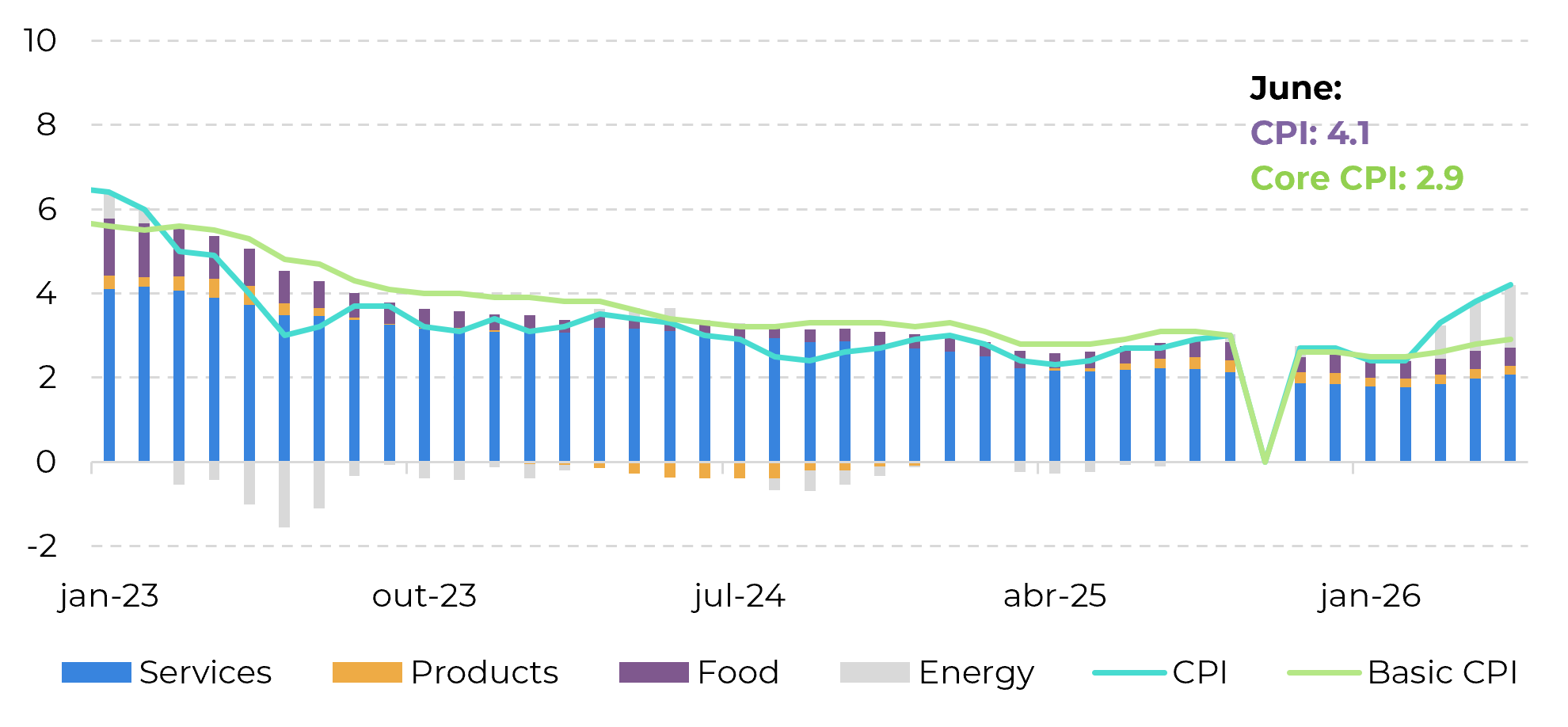
The market continues to monitor the effects of the conflict in the Middle East, persistent global inflation, and the maintenance of high interest rates in major economies. Weaker U.S. employment data temporarily reduced support for the dollar and favored a recovery in commodities over the past week by dampening expectations of U.S. interest rate hikes. Nevertheless, the Fed is likely to continue monitoring inflation to determine its monetary policy, as inflation remains above the 2% target due to the fallout from the conflict with Iran. 

U.S. Consumer Price Index (CPI)
Source: Bloomberg

In Brazil, the high-interest rate differential continues to support the real, although the approaching election season is increasing exchange rate volatility. A weaker real could benefit new sugar sales and should be monitored.

In terms of sugar, the recent price recovery was driven by funds covering short positions amid growing concerns about the 2026/27 Northern Hemisphere crop. Despite this, current supply remains high and limits more significant upward movements. Technically, the raw sugar contract encountered resistance near 15.5 c/lb.

Northern Hemisphere

India

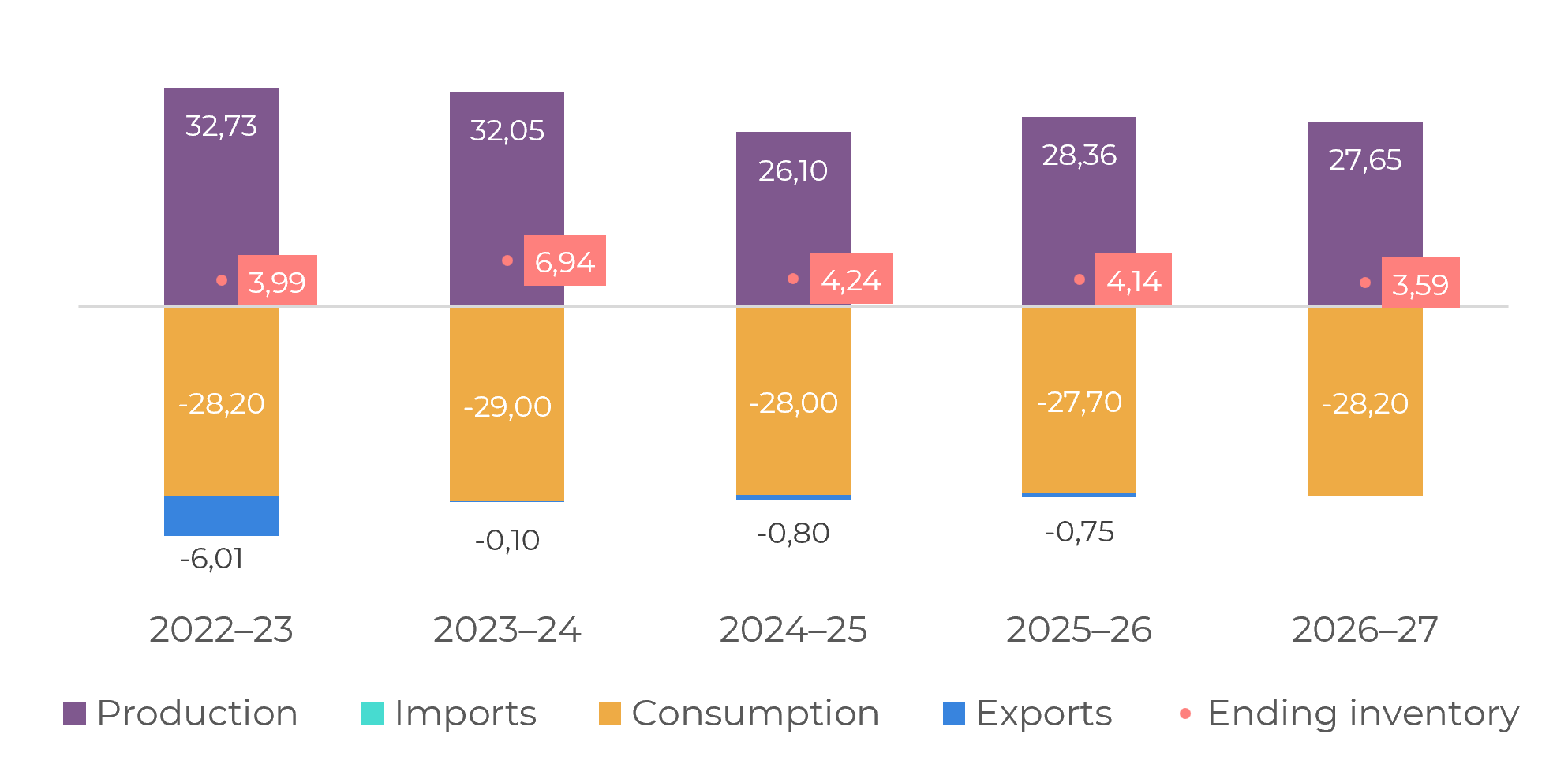
The monsoons have progressed reasonably well after a delayed start. Production is estimated at approximately 27.3 Mt, down from the previous season. The country is not expected to export sugar in 2026/27, and a deterioration in weather conditions due to the El Niño could even lead to a need for imports, which would support prices by directly impacting global supply.

Sugar Balance Sheet – India (Mt, October–September)
Source: ISMA, AISTA, ChiniMandi, NFCSF, Hedgepoint

Thailand

The country has a history of being negatively affected by El Niño, with a significant reduction in yields due to drought and higher temperatures. Since the climate event has a high probability of occurring and reaching high intensity during the country’s sugarcane growing season, we have lowered our forecast for the 26/27 crop year and estimate a crush of approximately 88 Mt of sugarcane, reducing exports to a volume of 6–6.5 Mt. This reduction directly impacts trade flows by decreasing availability by 1 Mt compared to the previous estimate.

Europe and the United Kingdom

Dry weather and high temperatures in the main producing countries (Germany, France, and Poland), as well as pest problems in the UK, have reduced sugar beet yields. Combined with a second consecutive year of declining planted area, the region’s sugar production is expected to be close to 14 Mt, already accounting for the diversion to ethanol and significantly increasing the need for imports to maintain sugar stocks.

Mexico, Central America, and Eurasia

Mexico, Guatemala, El Salvador, and Ukraine face less favorable outlooks for 2026/27. While the first three are expected to face adverse weather conditions due to the intensity of El Niño, Ukraine has seen an 18% reduction in planted area due to high inventories, reduced export capacity to Europe, and challenges posed by the war with Russia. In contrast, Russia is expected to maintain relatively stable production, acting as one of the few bearish factors in the Northern Hemisphere.

Brazilian Center-South

In Brazil, the Central-South harvest is performing solidly, with high crushing levels and sugarcane production expected to reach 635 million tons in 26/27 and may even exceed that level. Weather conditions have been favorable so far, with expectations close to the historical average, which should support a robust harvest. The production mix, however, tends to be more alcohol-oriented, reflecting the lower attractiveness of sugar in the face of global oversupply. 

China

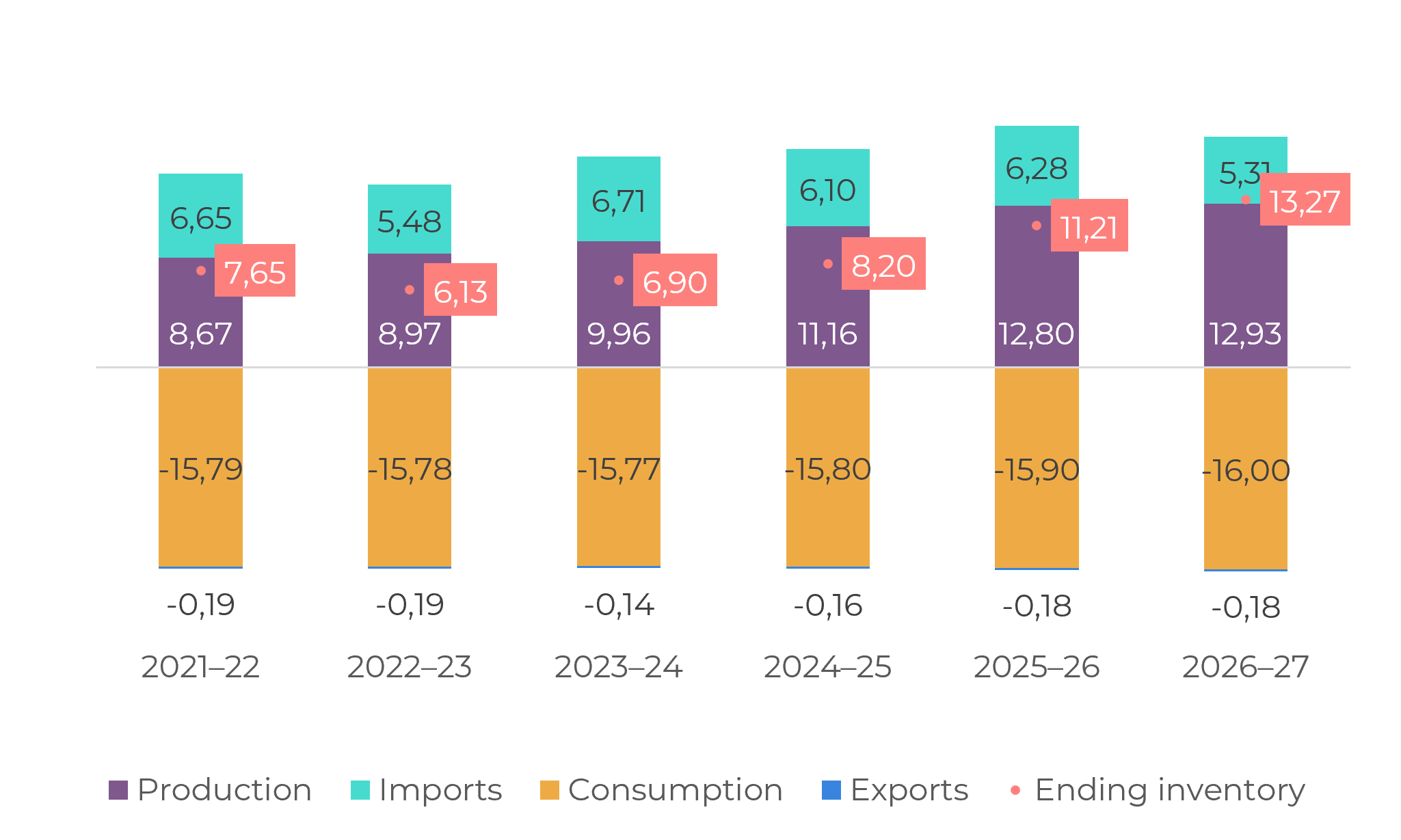
China continues to act as a moderately bearish factor for the international sugar market. Unlike other major importers, the country has been expanding its domestic production and building up stocks, thereby reducing its dependence on the foreign market. For 2026/27, production is expected to be close to 13 million metric tons, while imports are expected to remain below the levels seen in the previous season. The Ministry of Agriculture and Rural Affairs estimates that approximately 4.8Mt of sugar will be imported in the coming season; however, the possibility of a higher price range and the country’s comfortable stock levels lead us to anticipate lower imports, at around 4Mt, as import arbitrage may lose its appeal. 

Thus, although the poor harvest in the Northern Hemisphere provides support for global prices, more cautious Chinese demand may mitigate part of this upward trend and help keep the market in a scenario of moderate surplus.

Sugar Balance Sheet – China (Mt, October–September)
Source: GSMN, CSA, YNTW, Refinitiv, Greenpool, Hedgepoint. Note: Inventories also include volumes held in bonded warehouses.

Brazil

Even with rains delaying the crushing season, the forecast remains virtually unchanged: 635 Mt of sugarcane, an ATR slightly higher than expected, and a sugar-to-ethanol ratio of approximately 47.3%. There is potential for an increase in the sugar mix if prices continue to favor sugar over ethanol. Not only that, but the prospect of a tightening in trade flows in 2027 suggests that the next harvest in Brazil’s Center-South region may be predominantly sugar-oriented. In terms of El Niño, the climate event does not have a strong correlation with sugarcane-producing regions. However, due to its high intensity, we may see heavier rainfall in southern São Paulo and Mato Grosso do Sul during the next months, which could delay the harvest but benefit sugarcane toward the end of the season. El Niño years generally tend to boost yields in the region. 


Crop Summary

Source: UNICA, Hedgepoint

With regard to the NNE, El Niño typically brings drought and higher temperatures. If it occurs in the second half of the year, it could lead to a higher ATR for the 26/27 crop, but if it persists, it could hinder the development of the 27/28 crop.

Global Trade Flow

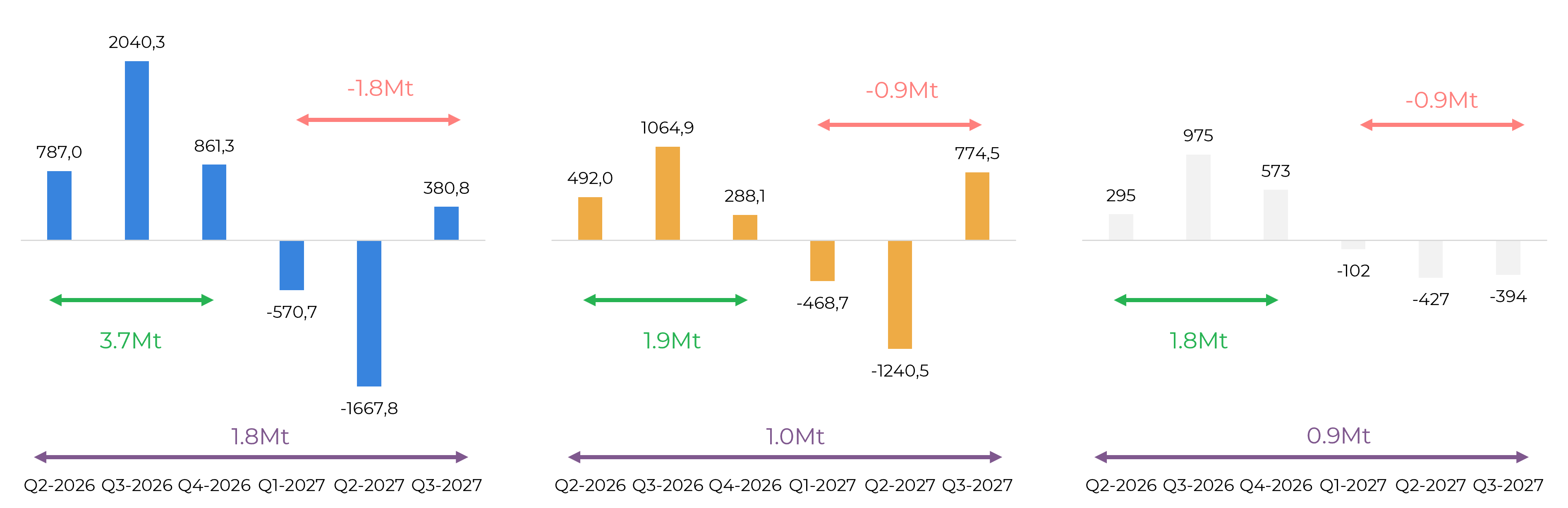
The reduction in exportable supply from the Northern Hemisphere has diminished the expected global market surplus starting in the fourth quarter of 2026. Brazil continues to act as the main supplier balancing the market and is expected to play an even more significant role in 2027/28. Changes in the product mix in the Center-South region may partially mitigate this scenario. Conversely, significant declines that could lead India to import will intensify the global tightness. These trends should be monitored closely.

Total trade flows (left), raw sugar (middle), and white sugar (right) | ‘000t tq 
Source: Green Pool, Hedgepoint

In the domestic scenario, public policies related to the fuel market play a significant role. The possible adoption of a higher blend of anhydrous ethanol in gasoline, E32, could help reduce the sugar surplus, raising the price floor from 14 c/lb to 14.2 c/lb. On the other hand, any gasoline subsidies could have the opposite effect, reducing ethanol’s competitiveness and putting downward pressure on sugar prices. The actual impact of these measures will depend on how they are implemented and the extent to which costs are passed on to the end consumer.

Summary

The global sugar market has become less comfortable compared to the start of the year. Although Brazilian supply remains robust and keeps the global market in surplus, the climate risks associated with the strengthening of El Niño have significantly reduced production prospects for the Northern Hemisphere in its upcoming 26/27 crop year. As a result, the global surplus in trade flows has been revised to approximately 1.8–2 million metric tons, down from the nearly 4 million metric tons previously estimated between the second quarter of 2026 and the third quarter of 2027. This tighter outlook supports a higher price level than that observed in the first half of the year, particularly for 2027 contracts. However, this new range is not expected to match the highs of 2023, as we remain in a surplus and the adverse conditions have so far affected only the Northern Hemisphere, with the Brazilian Center-South still facing a favorable outlook for supply.

Weekly Report — Sugar

Written by Lívea Coda
livea.coda@hedgepointglobal.com

Reviewed by Laleska Moda
laleska.moda@hedgepointglobal.com

Disclaimer

This document has been prepared by Hedgepoint Schweiz AG and its affiliates (“Hedgepoint”) solely for informational and instructional purposes, without intending to create obligations or commitments to third parties. It is not intended to promote or solicit an offer for the sale or purchase of any securities, commodities interests, or investment products.


Hedgepoint and its associates expressly disclaim any liability for the use of the information contained herein that directly or indirectly results in any kind of damages. Information is obtained from sources which we believe to be reliable, but we do not warrant or guarantee the timeliness or accuracy of this information.
The trading of commodities interests, such as futures, options, and swaps, involves substantial risk of loss and may not be suitable for all investors. You should carefully consider wither such trading is suitable for you in light of your financial condition. Past performance is not necessarily indicative of future results. Customers should rely on their own independent judgment and/or consult advisors before entering into any transactions.
Hedgepoint does not provide legal, tax or accounting advice and you are responsible for seeking any such advice separately.
Hedgepoint Schweiz AG is organized, incorporated, and existing under the laws of Switzerland, is filiated to ARIF, the Association Romande des Intermédiaires Financiers, which is a FINMA-authorized Self-Regulatory Organization. Hedgepoint Commodities LLC is organized, incorporated, and existing under the laws of the USA, and is authorized and regulated by the Commodity Futures Trading Commission (CFTC) and a member of the National Futures Association (NFA) to act as an Introducing Broker and Commodity Trading Advisor. HedgePoint Global Markets Limited is Regulated by the Dubai Financial Services Authority. The content is directed at Professional Clients and not Retail Clients. Hedgepoint Global Markets PTE. Ltd is organized, incorporated, and existing under the laws of Singapore, exempted from obtaining a financial services license as per the Second Schedule of the Securities and Futures (Licensing and Conduct of Business) Act, by the Monetary Authority of Singapore (MAS). Hedgepoint Global Markets DTVM Ltda. is authorized and regulated in Brazil by the Central Bank of Brazil (BCB) and the Brazilian Securities Commission (CVM). Hedgepoint Serviços Ltda. is organized, incorporated, and existing under the laws of Brazil. Hedgepoint Global Markets S.A. is organized, incorporated, and existing under the laws of Uruguay. In case of questions not resolved by the first instance of customer contact (client.services@Hedgepointglobal.com), please contact internal ombudsman channel (ombudsman@hedgepointglobal.com – global or ouvidoria@hedgepointglobal.com – Brazil only) or call 0800-8788408 (Brazil only).
Integrity, ethics, and transparency are values that guide our culture. To further strengthen our practices, Hedgepoint has a whistleblower channel for employees and third-parties by e-mail ethicline@hedgepointglobal.com or forms Ethic Line – Hedgepoint Global Markets.
“HedgePoint” and the “HedgePoint” logo are marks for the exclusive use of HedgePoint and/or its affiliates. Use or reproduction is prohibited, unless expressly authorized by HedgePoint.
Furthermore, the use of any other marks in this document has been authorized for identification purposes only. It does not, therefore, imply any rights of HedgePoint in these marks or imply endorsement, association or seal by the owners of these marks with HedgePoint or its affiliates.

To access this report, you need to be a subscriber.