
India, Europe and Brazil Shape the Global Sugar Sentiment
- Macro and geopolitical factors, particularly Middle East tensions, have had a greater impact on prices than sugar-specific news in the past few weeks.
- India remains a bullish risk due to a weaker monsoon and low reservoir levels.
- The European Commission cut sugar production to 14.1 Mt after heatwaves reduced beet yield expectations.
- Brazil's cane output remains strong; however, rains might penalize TRS and sugar mix, suggesting lower sugar production and exports.
- Brazilian exported volume remains resilient despite a weakened Chinese and Indonesian imports.
India, Europe and Brazil Shape the Global Sugar Sentiment
During the past few weeks, the sugar market has been driven more by external macroeconomic and geopolitical factors than by developments in its own fundamentals. Geopolitical tensions returned to the spotlight with the recurring escalation and de-escalation of the US-Iran conflict, directly affecting the energy complex and, in turn, influencing sugar and other commodity markets.
Meanwhile, changes in sugar-specific fundamentals have been limited. The market continues to debate whether climate conditions in India will ultimately lead to sugar import allowances; European weather and crop deterioration are also being closely watched, while UNICA's update on Brazil's Center-South crop remains delayed. Beyond these factors, market news flow has been unusually quiet, leaving participants with few fresh fundamental drivers to reassess price direction.
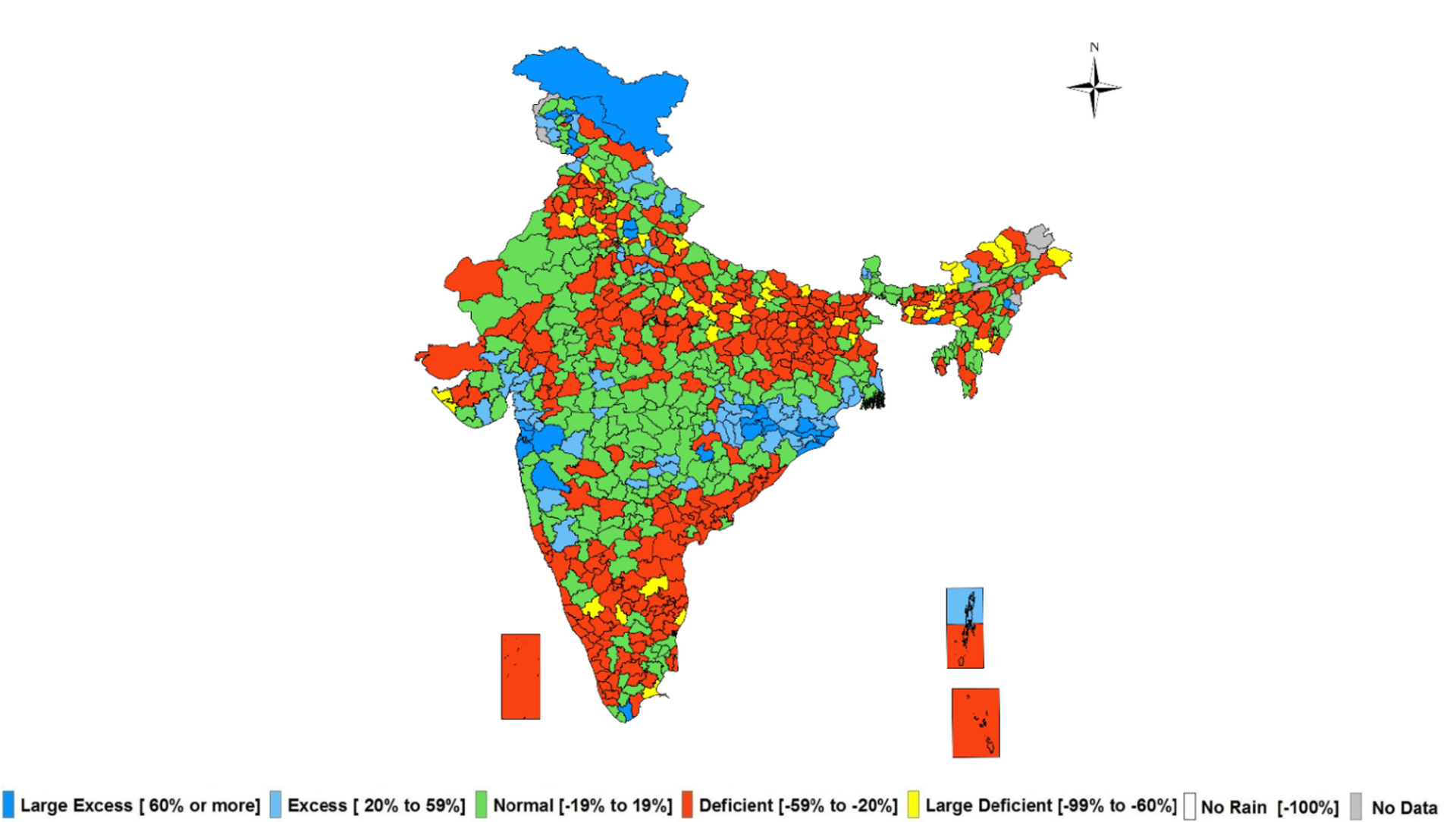
India remains a key bullish factor for sugar, with weaker monsoon conditions forecast for August after near-average rainfall in July. The main cane-producing states with below-average precipitation between June and July were Uttar Pradesh, Tamil Nadu, and Karnataka.
District Rainfall Map (% of normal)
Source: India Meteorological Department
Water availability remains a key risk, as all three states depend heavily on irrigation. Reservoir levels are currently critical in Uttar Pradesh, below normal in Tamil Nadu, and adequate in Karnataka. Given Uttar Pradesh's outsized share of Indian sugarcane production (~45%), its water situation deserves close monitoring.
Despite these concerns, we are not yet including Indian sugar imports in our base case. July rainfall was generally good, and we prefer to wait for August precipitation and reservoir data before considering any meaningful reduction to India's supply outlook.
Europe's sugar availability has been revised down by the European Commission, bringing its outlook more in line with our previous assessment. The region was impacted by three heatwaves in recent months, prompting the Commission to cut its production estimate to 14.1 Mt, down 15% from the previous season, but still more optimistic than our 13.8Mt for Europe & the UK. The agency reduction follows a downward revision in MARS beet yield projections to 76.0 t/ha, compared with 77.7 t/ha in the prior report.
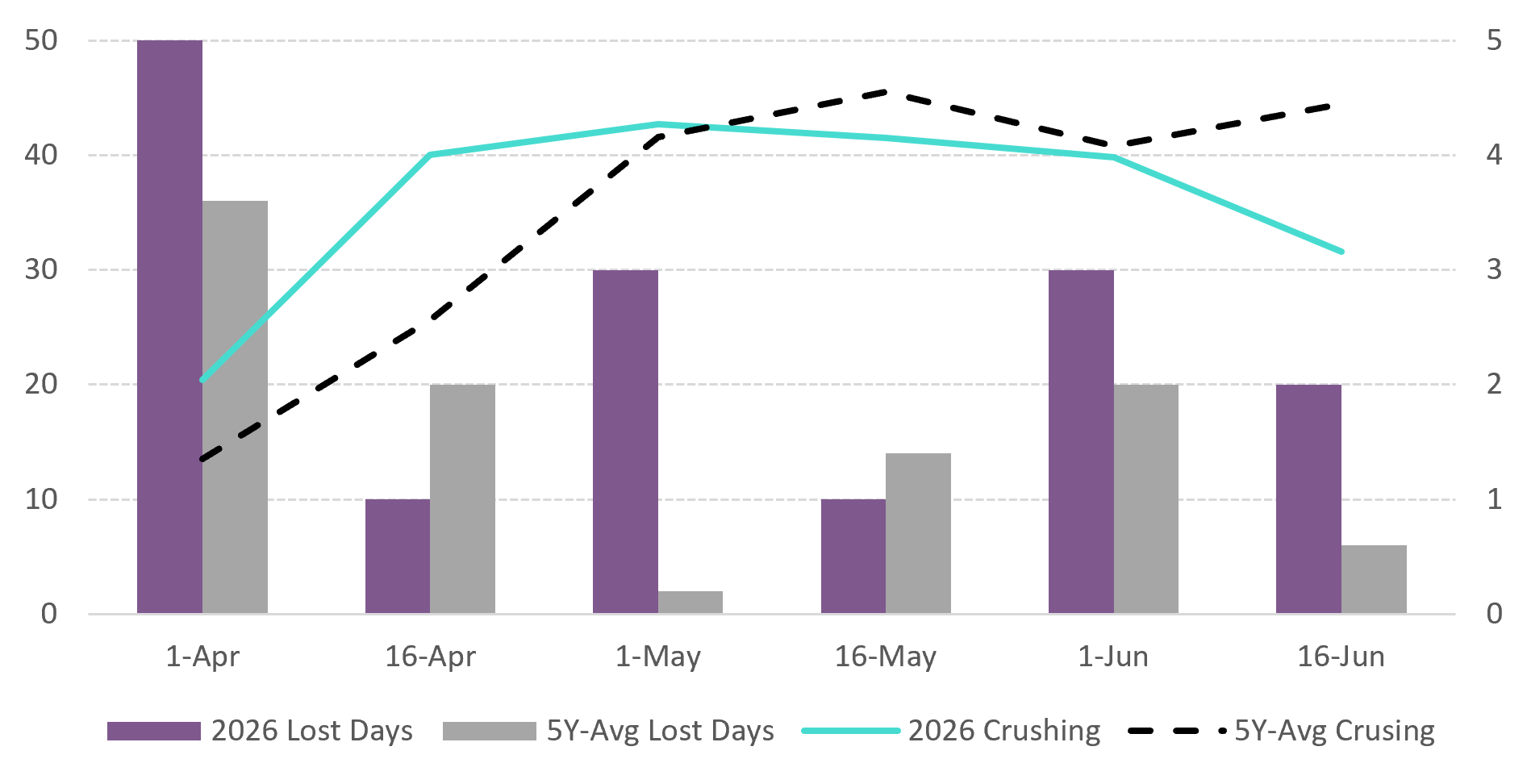
Regarding Brazil, although recent rains have disrupted crushing operations, we remain constructive on cane availability. We currently estimate the Center-South crop at 635.5 Mt, with an additional 5 Mt potentially being carried over from the 2026/25 season into 2027/28 due to the slower harvest pace. Crop conditions also remain favorable, as vegetation health indicators continue to point to strong yield potential. The main area of concern is Total Recoverable Sugar (TRS), which may come in lower than initially expected, closer to 138 kg/t. Even so, a sugar mix of 47.3% would still allow production to reach approximately 39.5 Mt.
Crushing pace x Lost days
Source: Bloomberg, Unica, MAPA, Hedgepoint
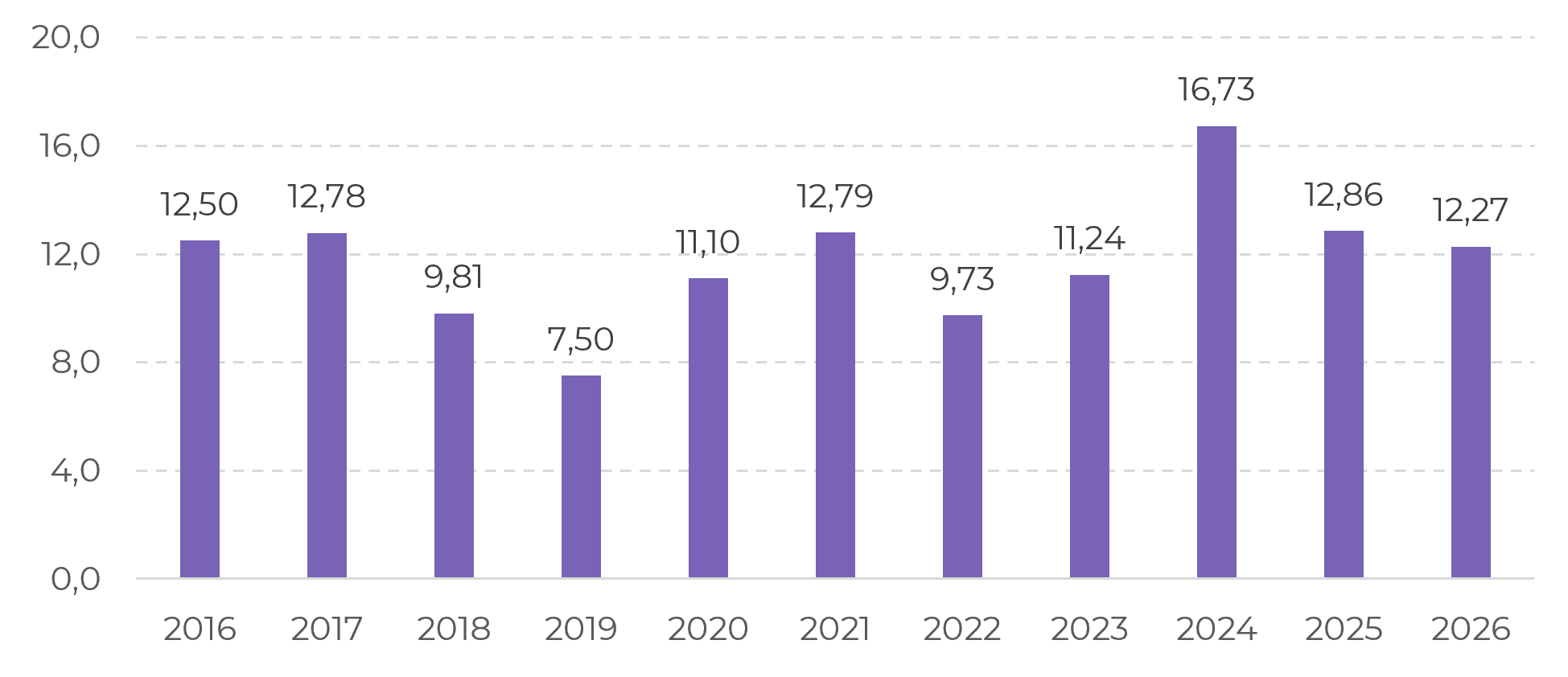
On the export side, our expectation is that due to the lower sugar availability, pushed by a reduced mix and TRS, exports should fall to 30.5Mt in 26/27 compared to 32Mt the prior year. While the weather-related disruptions could suggest a significant slowdown up to date, the actual performance has been more resilient. So far, Brazil has exported 12.3 Mt of sugar, only around 500 kt behind the volume shipped during the same period in 2025 and broadly in line with the five-year average of 12.67 Mt. Neither the rains nor the geopolitical tensions have, therefore, largely constrained exports so far. Nevertheless, since sugar availability remains robust, export flows could still accelerate once precipitation eases.
Brazilian Total Sugar Exports YTD (Mt)
Source: SECEX, Hedgepoint
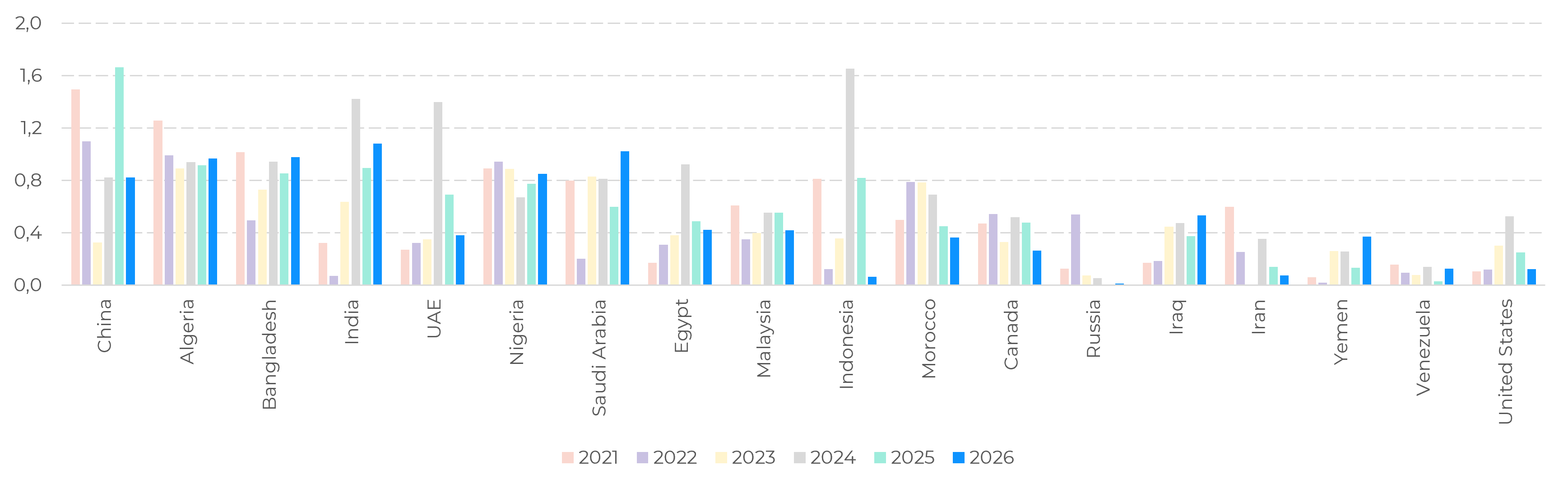
Brazilian Sugar Exports per Country YTD – Top Importers up to 80% of Total (Mt)
Source: SECEX, Hedgepoint
More notably, Chinese demand has weakened amid greater domestic availability, while imports by India have increased. Another important development has been Indonesia's sharp reduction in sugar imports, largely driven by lower import quotas, improved domestic supply, and softer consumption growth. This suggests that in terms of trade-flows, fundamentals keep dictating the market.
Summary
Sugar prices have been driven more by macroeconomic and geopolitical developments than by fundamentals in the short term. Key market themes remain: India's weather outlook, Europe's crop deterioration, and Brazil's production prospects. While India and Europe present risks to supply and therefore, add to the bullish side of the equation, Brazil continues to show strong cane availability and exports despite weather-related disruptions to harvesting.
Weekly Report — Sugar
Reviewed by Laleska Moda
laleska.moda@hedgepointglobal.com
Disclaimer
This document has been prepared by Hedgepoint Schweiz AG and its affiliates (“Hedgepoint”) solely for informational and instructional purposes, without intending to create obligations or commitments to third parties. It is not intended to promote or solicit an offer for the sale or purchase of any securities, commodities interests, or investment products.