Brazil's crop puzzle: bigger cane, less sugar
- UNICA delays boosted uncertainty in the market, but MAPA has come to the rescue.
- Cane crushing recovered some ground through July’s first fortnight;
- Cane quality and sugar mix remained subdued.
- Sugar output is seen at 39.5 Mt, despite mills' efforts to maximize sugar due to weather conditions expectations.
- Higher prices, but limited upside as Brazil remains a reliable source of sugar.
Brazil's crop puzzle: bigger cane, less sugar
While the market continues to watch Northern Hemisphere crop development for direction, attention shifted back to Brazil's Center-South over the past week. Delays in Unica's data release have fueled market speculation, while wetter weather prospects have provided some support to bullish sentiment. The week was marked by the publication of Unica's June figures, released with a two-month delay, alongside MAPA's July first fortnight data. Although both sets of figures offered supportive signals, they require careful interpretation. In this report, we assess these results and their potential implications for sugar prices.
UNICA's cumulative figures through July 1 totaled 214.5 Mt of cane and 10.75 Mt of sugar, representing a nearly 4% increase in cane processing and a 12.4% decline in sugar production year-on-year. What explains these numbers?
The season began under a comfortable global sugar trade-flow scenario. Expectations of a recovering 2025/26 Northern Hemisphere crop and a robust 2026/27 season in the Brazilian Center-South pointed to a sizeable global surplus. As a result, the most efficient way to absorb the additional sugar availability was through stronger ethanol demand, incentivized by lower hydrous ethanol prices due to a reduction in sugar mix by the mills – respecting the advantage ethanol was paying over sugar during the time.
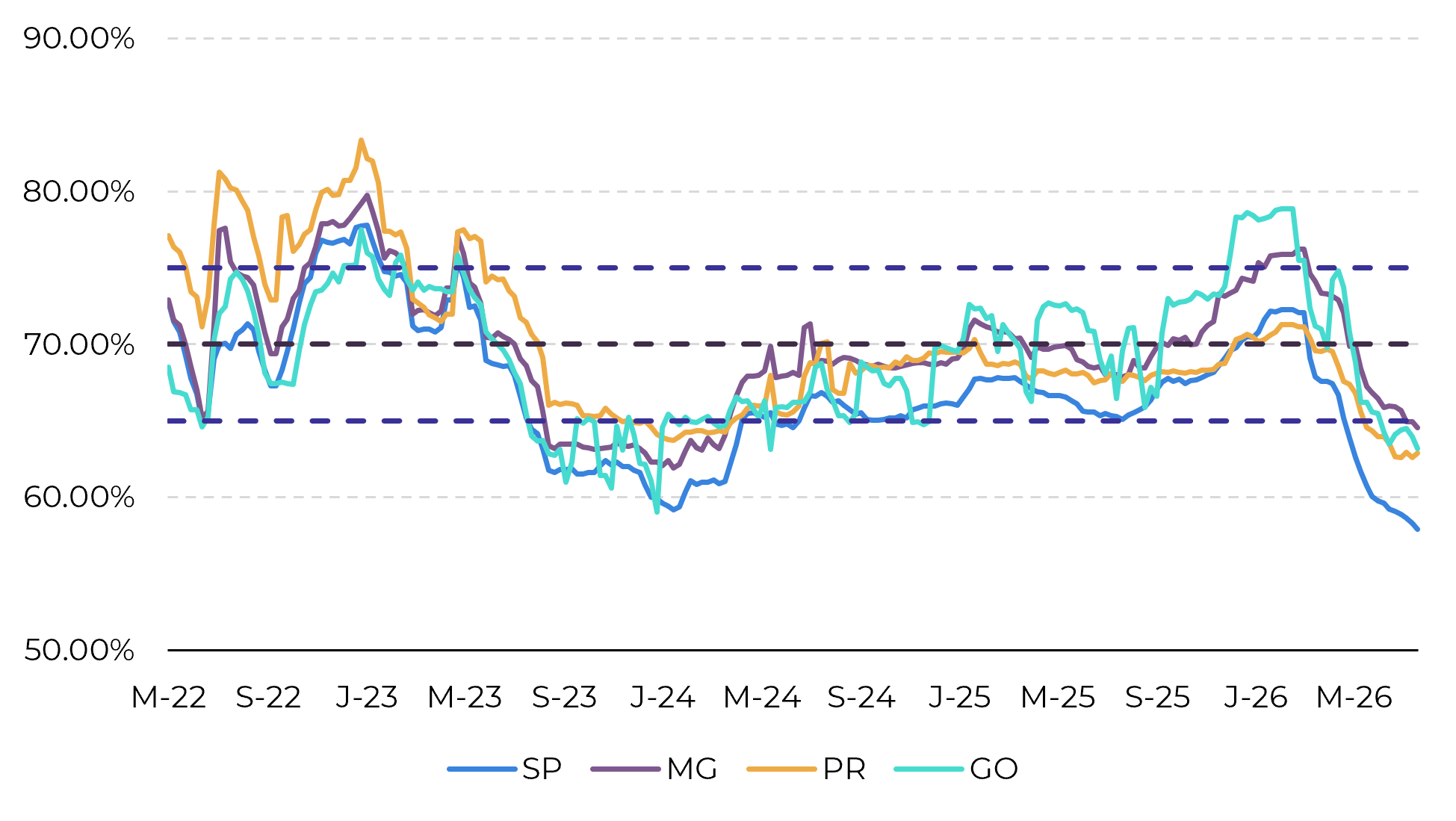
This adjustment materialized, with hydrous prices correcting significantly, as discussed in our previous reports (link). Pump parity has since become highly favorable for the biofuel in key sugar and ethanol-producing states and is increasingly open in states such as Amazonas (NNE), Acre (NNE), Bahia (NNE), and Paraná (CS).
Pump parity in states (%)
Source: ANP, Hedgepoint
At the same time, a strong El Niño pattern began to emerge, threatening Northern Hemisphere 2026/27 production prospects while also disrupting crushing operations in Brazil's Center-South. This added another layer of uncertainty to the market, particularly as UNICA, the region's most reliable source of crop data, experienced significant reporting delays, leaving market participants with limited visibility on harvest progress and crop performance, and increasing their reliance on MAPA's data as a more timely indicator of crop performance. Therefore, the reported lower crushing volumes in June due to rainfall were already widely expected when the Unica report was published last week.
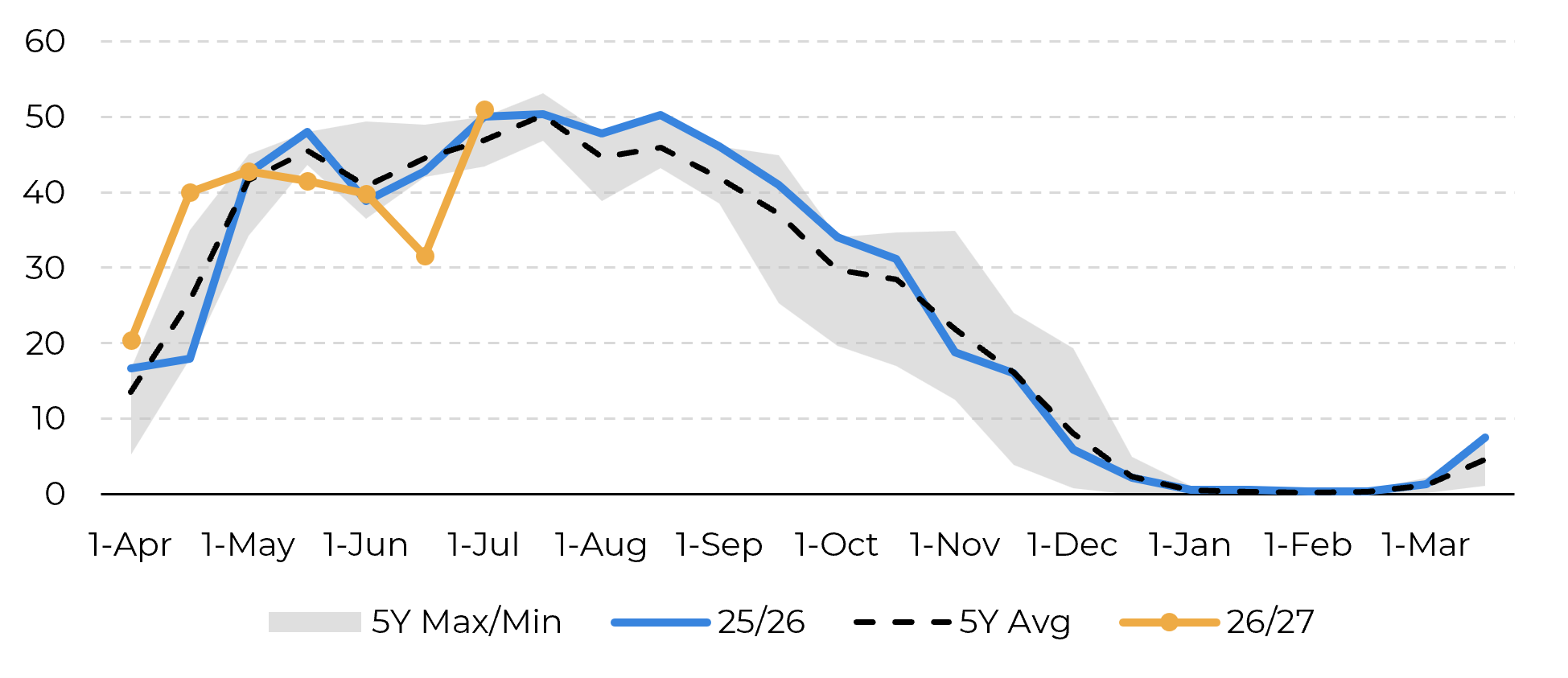
MAPA's figures for the first half of July, however, provided a more nuanced picture. Cane crushing reached 50.9 Mt, approximately 9% above the five-year average for the period, reinforcing our estimate of a 635.5 Mt Center-South crop. On the other hand, the report was more supportive from a sugar market perspective. Although mills started to maximize sugar production, supported by a sugar premium of roughly 200 points over hydrous ethanol during most of July, the sugar mix remained at 49%, below the five-year average of 50% for the period. In addition, Total Recoverable Sugar (TRS) stood at 134.6 kg/t, around 4% lower year-on-year. This indicator suggests limitations to final cane quality and, consequently, sugar output. We currently estimate Center-South sugar production at 39.5 Mt, a level that would constrain exports and provide support to prices. These results are attributed to higher precipitation levels.
Bi-weekly cane crushing at Center-South mills (M ton)
Source: UNICA, MAPA, Hedgepoint
Excessive rainfall, combined with warm temperatures and limited sunlight, shifts the cane's physiological focus from accumulating sucrose to vegetative growth. This typically results in lower sugar concentration and higher fiber content, reducing sugar extraction efficiency, besides disrupting harvesting activities. These concerns were among the key drivers behind last week's price rally and support the potential for a higher trading range moving forward.
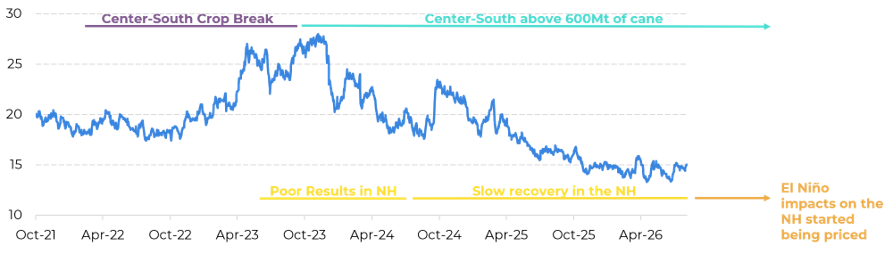
Nevertheless, while some Center-South cane may remain unharvested and carry over into the following season, we believe the upside for prices remains limited. Unlike previous periods of tightness driven by simultaneous crop disappointments in both Brazil and the Northern Hemisphere, Brazil is still expected to produce more than 600 Mt of cane. This points to a strong crop overall, even if sugar production falls short of its maximum potential. Furthermore, firmer prices could encourage additional switching toward sugar production, a scenario already incorporated into our 2026/27 balance sheet.
Raw sugar prices (c/lb)
Source: LSEG, Hedgepoint
Precipitation anomaly forecast (mm – August (left), September (Center) and October (Right)
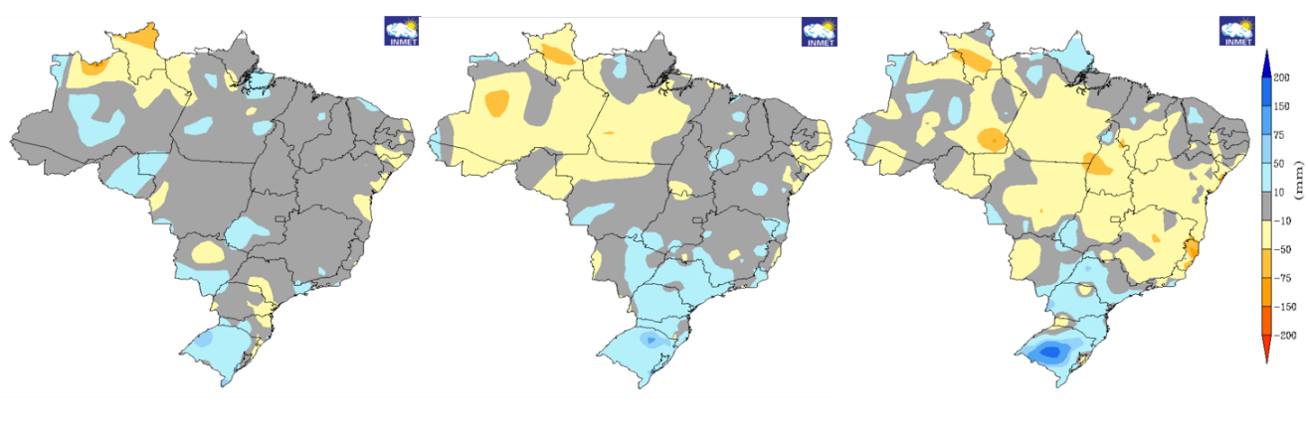
Source: Inmet
Summary
Market attention shifted back to Brazil's Center-South as delayed UNICA data and precipitation increased uncertainty around Brazilian Center-South’s crop performance. While MAPA's July figures reinforced expectations for a large cane crop, lower TRS and a below-average sugar mix suggest limited sugar production potential. Therefore, excessive rainfall is supporting a more constructive price outlook by affecting cane quality and harvesting, though Brazil's large crop should continue to cap major upside moves.
Weekly Report — Sugar
Reviewed by Laleska Moda
laleska.moda@hedgepointglobal.com
Disclaimer
This document has been prepared by Hedgepoint Schweiz AG and its affiliates (“Hedgepoint”) solely for informational and instructional purposes, without intending to create obligations or commitments to third parties. It is not intended to promote or solicit an offer for the sale or purchase of any securities, commodities interests, or investment products.
Hedgepoint and its associates expressly disclaim any liability for the use of the information contained herein that directly or indirectly results in any kind of damages. Information is obtained from sources which we believe to be reliable, but we do not warrant or guarantee the timeliness or accuracy of this information.
The trading of commodities interests, such as futures, options, and swaps, involves substantial risk of loss and may not be suitable for all investors. You should carefully consider wither such trading is suitable for you in light of your financial condition. Past performance is not necessarily indicative of future results. Customers should rely on their own independent judgment and/or consult advisors before entering into any transactions.
Hedgepoint does not provide legal, tax or accounting advice and you are responsible for seeking any such advice separately.
Hedgepoint Schweiz AG is organized, incorporated, and existing under the laws of Switzerland, and a member of ARIF. ARIF (Association Romande des Intermédiaires Financiers) is a self-regulatory organization approved by the Swiss Financial Market Supervisory Authority (FINMA) for the supervision of financial intermediaries covered under Article 2, paragraph 3, of the Swiss Federal Act on Combating Money Laundering and Terrorist Financing in the Financial Sector (AMLA). Hedgepoint Commodities LLC is organized, incorporated, and existing under the laws of the USA, and is authorized and regulated by the Commodity Futures Trading Commission (CFTC) and a member of the National Futures Association (NFA) to act as an Introducing Broker and Commodity Trading Advisor. Hedgepoint Global Markets Limited is Regulated by the Dubai Financial Services Authority. The content is directed at Professional Clients and not Retail Clients. Hedgepoint Global Markets PTE. Ltd is organized, incorporated, and existing under the laws of Singapore and is classified as exempted from holding a capital markets services licence under paragraph 3A(1)(d) of the Second Schedule to the Securities and Futures (Licensing and Conduct of Business) Regulations (Rg 10). Hedgepoint Global Markets DTVM Ltda. is authorized and regulated in Brazil by the Central Bank of Brazil (BCB) and the Brazilian Securities Commission (CVM). Hedgepoint Serviços Ltda. is organized, incorporated, and existing under the laws of Brazil. Hedgepoint Global Markets S.A. is organized, incorporated, and existing under the laws of Uruguay.
In case of questions not resolved by the first instance of customer contact (client.services@Hedgepointglobal.com), please contact internal ombudsman channel (ombudsman@hedgepointglobal.com – global or ouvidoria@hedgepointglobal.com – Brazil only) or call 0800-8788408 (Brazil only).
Integrity, ethics, and transparency are values that guide our culture. To further strengthen our practices, Hedgepoint has a whistleblower channel for employees and third-parties by e-mail ethicline@hedgepointglobal.com.
“Hedgepoint” and the “Hedgepoint” logo are marks for the exclusive use of Hedgepoint and/or its affiliates. Use or reproduction is prohibited, unless expressly authorized by Hedgepoint.
Furthermore, the use of any other marks in this document has been authorized for identification purposes only. It does not, therefore, imply any rights of Hedgepoint in these marks or imply endorsement, association or seal by the owners of these marks with Hedgepoint or its affiliates.