Outlook 2026: Northern Hemisphere risks rose, but Brazil keeps the market supplied
Outlook 2026: Northern Hemisphere risks rose, but Brazil keeps the market supplied
The global sugar market has undergone a significant change in perception over recent months. While concerns surrounding the 2026/27 Northern Hemisphere crop have intensified and weather-related risks have reduced the previously expected surplus, the market remains fundamentally supplied. The key difference today is that the margin of comfort has narrowed. Prices have responded accordingly, moving away from the lows observed earlier in the year and entering a higher trading range as participants reassessed risks associated with El Niño, geopolitics, inflation, and tighter export availability from major producers outside Brazil.
Even so, the central message remains unchanged: Brazil continues to be the supplier capable of balancing the global market and preventing a sustained shift into a structural deficit. Despite production problems spreading across several Northern Hemisphere origins, Brazil's abundant cane availability and capacity to adjust its sugar mix provide a powerful counterbalance that keeps the market fundamentally comfortable.
The macroeconomic backdrop remains complex. Geopolitical tensions involving the Middle East have contributed to higher volatility across commodity markets through their impact on energy prices. Oil, refined fuels, and natural gas have remained supported, increasing production and transportation costs throughout agricultural supply chains. At the same time, global inflation has reaccelerated in several economies, forcing central banks to maintain relatively restrictive monetary policies. In the United States, inflation remains above the Federal Reserve's target, and despite weaker employment indicators at times, the market continues to price a cautious monetary policy stance. These developments have created periods of strength in the US dollar and intermittent pressure on emerging markets and commodities. Nevertheless, investors appear increasingly comfortable separating macroeconomic noise from agricultural fundamentals, allowing sugar-specific developments to regain prominence.
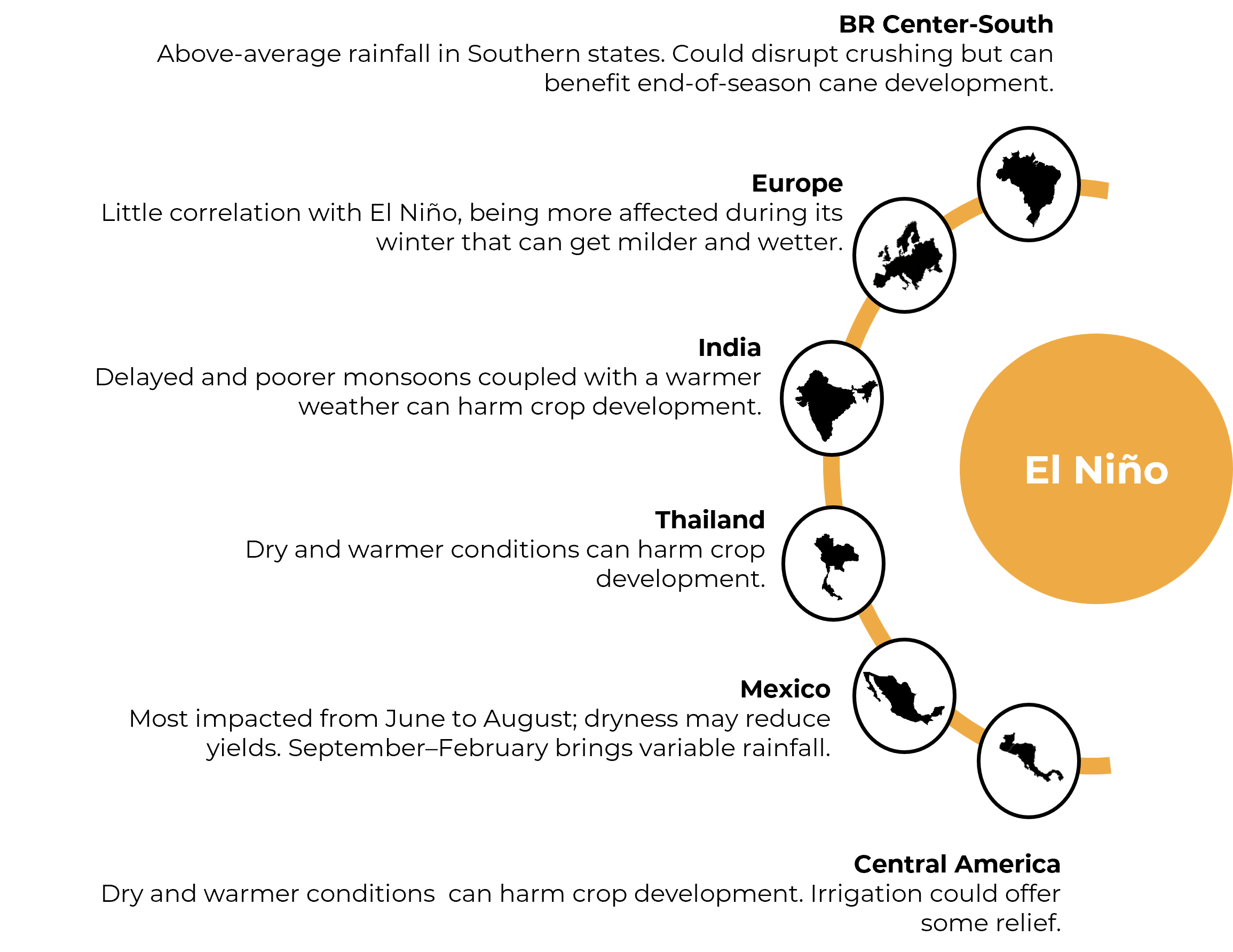
The largest source of uncertainty for sugar remains the emergence of a strong to very strong El Niño event. Climate models suggest a high probability that El Niño reaches exceptional intensity during the key development stages of several Northern Hemisphere sugar-producing regions. Historically, Thailand, India, Central America, and Mexico have shown considerable vulnerability to drought, excessive heat, and reduced rainfall associated with strong El Niño episodes. Consequently, production expectations have been revised down across multiple origins.
El Niño main effects on sugar-producing countries
Source: Hedgepoint
India remains the most critical variable. After a delayed monsoon onset, rainfall improved during July, but forecasts point toward below-average precipitation during the remainder of the season. Reservoir conditions remain concerning in important sugarcane-producing regions, and weather forecasts indicate increasing dryness during key development stages. Production is currently estimated near 27.6 Mt, below recent seasons and insufficient to generate exportable availability. The country's sugar balance remains tight, and there is growing concern that a more severe weather deterioration could force imports, with 1 Mt already approved by the government. This news led the market to test the 18c/lb level; however, prices failed to sustain those gains as healthy advances in Center-South harvesting contribute to a still over-supplied market.
Thailand has already suffered downward revisions. Below-average rainfall across major sugarcane regions and forecasts for drier conditions over the remainder of the cycle led to a reduction in expected cane crushing to approximately 88 Mt. As a result, sugar production is expected near 9.5 Mt and exports around 6 Mt, significantly below recent export levels. Because Thailand is one of the world's most important raw and white sugar exporters, this reduction affects both raw sugar availability and the refined sugar market, helping explain the firmness observed in the white premium.
Europe has also become a more supportive factor. Three consecutive heatwaves combined with dry conditions across France, Germany, and Poland have pressured beet yields. The European Commission has revised production lower, and current expectations point to regional output near 14 Mt. Lower European output increases import requirements and reduces export capacity, tightening regional availability and contributing to a firmer outlook for refined sugar.
Elsewhere, production prospects remain mixed. Mexico and Central America face weather-related concerns linked to El Niño, while Ukraine is facing reduced planted area, lower export opportunities into Europe, and persistent disruptions associated with the war. Russia remains one of the few relatively stable producers. China, meanwhile, continues to expand domestic production and build inventories. Chinese sugar output is expected to close at 13 Mt, while imports are likely to remain below previous expectations as comfortable stocks and weaker import arbitrage reduce dependency on international supplies.
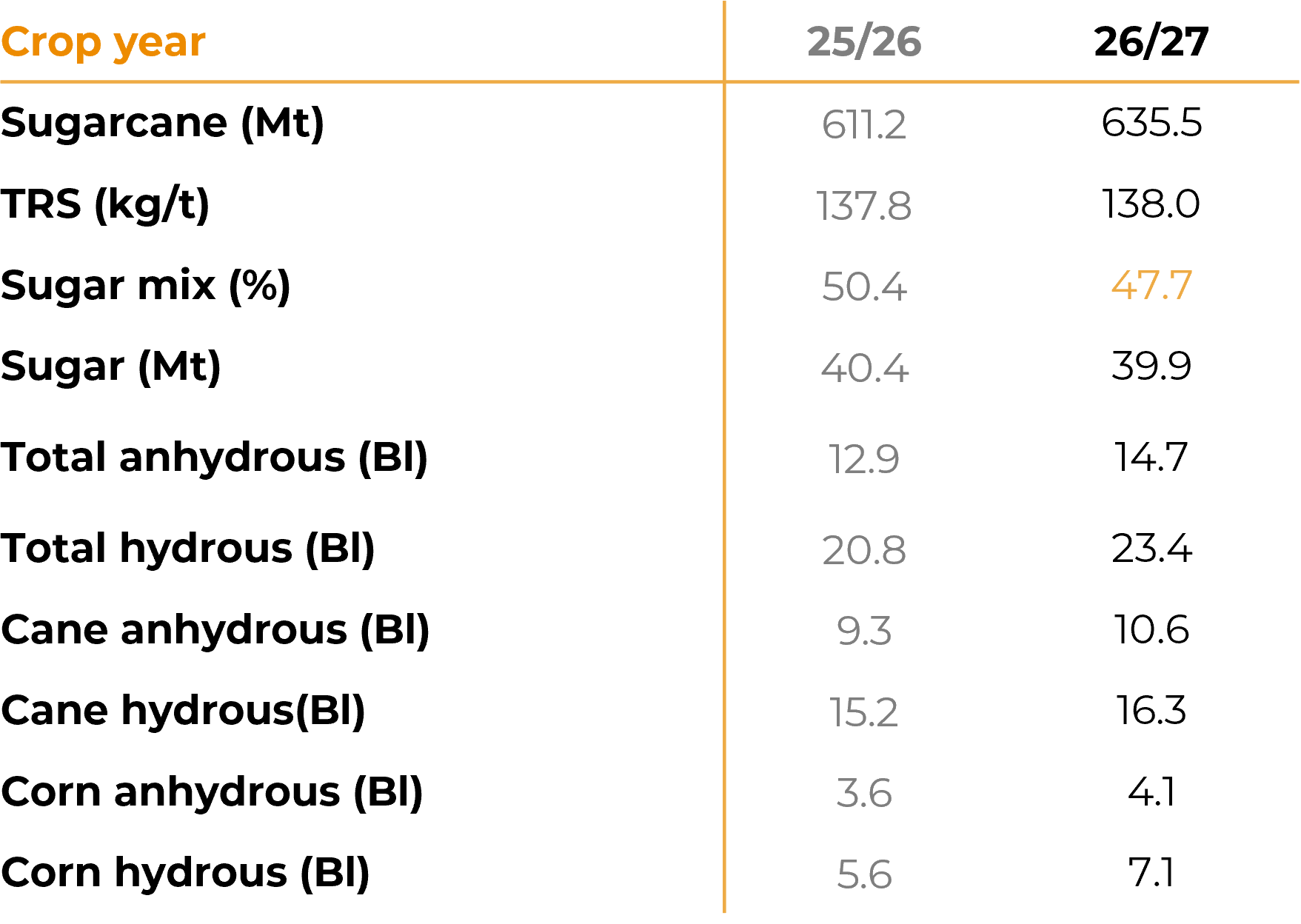
Against this backdrop of tightening Northern Hemisphere supply, Brazil remains the decisive element. Recent rains have disrupted harvesting operations and reduced crushing pace below potential. However, these delays should not be confused with a reduction in cane availability. Current estimates point to a crop of approximately 635.5 Mt, representing growth from the previous season and one of the largest crops in history. Cane health indicators, rainfall patterns, vegetation indices, and fertilizer availability all support constructive expectations for both current and future production.
The most important implication is that Brazil possesses sufficient raw material availability to respond to higher sugar prices. Whenever international prices move sufficiently above ethanol parity, mills have economic incentives to direct a larger share of cane toward sugar production. While excessive rainfall has prevented a more aggressive sugar mix response during portions of the current season, the underlying flexibility remains intact. Even under conservative assumptions – such as a 47.7% sugar mix - Brazilian sugar production remains near 40 Mt.
26/27 Crop Year estimate for Center-South
Source: Hedgepoint
This flexibility differentiates the current environment from previous bull markets. During earlier periods when sugar prices exceeded 25 c/lb, production difficulties affected both Brazil and the Northern Hemisphere simultaneously. Today, the Northern Hemisphere is facing increasing weather risks, but Brazil is not. While a strong El Niño can bring above-average rainfall to parts of southern Brazil and create harvesting disruptions, historical evidence suggests that severe yield losses are not a typical outcome.
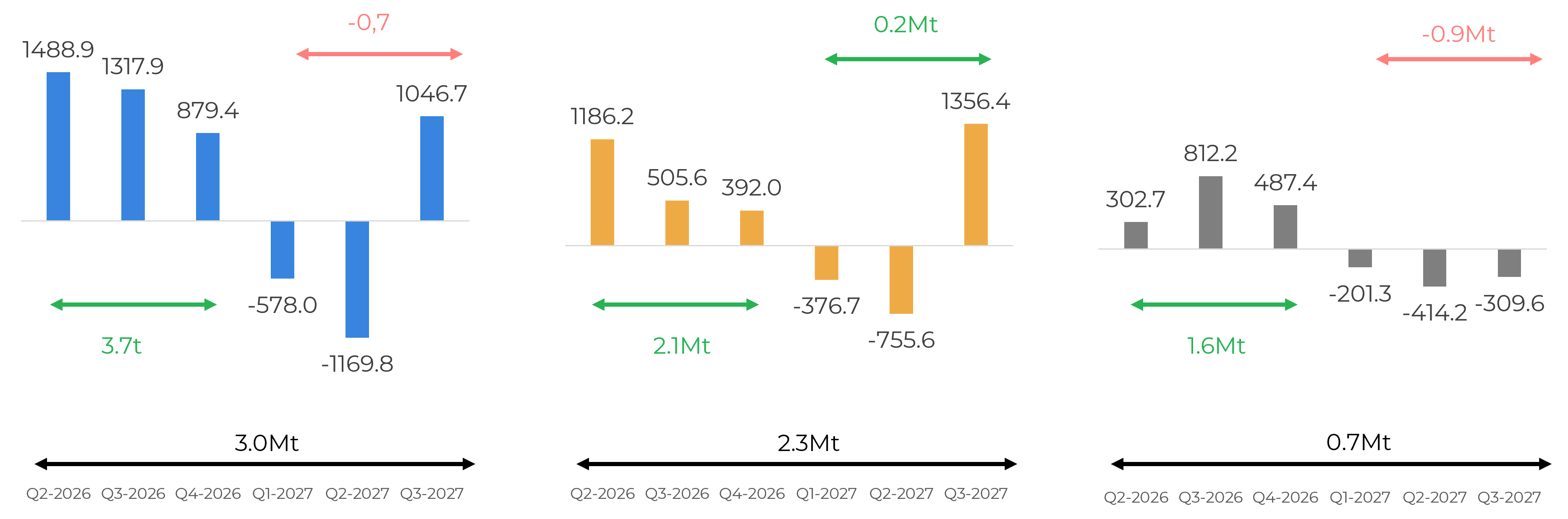
Global trade flows illustrate this dynamic clearly. Export availability is declining in several regions, reducing the projected surplus and creating tighter conditions throughout 2027. Yet Brazil remains capable of offsetting much of that tightening. Even under more conservative Brazilian scenarios characterized by a lower sugar mix, global trade flows remain in surplus. The market is becoming less comfortable, but not truly short of sugar. Should Brazil increase its sugar mix in response to stronger prices, the surplus expands again, and market tightness eases.
Considering 47.7% sugar mix, total trade flows (left), raws’ trade flows (center) and whites’ trade flows (right) in thousand tons tel quel
Source: GreenPool, Hedgepoint
Considering 47.1% sugar mix, total trade flows (left), raws’ trade flows (center) and whites’ trade flows (right) in thousand tons tel quel
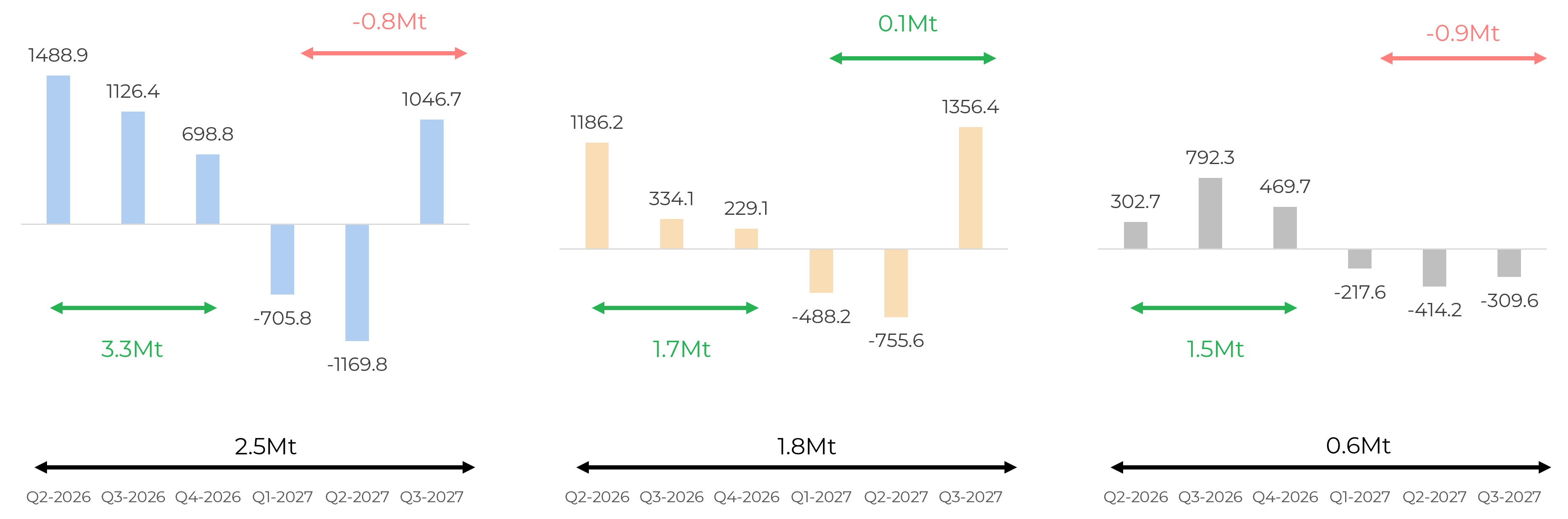
Source: GreenPool, Hedgepoint
Indian imports would reduce by 1Mt both scenarios, maintaining a surplus in global trade flows – 47.1% sugar mix (left) and 47.7% sugar mic (right)
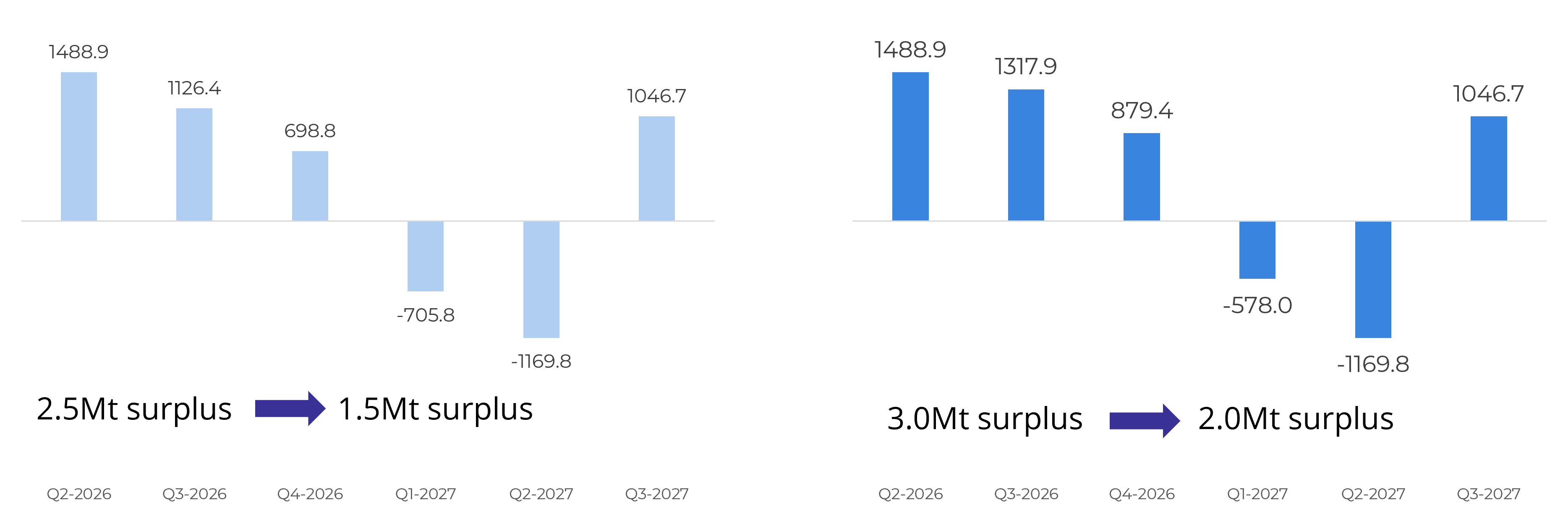
Source: Green Pool, Hegepoint
The outlook for H2 2026 and early 2027 is therefore one of moderate tightening rather than structural shortage. El Niño is reducing global supply potential and justifying higher prices than those observed earlier this year. However, Brazil's large crop, substantial cane availability, and capacity to increase sugar production if necessary, prevent the market from entering a truly uncomfortable situation. In short, the market is becoming tighter, but Brazil still has enough sugar to keep the global balance comfortable.
Summary
The global sugar market has entered a more balanced phase, driven by rising weather-related risks in the Northern Hemisphere - particularly due to El Niño - which have lowered production outlooks in key regions such as India, Thailand, and Europe. Despite this tighter supply scenario and the recovery in prices, the market remains well-supplied thanks to abundant sugarcane availability in Brazil, which continues to act as the primary factor balancing the global market. Want to understand the impacts of weather, macroeconomics, and Brazil's role in price dynamics? Watch the full recording of the "Second Half of 2026 Outlook" on the Hedgepoint HUB via the link.
Weekly Report — Sugar
Reviewed by Laleska Moda
laleska.moda@hedgepointglobal.com
Disclaimer
This document has been prepared by Hedgepoint Schweiz AG and its affiliates (“Hedgepoint”) solely for informational and instructional purposes, without intending to create obligations or commitments to third parties. It is not intended to promote or solicit an offer for the sale or purchase of any securities, commodities interests, or investment products.
Hedgepoint and its associates expressly disclaim any liability for the use of the information contained herein that directly or indirectly results in any kind of damages. Information is obtained from sources which we believe to be reliable, but we do not warrant or guarantee the timeliness or accuracy of this information.
The trading of commodities interests, such as futures, options, and swaps, involves substantial risk of loss and may not be suitable for all investors. You should carefully consider wither such trading is suitable for you in light of your financial condition. Past performance is not necessarily indicative of future results. Customers should rely on their own independent judgment and/or consult advisors before entering into any transactions.
Hedgepoint does not provide legal, tax or accounting advice and you are responsible for seeking any such advice separately.
Hedgepoint Schweiz AG is organized, incorporated, and existing under the laws of Switzerland, and a member of ARIF. ARIF (Association Romande des Intermédiaires Financiers) is a self-regulatory organization approved by the Swiss Financial Market Supervisory Authority (FINMA) for the supervision of financial intermediaries covered under Article 2, paragraph 3, of the Swiss Federal Act on Combating Money Laundering and Terrorist Financing in the Financial Sector (AMLA). Hedgepoint Commodities LLC is organized, incorporated, and existing under the laws of the USA, and is authorized and regulated by the Commodity Futures Trading Commission (CFTC) and a member of the National Futures Association (NFA) to act as an Introducing Broker and Commodity Trading Advisor. Hedgepoint Global Markets Limited is Regulated by the Dubai Financial Services Authority. The content is directed at Professional Clients and not Retail Clients. Hedgepoint Global Markets PTE. Ltd is organized, incorporated, and existing under the laws of Singapore and is classified as exempted from holding a capital markets services licence under paragraph 3A(1)(d) of the Second Schedule to the Securities and Futures (Licensing and Conduct of Business) Regulations (Rg 10). Hedgepoint Global Markets DTVM Ltda. is authorized and regulated in Brazil by the Central Bank of Brazil (BCB) and the Brazilian Securities Commission (CVM). Hedgepoint Serviços Ltda. is organized, incorporated, and existing under the laws of Brazil. Hedgepoint Global Markets S.A. is organized, incorporated, and existing under the laws of Uruguay.
In case of questions not resolved by the first instance of customer contact (client.services@Hedgepointglobal.com), please contact internal ombudsman channel (ombudsman@hedgepointglobal.com – global or ouvidoria@hedgepointglobal.com – Brazil only) or call 0800-8788408 (Brazil only).
Integrity, ethics, and transparency are values that guide our culture. To further strengthen our practices, Hedgepoint has a whistleblower channel for employees and third-parties by e-mail ethicline@hedgepointglobal.com.
“Hedgepoint” and the “Hedgepoint” logo are marks for the exclusive use of Hedgepoint and/or its affiliates. Use or reproduction is prohibited, unless expressly authorized by Hedgepoint.
Furthermore, the use of any other marks in this document has been authorized for identification purposes only. It does not, therefore, imply any rights of Hedgepoint in these marks or imply endorsement, association or seal by the owners of these marks with Hedgepoint or its affiliates.