
Sugar | Short-term shows signs of tightening
- Center-South results disappointed in early August, reinforcing concerns over short-term sugar availability.
- Volatile weather linked to the super El Niño continues to disrupt crushing, TRS recovery, and sugar mix performance.
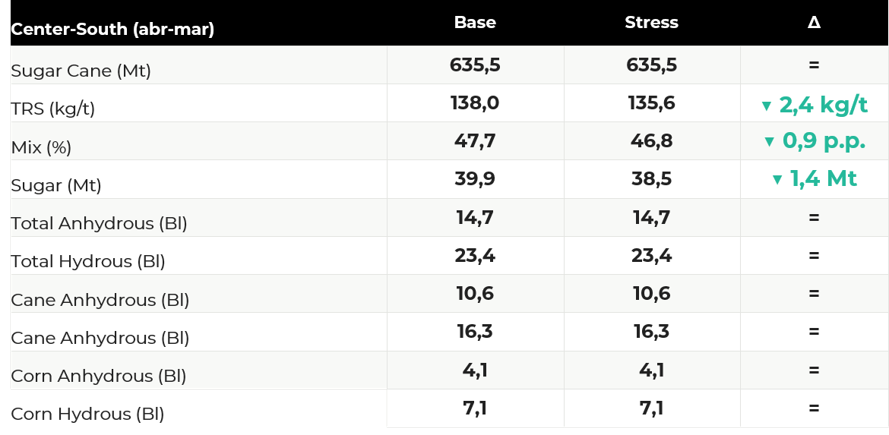
- We lowered our sugar production forecast by 1.4 Mt to 38.5 Mt, reducing export availability.
- Tighter supply prospects in Brazil, combined with weaker crops in India and the EU, support prices above 18 c/lb; however, we are not at a severe shortage scenario.
- Expectations of stronger cane availability and a higher sugar mix in CS in 2027/28 remain the main bearish factor.
Short-term shows signs of tightening
The sugar market has continued to test new highs, but unlike in recent weeks, data from Brazil's Ministry of Agriculture (MAPA) suggests that one of the market's key bearish arguments is losing strength. The first-half August results for the Brazilian Center-South were weaker than expected, raising concerns over the region's production potential and challenging assumptions of abundant sugar availability in the short-term.
Center-South crushing has been on a roller coaster this season. Cane processing recovered sharply from 31.15 million tons in the second half of June to 50.6 million tons in the first half of July, before easing to 46.08 million tons and then rebounding to 48.4 million tons in the first half of August, according to MAPA. This volatility reflects the irregular rainfall pattern associated with the ongoing super El Niño.
MAPA’s latest data per fortnight
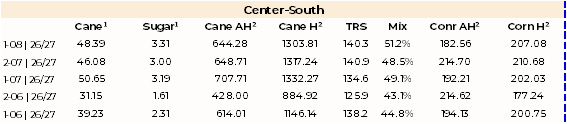
Source MAPA. Obs: ¹- million tons ,² - thousands of liters; ³ - kg of TRS/ton of cane
Over the same period, the ethanol mix increased steadily from 43.1% to 51.2%. Despite this improvement, it remains below the level that would be expected given the current price advantage of sugar over ethanol. Meanwhile, TRS rose from 138.0 kg/t to a peak of 141.0 kg/t before stabilizing at 140.3 kg/t. Although improving, TRS remains well below the five-year average of 149.5 kg/t for the period, largely due to unfavorable harvesting conditions and thus contributing to the mill’s mix change challenges.
As a result, we have revised both our sugar mix and TRS assumptions for the season, reducing sugar production and export availability. This adjustment comes despite vegetation health indicators continuing to point to strong cane yields and robust crop volumes.
Before discussing our expectations, it is worth addressing the delay in UNICA's reporting. Currently, UNICA data is running two months behind MAPA's figures. While the latest available report from the agency is from June’s second fortnight, the Ministry has already released August first half. Nevertheless, the data available paints a similar picture of a crop that is increasingly geared toward ethanol production, though not necessarily by choice.
As of the second half of June, cumulative cane crushing reached 214.5 million tons according to UNICA, up 3.8% year-over-year. Despite the larger crop, sugar production fell 12.4% to 10.75 million tons, while ethanol output surged 20.4% to 11.37 billion liters. This shift was driven by a substantial increase in the ethanol mix, which rose from 49.0% to 57.5%, reducing the sugar mix from 51.0% to 42.5% throughout the period. The data reinforces the view that operational and weather-related challenges have constrained sugar production, even as cane availability has remained supportive.
A comparison between the two databases for June confirms broadly similar trends, although some differences remain. MAPA reported slightly higher cane crushing than UNICA (70.39 million versus 69.79 million tons) and marginally higher sugar production (3.922 million versus 3.903 million tons). However, substantial discrepancies emerged in ethanol volumes, with MAPA showing significantly lower anhydrous ethanol production but higher hydrous ethanol output. TRS values were nearly identical between the two sources, while the sugar mix differed by less than half a percentage point.
As a result, we have shifted our base case further down our stress scenario outlined in previous reports (link). We now expect the sugar mix to remain near 46.8%, while TRS is unlikely to exceed 135.6 kg/t for the season – especially after a rainy start in September and current weather forecasts. Keeping our cane volume expectations unchanged at 635.5 Mt, these assumptions imply a reduction of 1.4Mt in sugar production, now projected at 38.5 Mt. This downward revision directly reduces export availability and tightens the global trade balance.
Brazilian Center-South Revision Summary
Source: Headgepoint
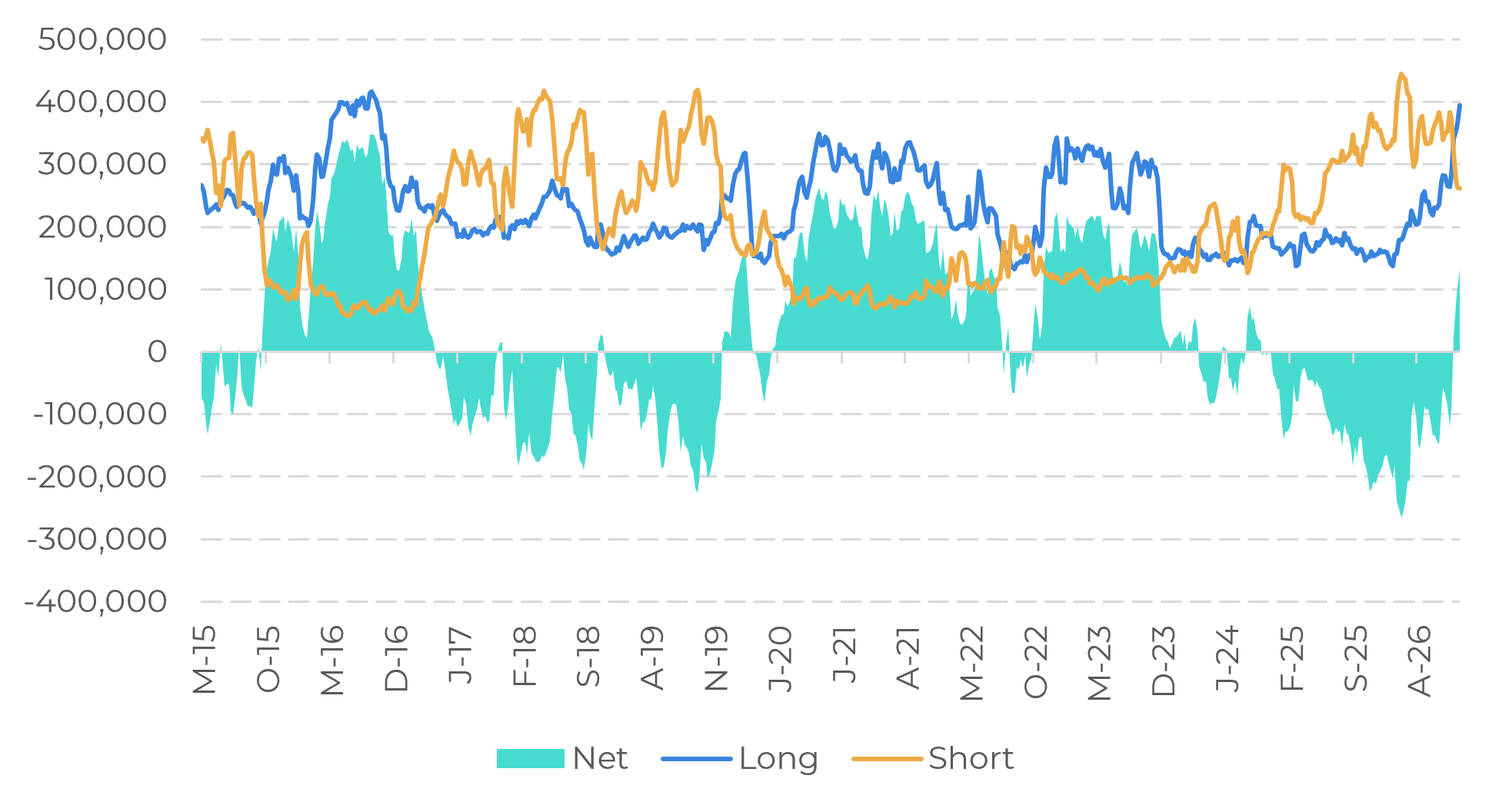
Combined with worsening crop prospects in both the EU and India, the near-term tightening in the Center-South provides sufficient support for sugar prices to remain above 18 c/lb. Meanwhile, speculative funds have reinforced bullish sentiment by expanding their net long positions and increasing bets on further price gains, while also using sugar and other commodities exposure as a hedge against persistently elevated global inflation.
Non-Commercial Position (‘000 lots)
Source: CFTC
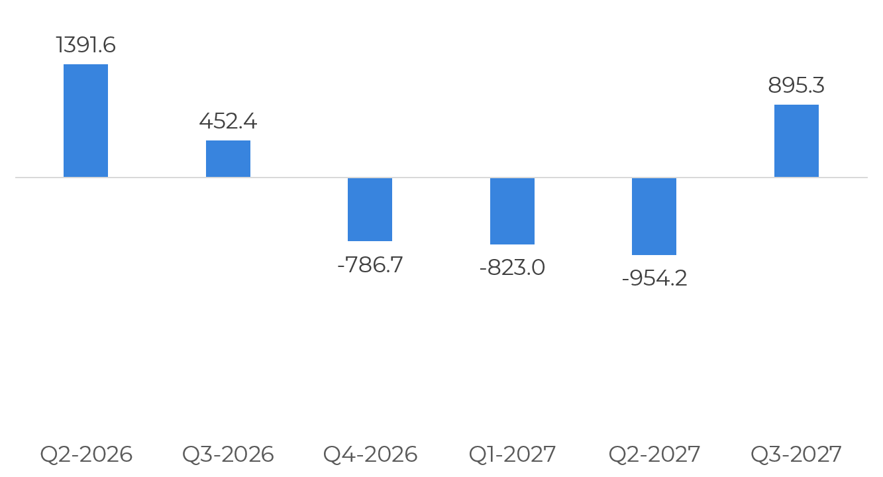
The revised balance points to a significant tightening in availability. Instead of an oversupply exceeding 1 Mt, global trade flows between Q2-26 and Q3-27 are now expected at just +175 kt, bringing the market much closer to equilibrium and increasing the potential for volatility. If Brazil recovers part of the recent losses in TRS and sugar mix over the coming fortnights, some short-term price correction may follow, provided India does not approve additional import quotas – of course, this would be a bold assumption. The main bearish argument, however, remains the longer-term outlook. Expectations still point to strong cane availability in Brazil's Center-South and a higher sugar mix in 2027/28.
Global Trade Flows
Source: Green Pool, Hedgepoint
Summary
Brazil’s Center-South sugar outlook has deteriorated despite continued expectations for strong cane availability. Irregular rainfall linked to the ongoing super El Niño has driven volatile crushing results, while TRS remains well below historical averages and the sugar mix has struggled to fully reflect sugar’s price premium over ethanol. Both MAPA and UNICA data point to the same conclusion: mills are allocating more cane to ethanol, not necessarily because of market incentives, but due to operational and weather-related constraints. As a result, we lowered our seasonal assumptions for TRS and sugar mix, reducing Brazilian sugar production and export availability.
The tighter Brazilian outlook, combined with worsening crop prospects in India and the EU, has significantly narrowed the global surplus and strengthened the case for prices to remain above 18 c/lb. Our balance now points to only a marginal surplus through Q3-27, increasing the potential for volatility, while speculative funds have further supported the rally through larger net long positions. Although some short-term price correction remains possible if Brazil recovers part of its recent losses and India refrains from additional import quotas, the main bearish argument continues to be the longer-term outlook of abundant Center-South cane availability and a potentially higher sugar mix in 2027/28.
Weekly Report — Sugar
Reviewed by Laleska Moda
laleska.moda@hedgepointglobal.com
Disclaimer
This document has been prepared by Hedgepoint Schweiz AG and its affiliates (“Hedgepoint”) solely for informational and instructional purposes, without intending to create obligations or commitments to third parties. It is not intended to promote or solicit an offer for the sale or purchase of any securities, commodities interests, or investment products.
Hedgepoint and its associates expressly disclaim any liability for the use of the information contained herein that directly or indirectly results in any kind of damages. Information is obtained from sources which we believe to be reliable, but we do not warrant or guarantee the timeliness or accuracy of this information.
The trading of commodities interests, such as futures, options, and swaps, involves substantial risk of loss and may not be suitable for all investors. You should carefully consider wither such trading is suitable for you in light of your financial condition. Past performance is not necessarily indicative of future results. Customers should rely on their own independent judgment and/or consult advisors before entering into any transactions.
Hedgepoint does not provide legal, tax or accounting advice and you are responsible for seeking any such advice separately.
Hedgepoint Schweiz AG is organized, incorporated, and existing under the laws of Switzerland, and a member of ARIF. ARIF (Association Romande des Intermédiaires Financiers) is a self-regulatory organization approved by the Swiss Financial Market Supervisory Authority (FINMA) for the supervision of financial intermediaries covered under Article 2, paragraph 3, of the Swiss Federal Act on Combating Money Laundering and Terrorist Financing in the Financial Sector (AMLA). Hedgepoint Commodities LLC is organized, incorporated, and existing under the laws of the USA, and is authorized and regulated by the Commodity Futures Trading Commission (CFTC) and a member of the National Futures Association (NFA) to act as an Introducing Broker and Commodity Trading Advisor. Hedgepoint Global Markets Limited is Regulated by the Dubai Financial Services Authority. The content is directed at Professional Clients and not Retail Clients. Hedgepoint Global Markets PTE. Ltd is organized, incorporated, and existing under the laws of Singapore and is classified as exempted from holding a capital markets services licence under paragraph 3A(1)(d) of the Second Schedule to the Securities and Futures (Licensing and Conduct of Business) Regulations (Rg 10). Hedgepoint Global Markets DTVM Ltda. is authorized and regulated in Brazil by the Central Bank of Brazil (BCB) and the Brazilian Securities Commission (CVM). Hedgepoint Serviços Ltda. is organized, incorporated, and existing under the laws of Brazil. Hedgepoint Global Markets S.A. is organized, incorporated, and existing under the laws of Uruguay.
In case of questions not resolved by the first instance of customer contact (client.services@Hedgepointglobal.com), please contact internal ombudsman channel (ombudsman@hedgepointglobal.com – global or ouvidoria@hedgepointglobal.com – Brazil only) or call 0800-8788408 (Brazil only).
Integrity, ethics, and transparency are values that guide our culture. To further strengthen our practices, Hedgepoint has a whistleblower channel for employees and third-parties by e-mail ethicline@hedgepointglobal.com.
“Hedgepoint” and the “Hedgepoint” logo are marks for the exclusive use of Hedgepoint and/or its affiliates. Use or reproduction is prohibited, unless expressly authorized by Hedgepoint.
Furthermore, the use of any other marks in this document has been authorized for identification purposes only. It does not, therefore, imply any rights of Hedgepoint in these marks or imply endorsement, association or seal by the owners of these marks with Hedgepoint or its affiliates.