
The rally loses momentum
- Commodities retreated after a hawkish Fed decision strengthened the U.S. dollar, reduced inflation concerns, and triggered profit-taking across risk assets.
- Sugar fundamentals remain supportive, with Center-South TRS and mix still showing weakness despite a strong crushing result in the second fortnight of August.
- Despite tighter supply prospects, weak FOB Santos premiums suggest subdued demand.
- The March 2027 contract remains the most bullish point on the curve due to limited Brazilian inter-crop supplies and weaker Northern Hemisphere production, while fresh volumes from late March should ease tightness for July 2027 and beyond.
The rally loses momentum
Last week, supportive fundamentals took a back seat to shifting expectations about monetary policy and the unwinding of positions built up during the recent risk rally. Commodity prices fell broadly on September 17 after the Federal Reserve sounded more hawkish than markets expected. The U.S. central bank raised interest rates by 25 basis points and hinted that more hikes could follow, which pushed up expectations for borrowing costs and strengthened the dollar. As a result, investors pulled money out of riskier assets, leading to widespread profit-taking — especially in commodities that had recently gained on geopolitical tensions and inflation worries as a hedging strategy.
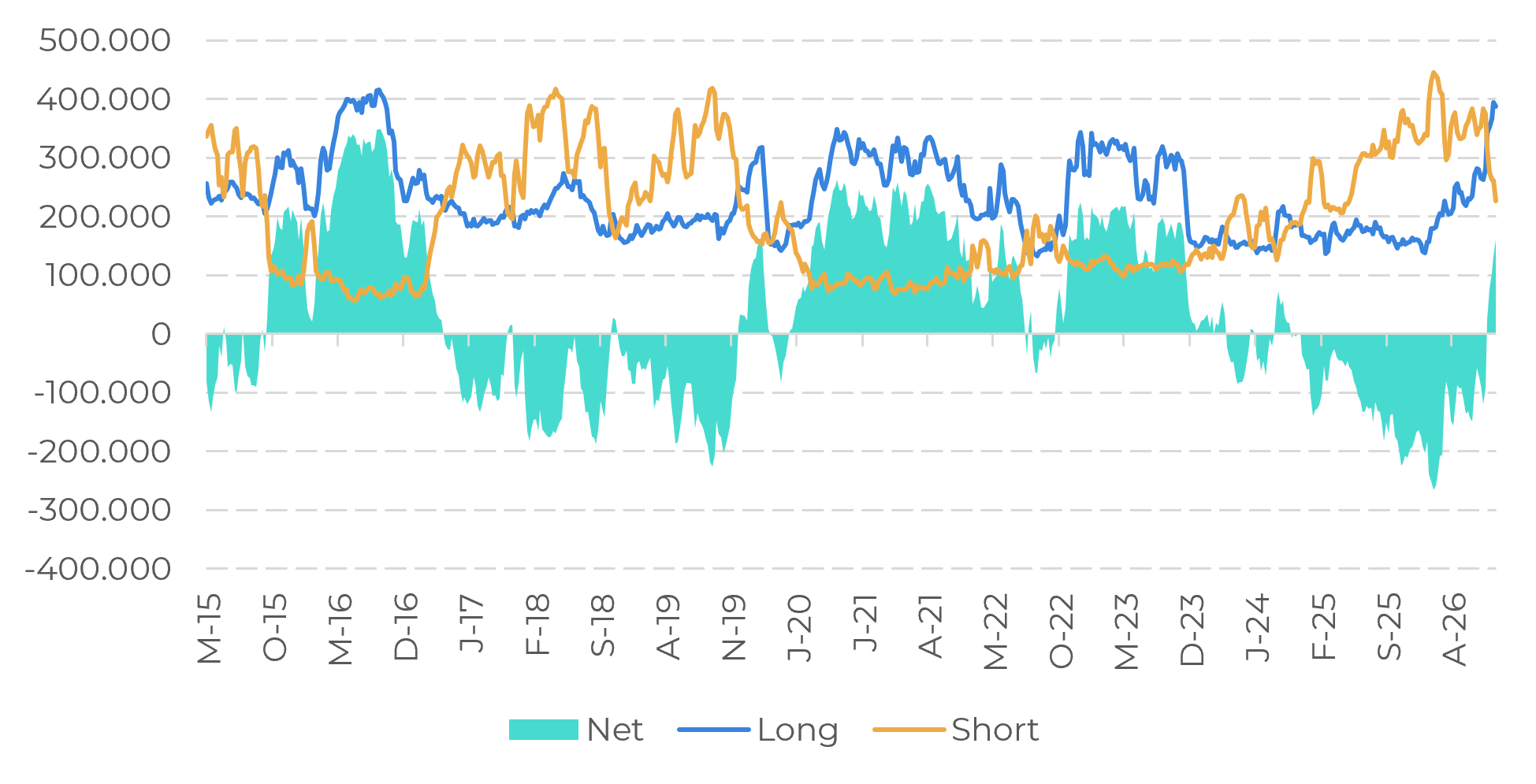
Non-Commercial Position (‘000 lots)
Source: CFTC
Energy markets faced additional pressure after some news suggesting Saudi Arabia could bring back a large part of the East-West pipeline capacity that had been damaged earlier in the month, easing fears of a prolonged supply disruption, which had driven oil prices sharply higher in previous weeks. Brent crude fell, easing inflation concerns and dragging down commodity indices, which tend to move closely with energy prices.
Put together, a stronger dollar, cheaper oil, and investors unwinding their bullish bets created a broadly negative environment for commodities. It's worth noting, though, that this drop was mostly driven by macroeconomic factors rather than any real changes to supply and demand. Some markets — sugar included — still face tighter supply conditions in major producing regions.
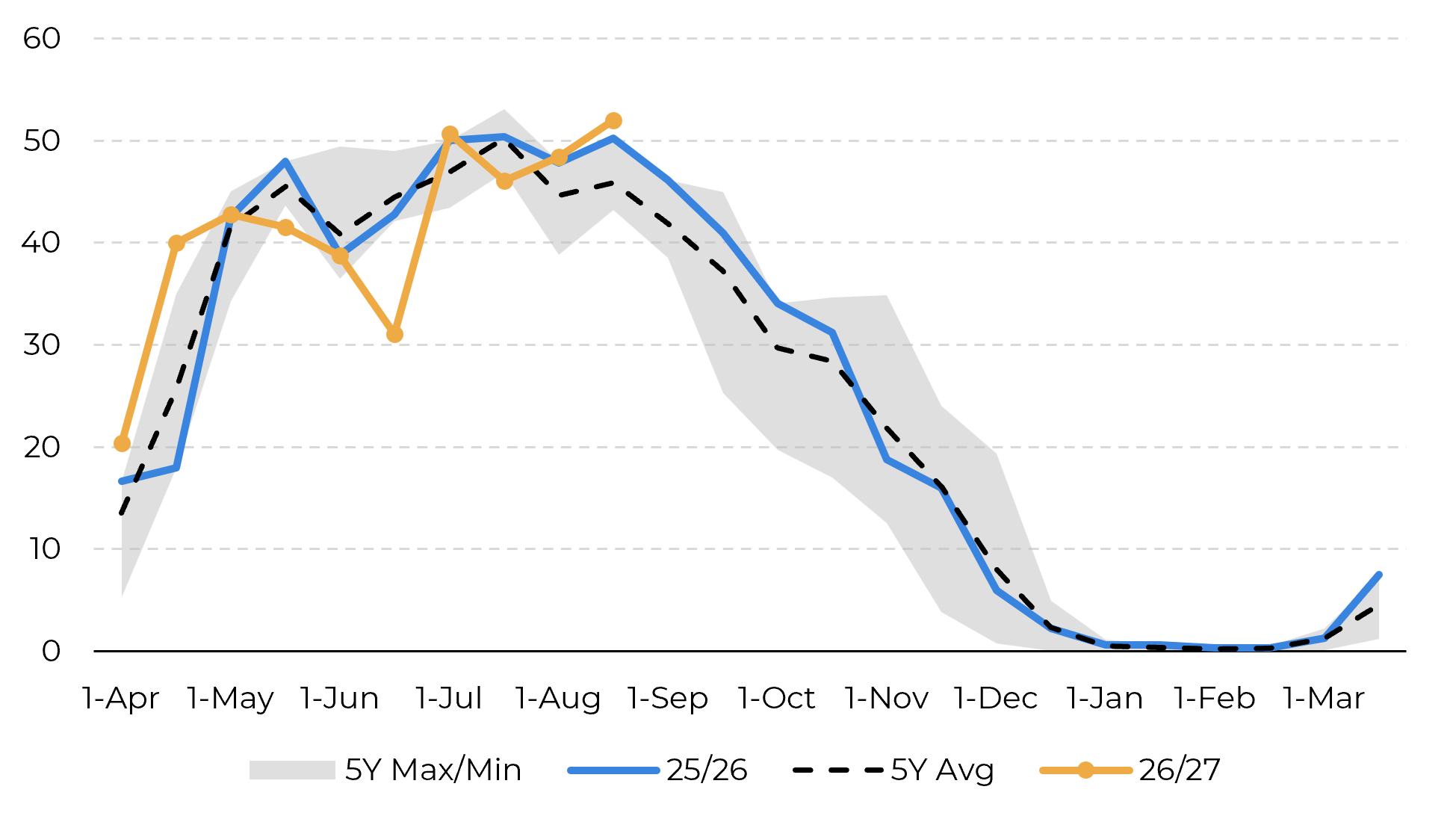
In terms of fundamentals, weather has become a key supportive factor for prices, offering short-term relief to the bulls. Although MAPA’s second-half August data showed a strong crushing pace, both TRS and sugar mix continued to reflect weather-related stress, despite fewer operational disruptions during the period. Cane crushing reached nearly 52 Mt in Center-South, but TRS remained at 145 kg/t, roughly 9 kg/t below the five-year average. Similarly, the sugar mix stood close to 52%, still well below last season’s 54%, despite sugar maintaining a clear pricing advantage over ethanol.
Bi-weekly sugarcane crushing at Center-South (M ton)
Source: UNICA until the second fortnight of June, MAPA, Hedgepoint
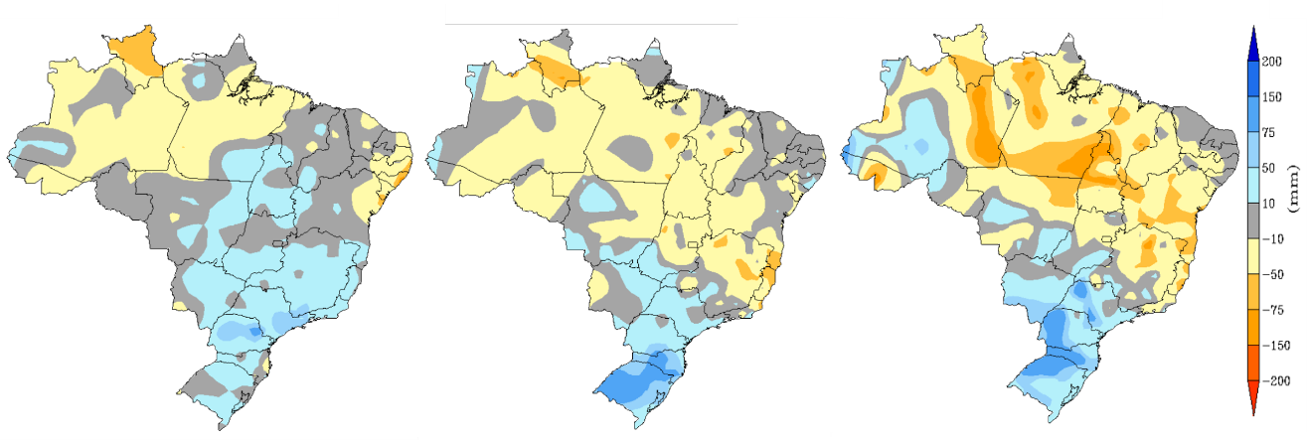
Weather conditions remain a concern as the season progresses. Above-average rainfall across Brazil’s Center-South during the first half of September likely resulted in around seven lost harvesting days, constraining crushing activity. Looking ahead, long-term precipitation forecasts continue to indicate limited weather relief. INMET, for example, projects above-average rainfall through September, October, and November, raising short-term supply risks not only through potential disruptions to harvesting and crushing, but also through possible delays to loading operations at Santos and other key export terminals.
Precipitation Anomaly in mm for September (left), October (center) and November (right)
Source: Inmet
As discussed in our latest balance sheet revision, we lowered our Center-South sugar production estimate to around 38.5 Mt and reduced the projected global trade surplus to just 175 kt. Should wet conditions persist, further downward revisions may be warranted, particularly if rains continue to weigh on TRS recovery and crushing pace. That said, the longer-term implications are not entirely negative. Improved soil moisture could support cane development for the 2027/28 season, already reflected in a robust vegetation health index, while any unharvested cane carried over into next year may contribute to an earlier start of the upcoming campaign.
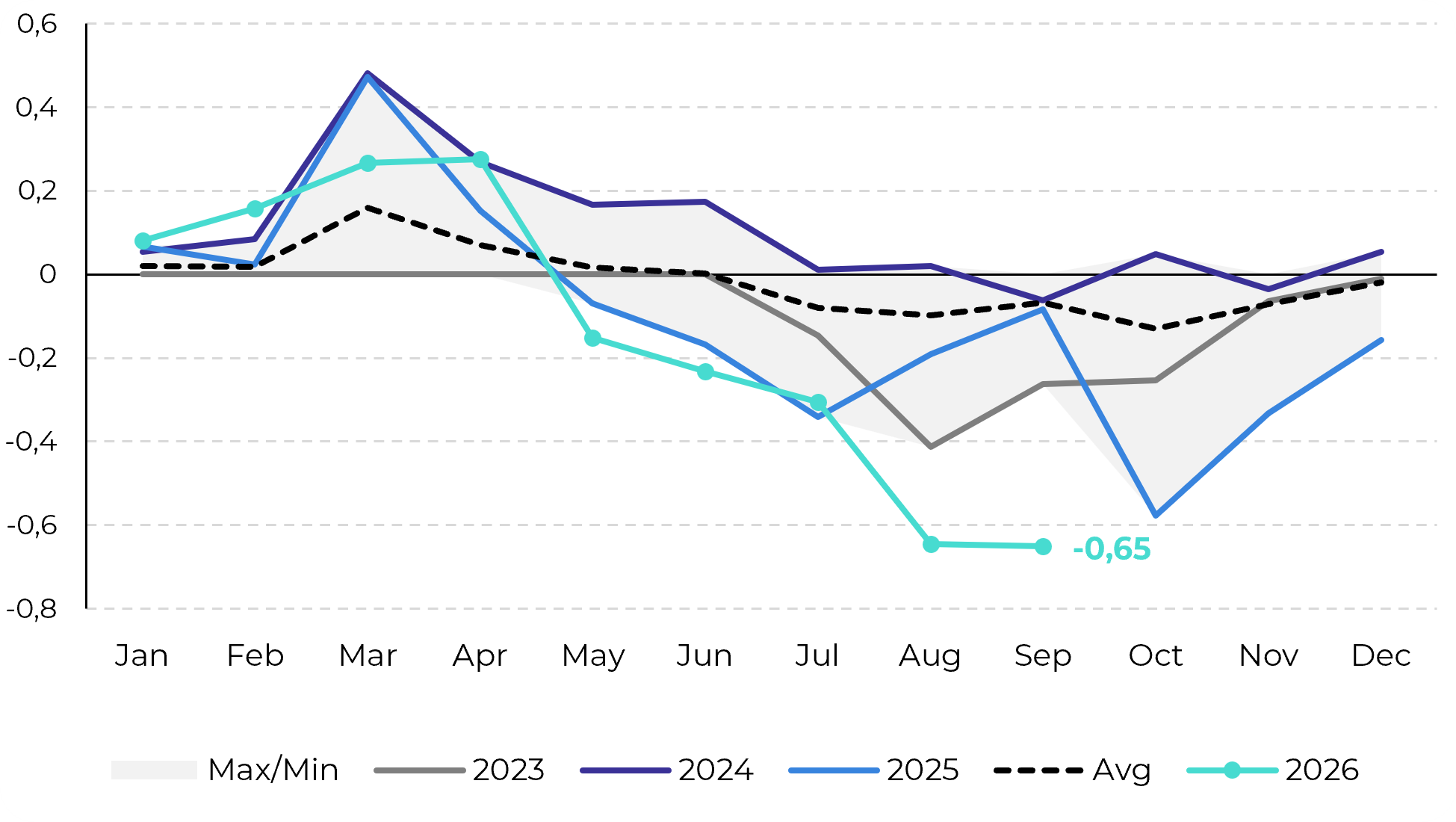
In the near term, the market has undoubtedly become tighter. However, tighter fundamentals do not necessarily imply a strong or sustained bullish trend, especially against a backdrop of subdued demand. Physical market indicators have yet to fully reflect the supply-side concerns. FOB premiums at Santos remain relatively modest, raising questions about whether the production delays and downward revisions are effectively translating into tighter physical availability.
As we approach the October contract expiry, several uncertainties remain unresolved. Recent macroeconomic developments, combined with the weakness in FOB premiums, suggest that the market may have overreacted to the short-term tightening in supply conditions when prices surged above 18.7 c/lb. Part of this move may have been driven by speculative funds expanding their net long positions as a hedge against rising inflation expectations rather than by a material deterioration in physical availability.
While fundamentals continue to point to a tighter supply outlook, the recent correction highlights the market's difficulty in sustaining further gains at current levels. Relatively subdued FOB premiums suggest that the tightening reflected in revised production estimates has yet to be fully confirmed by the physical market. A question remains: where is the demand? As a result, although the balance sheet has become more supportive, the scope for a significant additional rally in the coming weeks may be limited unless further supply disruptions emerge or demand decides to enter the market. Rumors of another round of import quota allowances from the Indian government might do the trick, especially if done during the Brazilian inter-crop.
FOB Premium at Santos Port (c/lb)
Source: LSEG, Hedgepoint
The March 2027 contract, therefore, continues to stand out as the most supportive point on the curve. Brazil's Center-South is unlikely to offer abundant sugar availability during the inter-crop period, while production prospects across key Northern Hemisphere producers remain below average. This combination could keep the market relatively tight through the first quarter of 2027, providing support to nearby contracts.
From late March onward, fresh supply should gradually begin to enter the market, easing concerns over availability and reducing bullish pressure on July 2027 and subsequent contracts – if there is no other supply disruption such as the ones driven by the super El Niño this season. This view is broadly consistent with the current spread structure, suggesting that much of this expected supply recovery is already reflected in market pricing.
Summary
Sugar prices have retreated amid a broader macro-driven selloff, but underlying fundamentals remain somewhat supportive. Persistent rains in Brazil's Center-South continue to threaten crushing, TRS recovery, and export logistics, leading to tighter supply prospects and recent downward revisions to production estimates. However, weak demand and subdued FOB premiums suggest that physical market tightness has yet to fully materialize, limiting the potential for a sustained rally in the near term. Looking ahead, the March 2027 contract remains the most supported due to limited inter-crop availability and weaker Northern Hemisphere output, while fresh supply from Center South’s new season in late March 2027 could gradually ease market concerns.
Weekly Report — Sugar
Reviewed by Laleska Moda
laleska.moda@hedgepointglobal.com
Disclaimer
This document has been prepared by Hedgepoint Schweiz AG and its affiliates (“Hedgepoint”) solely for informational and instructional purposes, without intending to create obligations or commitments to third parties. It is not intended to promote or solicit an offer for the sale or purchase of any securities, commodities interests, or investment products.
Hedgepoint and its associates expressly disclaim any liability for the use of the information contained herein that directly or indirectly results in any kind of damages. Information is obtained from sources which we believe to be reliable, but we do not warrant or guarantee the timeliness or accuracy of this information.
The trading of commodities interests, such as futures, options, and swaps, involves substantial risk of loss and may not be suitable for all investors. You should carefully consider wither such trading is suitable for you in light of your financial condition. Past performance is not necessarily indicative of future results. Customers should rely on their own independent judgment and/or consult advisors before entering into any transactions.
Hedgepoint does not provide legal, tax or accounting advice and you are responsible for seeking any such advice separately.
Hedgepoint Schweiz AG is organized, incorporated, and existing under the laws of Switzerland, and a member of ARIF. ARIF (Association Romande des Intermédiaires Financiers) is a self-regulatory organization approved by the Swiss Financial Market Supervisory Authority (FINMA) for the supervision of financial intermediaries covered under Article 2, paragraph 3, of the Swiss Federal Act on Combating Money Laundering and Terrorist Financing in the Financial Sector (AMLA). Hedgepoint Commodities LLC is organized, incorporated, and existing under the laws of the USA, and is authorized and regulated by the Commodity Futures Trading Commission (CFTC) and a member of the National Futures Association (NFA) to act as an Introducing Broker and Commodity Trading Advisor. Hedgepoint Global Markets Limited is Regulated by the Dubai Financial Services Authority. The content is directed at Professional Clients and not Retail Clients. Hedgepoint Global Markets PTE. Ltd is organized, incorporated, and existing under the laws of Singapore and is classified as exempted from holding a capital markets services licence under paragraph 3A(1)(d) of the Second Schedule to the Securities and Futures (Licensing and Conduct of Business) Regulations (Rg 10). Hedgepoint Global Markets DTVM Ltda. is authorized and regulated in Brazil by the Central Bank of Brazil (BCB) and the Brazilian Securities Commission (CVM). Hedgepoint Serviços Ltda. is organized, incorporated, and existing under the laws of Brazil. Hedgepoint Global Markets S.A. is organized, incorporated, and existing under the laws of Uruguay.
In case of questions not resolved by the first instance of customer contact (client.services@Hedgepointglobal.com), please contact internal ombudsman channel (ombudsman@hedgepointglobal.com – global or ouvidoria@hedgepointglobal.com – Brazil only) or call 0800-8788408 (Brazil only).
Integrity, ethics, and transparency are values that guide our culture. To further strengthen our practices, Hedgepoint has a whistleblower channel for employees and third-parties by e-mail ethicline@hedgepointglobal.com.
“Hedgepoint” and the “Hedgepoint” logo are marks for the exclusive use of Hedgepoint and/or its affiliates. Use or reproduction is prohibited, unless expressly authorized by Hedgepoint.
Furthermore, the use of any other marks in this document has been authorized for identification purposes only. It does not, therefore, imply any rights of Hedgepoint in these marks or imply endorsement, association or seal by the owners of these marks with Hedgepoint or its affiliates.