Brazil's Political Shock Brings Macro Back to the Forefront
- Brazil’s election triggered a sharp risk-off move, driving the BRL and domestic equities significantly lower.
- Raw sugar followed the currency correction, falling 5.6% on Monday as the weaker BRL encouraged producer hedging.
- Macro remains the key short-term driver, with Brazil’s fiscal outlook, monetary policy and political developments shaping sentiment at the same time as US developments can shake the USD.
- Whites outperformed raws, widening the white premium amid concerns over Northern Hemisphere supply and quality availability.
- Center-South fundamentals remain supportive further out, as persistent rains constrain the current crop while improving prospects for 2027/28.
Sugar's Weather Rally: The Tightness Is Real, but It Is Concentrated
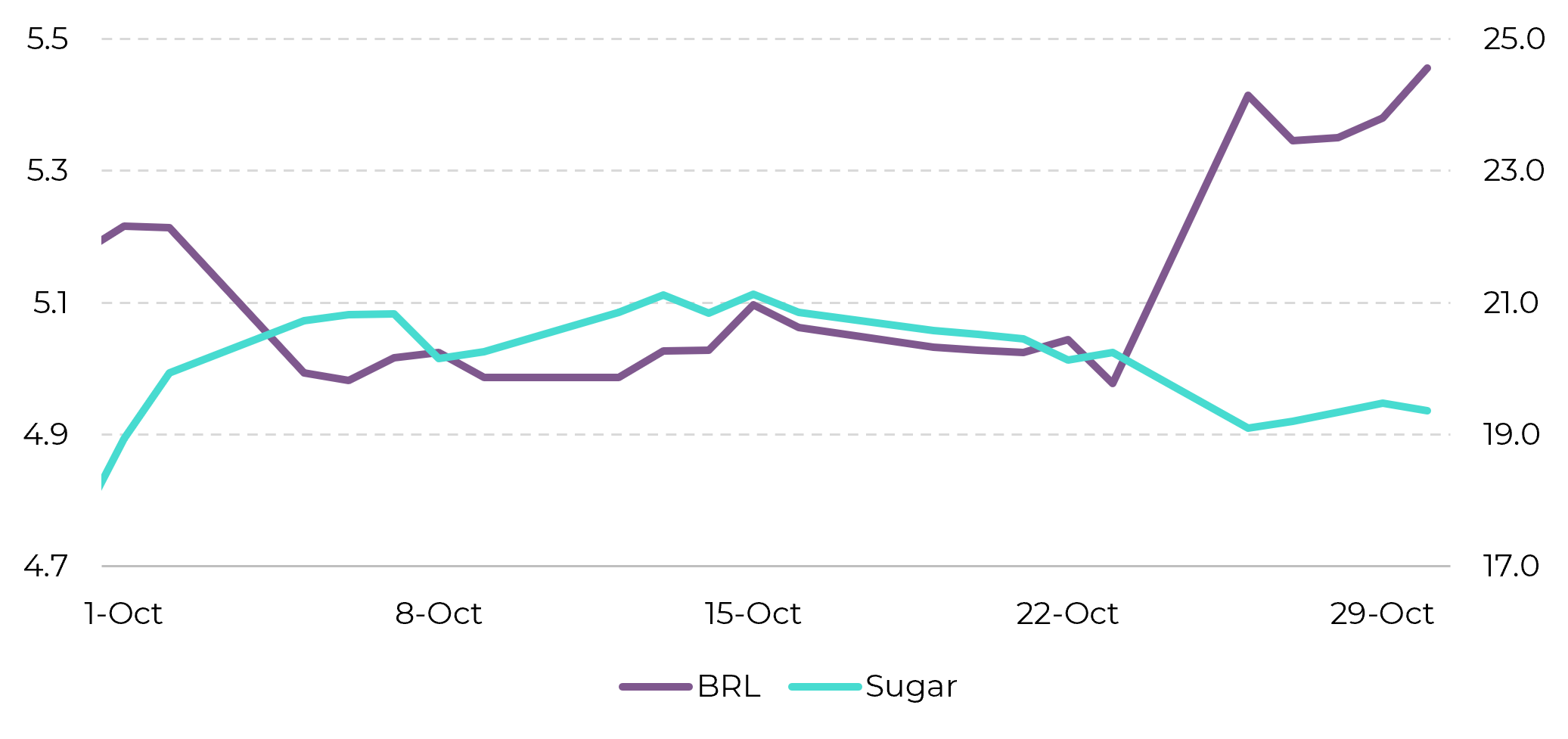
Commodity markets opened the week under significant pressure following the Brazilian election results. Against market expectations, left-wing candidate Lula da Silva won the second round on Sunday, October 25, securing the presidency for the next four years. Markets reacted sharply on Monday as investors reassessed the country’s fiscal policy outlook. The BRL depreciated by more than 11% during the session, one of its largest intraday declines on record, while the Ibovespa closed nearly 14% lower, marking its steepest daily fall since 2020.
The political shock quickly spilled over into commodity markets, particularly those in which Brazil plays a major role. Sugar was no exception. A weaker BRL improves the local-currency remuneration of dollar-denominated exports and typically increases the incentive for Brazilian producers to hedge future sales. As a result, the raw sugar front contract fell nearly 5.6% on Monday despite no corresponding deterioration in the commodity’s underlying fundamentals.
Figure 1 – Raw sugar front contract: March jump
Source: LSEG, Hedgepoint
Trading activity was particularly strong, reaching around 337k futures and 95k options during the session. This suggests that the correction was driven not only by the broader macro move, but also by a significant technical adjustment as Brazilian producers increased short futures hedges to take advantage of the more attractive BRL/USD level and secure export revenues.
As markets gradually digested the election outcome, the BRL remained highly volatile throughout the week. The incoming administration has increased uncertainty regarding the direction of government policy, especially on the fiscal front. At the same time, the election result provided somewhat greater visibility regarding the potential direction of Brazil-US relations.
Brazilian politics, however, was only one part of an increasingly complex global macro environment. Monetary policy, US political developments and major technology earnings also remained in focus, adding volatility to currencies and commodities.
In the US, Fed Chair Kevin Warsh announced on Wednesday that interest rates would remain unchanged at 3.75-4.00%, contrary to expectations for a hike amid resilient economic activity and persistent inflation. US GDP expanded by 3.4% in Q3, above expectations of 3.2%, supported by robust consumer spending and investment related to artificial intelligence, despite weaker consumer sentiment. Meanwhile, inflation increased by 0.5% in September, reinforcing expectations that monetary tightening could resume. Attention has therefore shifted toward the December meeting, following the US midterm elections.
The political backdrop is equally important. Trump’s low approval ratings have strengthened expectations of a Democratic recovery in the House and a competitive race for control of the Senate. A shift in congressional control could make implementation of the administration’s agenda more difficult, while potentially adding another layer of uncertainty to the evolving Brazil-US relationship.
In Europe, the European Central Bank also kept monetary policy unchanged on Thursday, maintaining the deposit facility rate at 2.5%. While inflation has remained relatively stable, the combination of persistent energy pressures and tighter financial conditions continues to cloud the outlook for both inflation and economic activity.
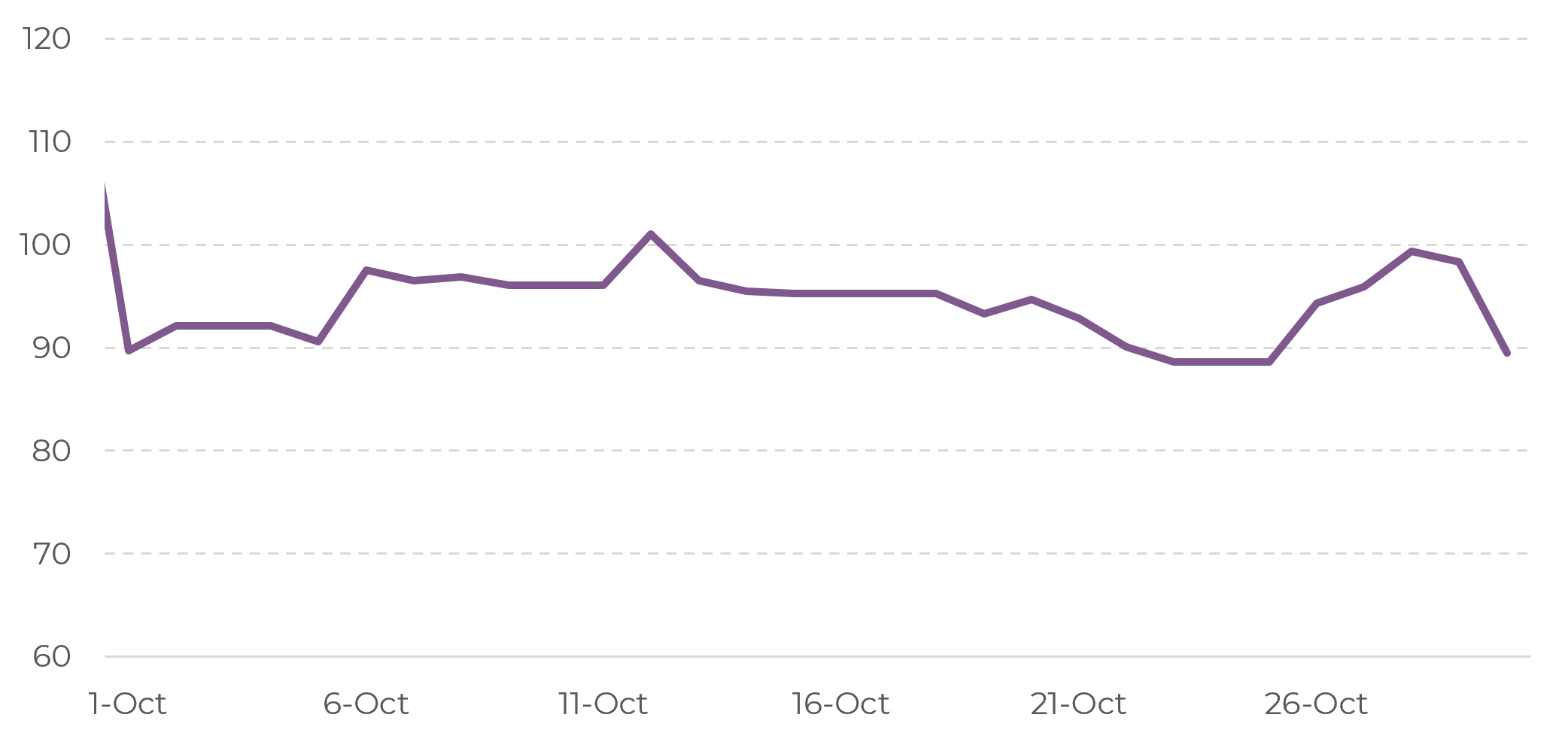
Against this backdrop, macro factors have returned as the dominant short-term driver for sugar prices. Given the raw market’s greater exposure to Brazil and consequently to BRL volatility, raws came under substantially more pressure than whites during the week. This divergence widened the white premium.
Figure 2 – White Premium in October 2026
Source: LSEG, Hedgepoint
However, the move could have greater persistence than the initial macro shock. While currency volatility primarily affected raws, fundamentals continue to point toward tighter availability of the white quality in the Northern Hemisphere due to expected crop failures. The resulting combination of macro pressure on raws and tighter refined-market fundamentals has therefore provided relative support to whites.
By Friday, part of the initial sell-off had been recovered, although the raw sugar front contract still accumulated a weekly decline of 4.3%, closing at 19.36 c/lb.
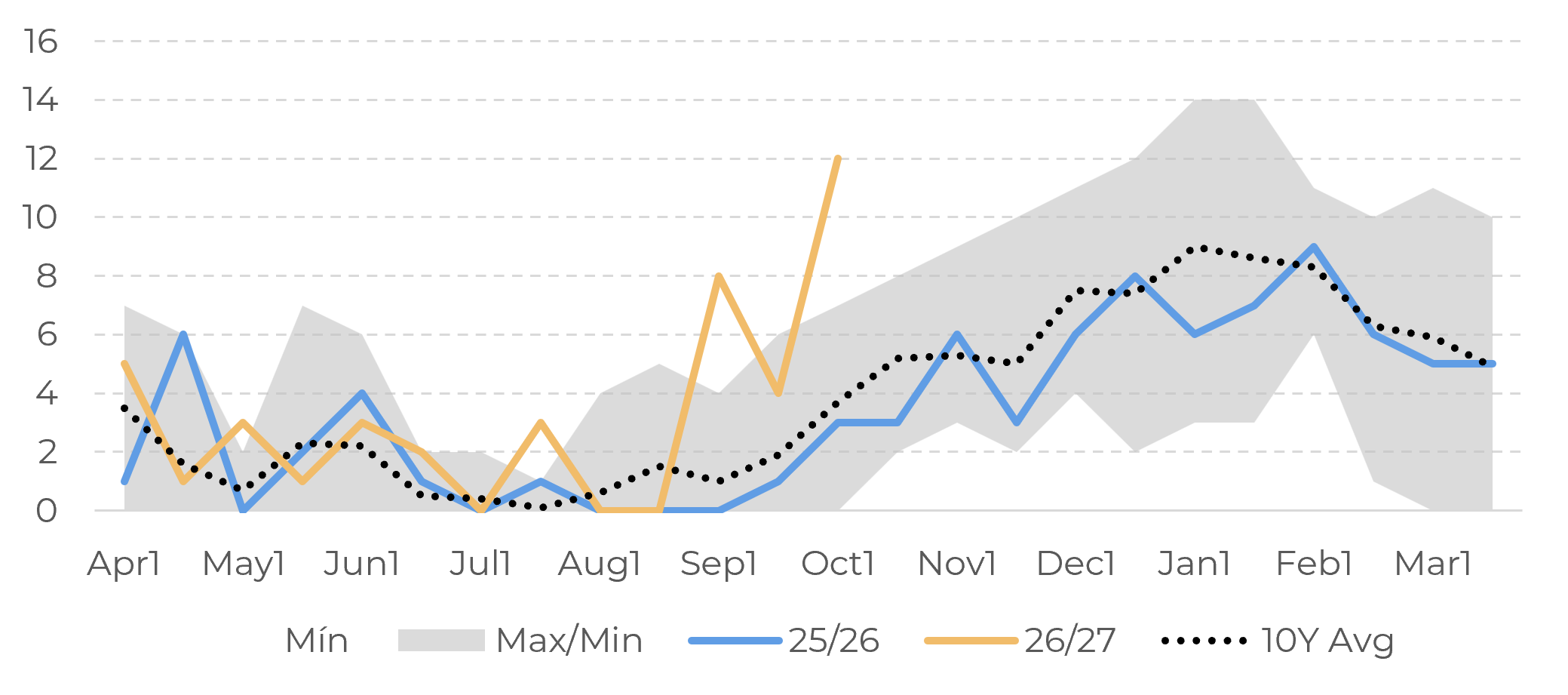
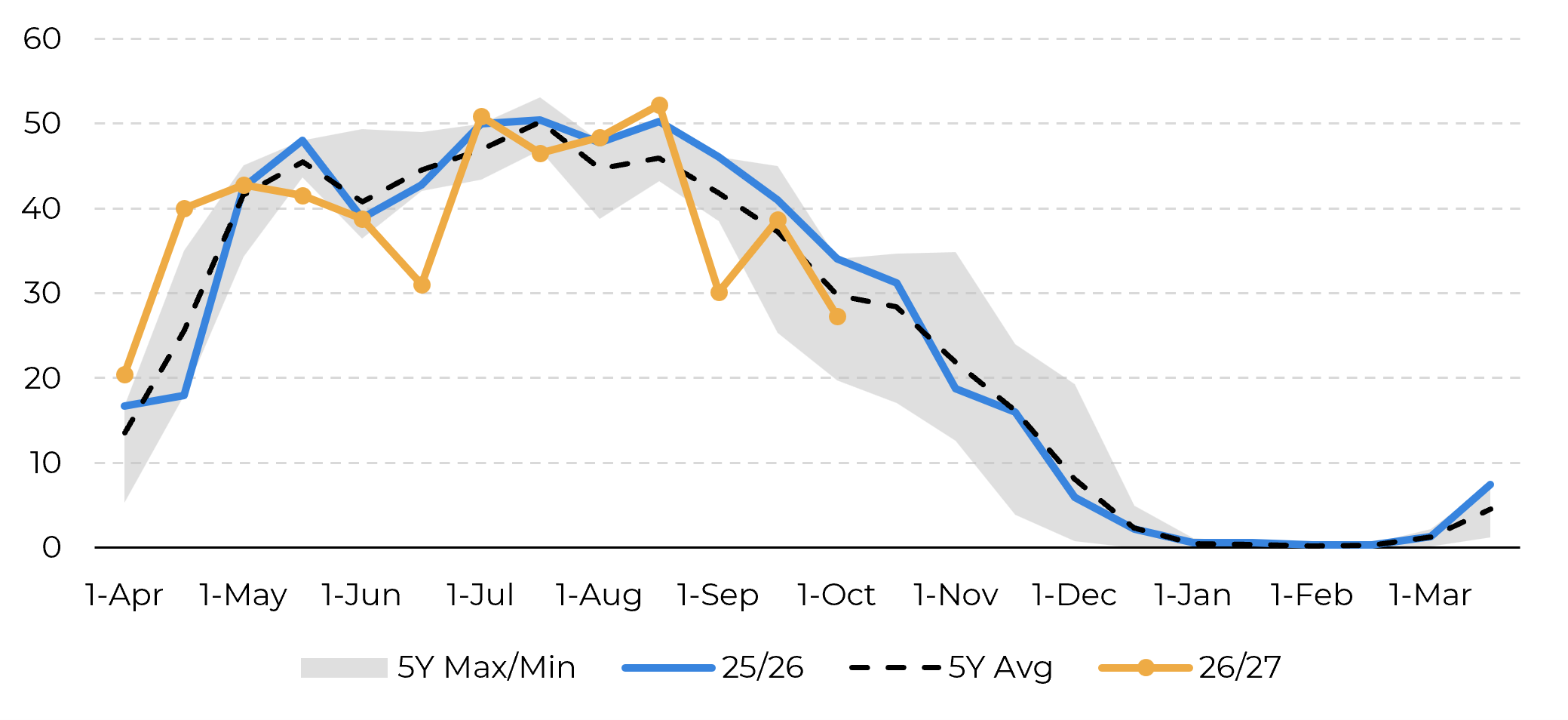
On the fundamental side, persistent rainfall in Brazil’s Center-South is no longer new information for the market, but the continuation of abundant precipitation remains important for near-term availability. MAPA data for the first half of October indicated an estimated 12 lost crushing days, limiting milling activity despite the still-high availability of cane.
Figure 3 – Lost days estimate per fortnight in CS (nº of days)
Source: Bloomberg, Hedgepoint
Center-South mills crushed approximately 27.3 Mt of sugarcane during the period, while another 4.7 Mt was processed in the North-Northeast, where the harvest continues to gain momentum. At the same time, Total Recoverable Sugar (TRS) and the sugar mix remain under pressure, pointing to weaker results toward the end of the Center-South season and remaining consistent with our 37.5 Mt sugar production estimate.
Figure 4 – Cane crushing per fortnight in Center South (Mt)
Source: UNICA until the second fortnight of August, MAPA, Hedgepoint
Summary
Sugar remains caught between macro volatility and supportive near-term fundamentals. Brazil’s political transition and the resulting BRL weakness triggered a substantial adjustment in raws and producer hedging, while whites proved more resilient amid tighter Northern Hemisphere availability. At the same time, persistent Center-South rains are restricting the current harvest and pressuring TRS and mix, supporting nearby fundamentals even as improved moisture conditions enhance the outlook for 2027/28 cane availability.
Weekly Report — Sugar
Reviewed by Laleska Moda
laleska.moda@hedgepointglobal.com
Disclaimer
This document has been prepared by Hedgepoint Schweiz AG and its affiliates (“Hedgepoint”) solely for informational and instructional purposes, without intending to create obligations or commitments to third parties. It is not intended to promote or solicit an offer for the sale or purchase of any securities, commodities interests, or investment products.
Hedgepoint and its associates expressly disclaim any liability for the use of the information contained herein that directly or indirectly results in any kind of damages. Information is obtained from sources which we believe to be reliable, but we do not warrant or guarantee the timeliness or accuracy of this information.
The trading of commodities interests, such as futures, options, and swaps, involves substantial risk of loss and may not be suitable for all investors. You should carefully consider wither such trading is suitable for you in light of your financial condition. Past performance is not necessarily indicative of future results. Customers should rely on their own independent judgment and/or consult advisors before entering into any transactions.
Hedgepoint does not provide legal, tax or accounting advice and you are responsible for seeking any such advice separately.
Hedgepoint Schweiz AG is organized, incorporated, and existing under the laws of Switzerland, and a member of ARIF. ARIF (Association Romande des Intermédiaires Financiers) is a self-regulatory organization approved by the Swiss Financial Market Supervisory Authority (FINMA) for the supervision of financial intermediaries covered under Article 2, paragraph 3, of the Swiss Federal Act on Combating Money Laundering and Terrorist Financing in the Financial Sector (AMLA). Hedgepoint Commodities LLC is organized, incorporated, and existing under the laws of the USA, and is authorized and regulated by the Commodity Futures Trading Commission (CFTC) and a member of the National Futures Association (NFA) to act as an Introducing Broker and Commodity Trading Advisor. Hedgepoint Global Markets Limited is Regulated by the Dubai Financial Services Authority. The content is directed at Professional Clients and not Retail Clients. Hedgepoint Global Markets PTE. Ltd is organized, incorporated, and existing under the laws of Singapore and is classified as exempted from holding a capital markets services licence under paragraph 3A(1)(d) of the Second Schedule to the Securities and Futures (Licensing and Conduct of Business) Regulations (Rg 10). Hedgepoint Global Markets DTVM Ltda. is authorized and regulated in Brazil by the Central Bank of Brazil (BCB) and the Brazilian Securities Commission (CVM). Hedgepoint Serviços Ltda. is organized, incorporated, and existing under the laws of Brazil. Hedgepoint Global Markets S.A. is organized, incorporated, and existing under the laws of Uruguay.
In case of questions not resolved by the first instance of customer contact (client.services@Hedgepointglobal.com), please contact internal ombudsman channel (ombudsman@hedgepointglobal.com – global or ouvidoria@hedgepointglobal.com – Brazil only) or call 0800-8788408 (Brazil only).
Integrity, ethics, and transparency are values that guide our culture. To further strengthen our practices, Hedgepoint has a whistleblower channel for employees and third-parties by e-mail ethicline@hedgepointglobal.com.
“Hedgepoint” and the “Hedgepoint” logo are marks for the exclusive use of Hedgepoint and/or its affiliates. Use or reproduction is prohibited, unless expressly authorized by Hedgepoint.
Furthermore, the use of any other marks in this document has been authorized for identification purposes only. It does not, therefore, imply any rights of Hedgepoint in these marks or imply endorsement, association or seal by the owners of these marks with Hedgepoint or its affiliates.