Jan 19 / Lívea Coda

Higher Indian production meets a bearish global sugar environment

  • Global sugar prices stayed bearish in 2025, falling 22% to 15 c/lb, mainly due to strong supply from Brazil and other Northern Hemisphere producers; India’s bullish influence was limited.
  • India’s 2024/25 output underperformed, with net sugar production at 26.1 Mt and 800 kt exported; a remaining 200 kt is likely to roll into 2025/26.
  • For 2025/26, India’s production is outperforming expectations, with output up 20% year-on-year, lifting our net production estimate to 31.8 Mt.
  • Export prospects remain constrained as domestic vs. international price dynamics close arbitrage; export parity sits near 18.5 c/lb (raws) and USD 445/t (whites), while potential Minimum Selling Price (MSP) hikes may further limit export viability.
  • Brazil’s robust intercrop and stable cane forecasts (610 Mt) dampen any bullish impact from India, reinforcing the bearish global context.

Higher Indian production meets a bearish global sugar environment

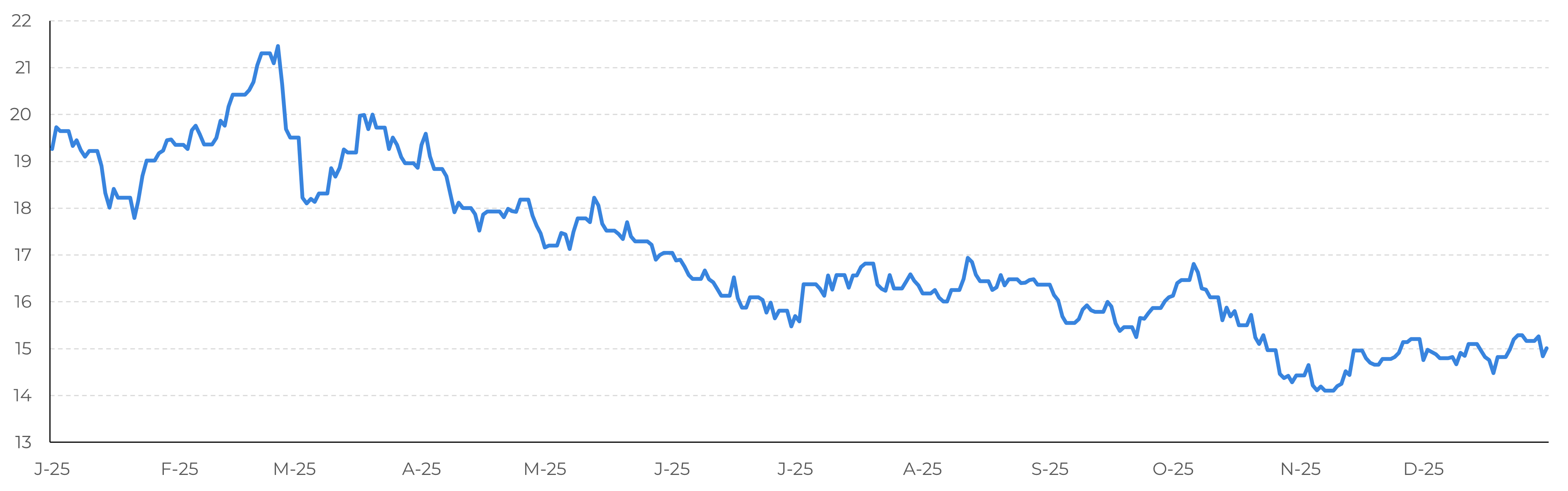
Sugar prices remained on a bearish trajectory throughout 2025, driven primarily by increased availability in Brazil and several Northern Hemisphere producers, such as the European Union. With cane estimates consistently revised upward, Brazil’s strong output exerted downward pressure on prices, which ended the year at 15 c/lb; representing a 22% annual decline. Although there are still key uncertainties for Brazil in 2026, this report focuses on India’s role in the market. The latter provided some bullish support during 2025, but its overall impact on global prices was limited.


Raw sugar prices through 2025 (c/lb)
Source: LSEG

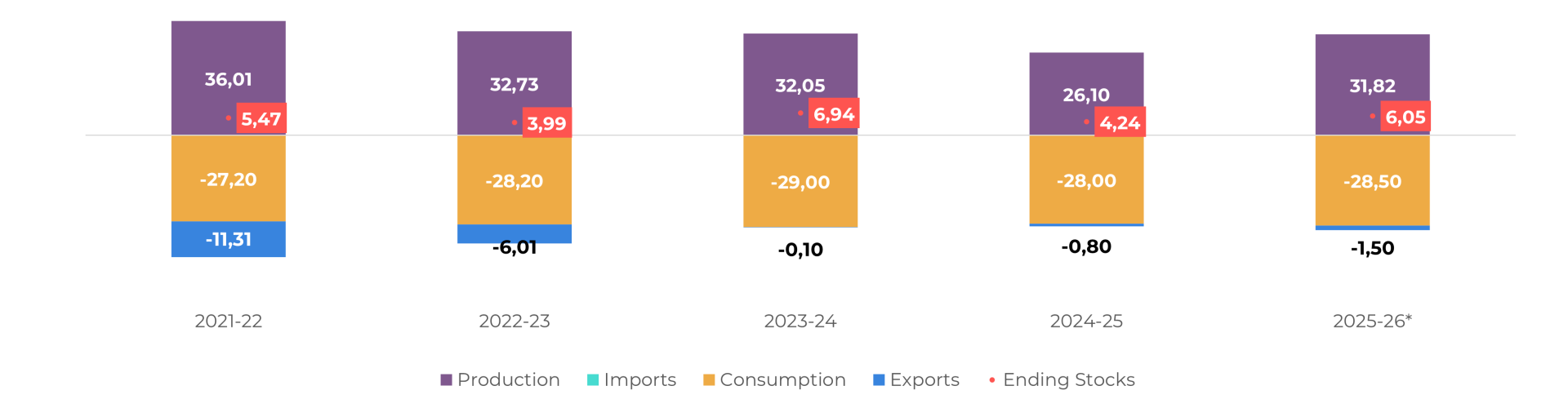
Namely, in the 2024/25 season, India’s sugar production came in below expectations at roughly 29.6 Mt gross. After diverting 3.4 Mt to ethanol, net sugar output reached 26.1 Mt. On the export front, the country shipped 800 kt, with the remaining 200 kt quota likely to be carried into 2025/26.

For the 2025/26 season, early results align with our forecasts; pointing to a significantly more positive outlook that reinforces the global bearish trend. Production has been advancing at an excellent pace: from October 2025 to January 15, 2026, India produced nearly 16 Mt, a 20% increase over the same period last year. Cane crush also rose notably, totaling 176.4 Mt compared with 148.4 Mt in the previous season.

Average sugar recovery improved to 9%, up from 8.8% in 2024/25. As a result, we have raised our net production estimate slightly to 31.8 Mt, while ethanol diversion expectations have been trimmed to 3.7 Mt.

Average sugar recovery improved to 9%, up from 8.8% in 2024/25. As a result, we have raised our net production estimate slightly to 31.8 Mt, while ethanol diversion expectations have been trimmed to 3.7 Mt.

India Supply and Demand (Oct - Sep | Mt)
Source: Hedgepoint

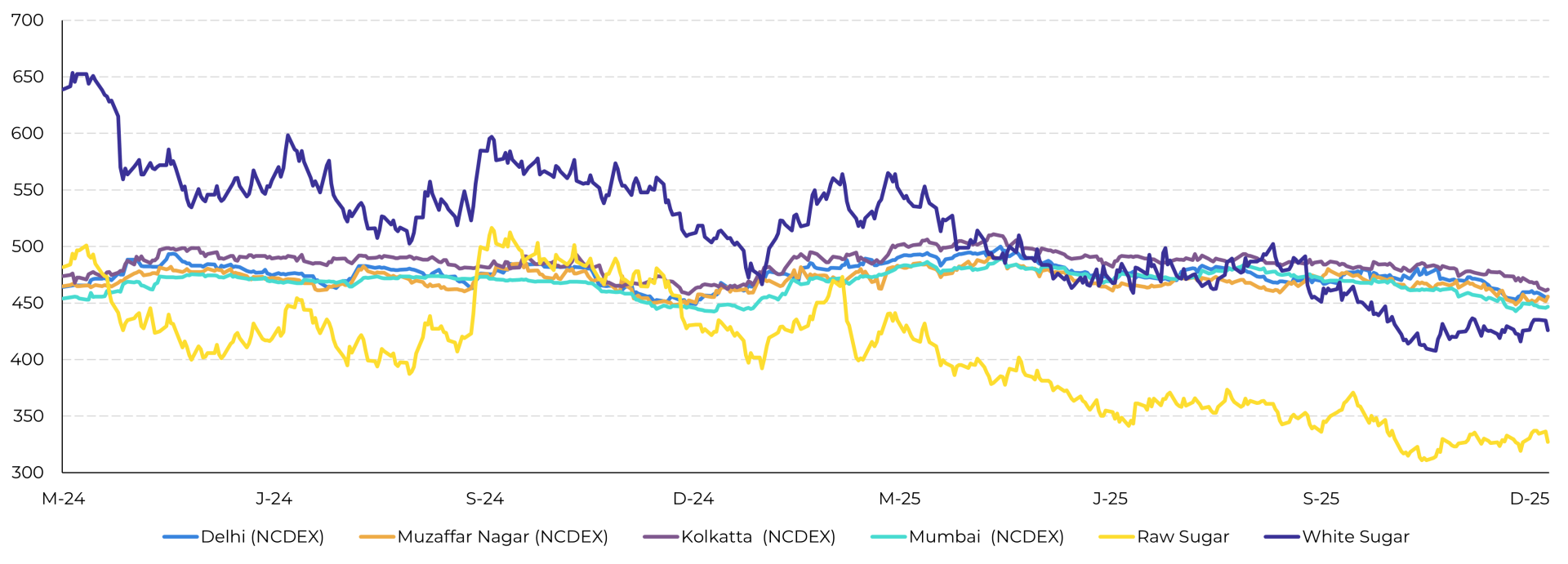
Regarding exports, the government has already authorized 1.5 Mt, which aligns with expectations. There is room for an additional 500 kt, but actual shipments will depend heavily on price dynamics; particularly the gap between domestic and international prices, with the latter under pressure from global oversupply. At current price levels, it is not economically viable for Indian producers to sell into the international market. Based on domestic prices, India’s export parity stands at around 18.5 c/lb for raws and approximately USD 445/t for whites, indicating that both markets remain effectively closed. Sugar already sold will be shipped, but these price conditions may delay new export deals.

India’s domestic prices vs international (USD/t)
Source: Bloomberg, Hedgepoint


Another potential constraint is a possible increase in the Minimum Selling Price (MSP), which has remained unchanged at ₹31/kg for seven years. Both ISMA and NFCSF have repeatedly pushed for an adjustment, and current discussions center on the latter's proposal for a substantial hike to ₹41/kg; an increase that would better reflect rising production costs and the Fair and Remunerative Price (FRP), which has grown nearly 30% in six years (from ₹275 to ₹355 per quintal). While a full adjustment to this level seems unlikely, any upward revision would strengthen domestic prices and make new export deals even more challenging at current global prices.

However, any bullish sentiment one might expect from this dynamic must be viewed within a more complex global context. Normally, at this time of year, the market would react more directly to India’s exports outlook. This season, however, Brazil’s intercrop period is far from tight. In fact, the latest UNICA reports show that cane crushing has remained robust, prompting several market participants, who previously anticipated an abrupt drop, to revise their cane estimates upward.

At present, we estimate Center-South cane output at around 610 Mt for the 2025/26 cycle, only slightly above our previous number of 605 Mt. This more optimistic assessment of Center-South performance, combined with expectations that strong results could continue into the next season, has tempered the influence of other major producers on global prices.

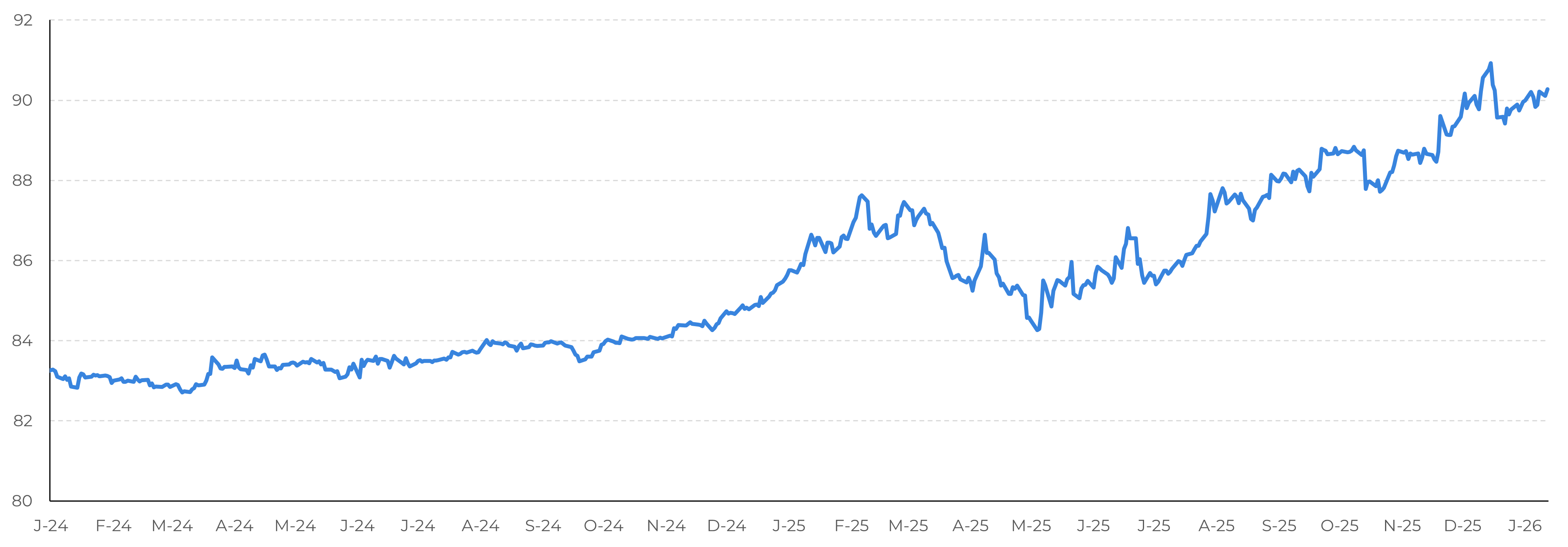
In the end, the expectation that Indian producers could secure higher returns for their sugar may be difficult to realize. This outcome depends not only on their negotiation leverage but also on a broader market environment that currently works against any upward movement. Beyond fundamentals, macroeconomic indicators are also unfavorable. In India’s case, any potential support from higher domestic prices could be offset by the depreciation of the Indian Rupee (INR), which could smoothen the export parity; meaning that the only piece of potentially bullish news may end up being far less supportive than it appears.

INR depreciation against the dolar

Source: LSEG


Summary

Sugar prices stayed under pressure in 2025 due to abundant supply from Brazil and other major producers, while India, despite weaker 2024/25 output, offered only limited bullish support. In 2025/26, India’s production has accelerated sharply, reinforcing the global bearish trend, though high domestic prices and a likely increase in the MSP restrict export viability. Meanwhile, Brazil’s stronger than expected intercrop and steady cane outlook have further capped any short-term upside.


Weekly Report — Sugar

Written by Lívea Coda
livea.coda@hedgepointglobal.com


Reviewed by Thais Italiani
thais.italiani@hedgepointglobal.com

Disclaimer

This document has been prepared by Hedgepoint Schweiz AG and its affiliates (“Hedgepoint”) solely for informational and instructional purposes, without intending to create obligations or commitments to third parties. It is not intended to promote or solicit an offer for the sale or purchase of any securities, commodities interests, or investment products.


Hedgepoint and its associates expressly disclaim any liability for the use of the information contained herein that directly or indirectly results in any kind of damages. Information is obtained from sources which we believe to be reliable, but we do not warrant or guarantee the timeliness or accuracy of this information.
The trading of commodities interests, such as futures, options, and swaps, involves substantial risk of loss and may not be suitable for all investors. You should carefully consider wither such trading is suitable for you in light of your financial condition. Past performance is not necessarily indicative of future results. Customers should rely on their own independent judgment and/or consult advisors before entering into any transactions.
Hedgepoint does not provide legal, tax or accounting advice and you are responsible for seeking any such advice separately.
Hedgepoint Schweiz AG is organized, incorporated, and existing under the laws of Switzerland, is filiated to ARIF, the Association Romande des Intermédiaires Financiers, which is a FINMA-authorized Self-Regulatory Organization. Hedgepoint Commodities LLC is organized, incorporated, and existing under the laws of the USA, and is authorized and regulated by the Commodity Futures Trading Commission (CFTC) and a member of the National Futures Association (NFA) to act as an Introducing Broker and Commodity Trading Advisor. HedgePoint Global Markets Limited is Regulated by the Dubai Financial Services Authority. The content is directed at Professional Clients and not Retail Clients. Hedgepoint Global Markets PTE. Ltd is organized, incorporated, and existing under the laws of Singapore, exempted from obtaining a financial services license as per the Second Schedule of the Securities and Futures (Licensing and Conduct of Business) Act, by the Monetary Authority of Singapore (MAS). Hedgepoint Global Markets DTVM Ltda. is authorized and regulated in Brazil by the Central Bank of Brazil (BCB) and the Brazilian Securities Commission (CVM). Hedgepoint Serviços Ltda. is organized, incorporated, and existing under the laws of Brazil. Hedgepoint Global Markets S.A. is organized, incorporated, and existing under the laws of Uruguay. In case of questions not resolved by the first instance of customer contact (client.services@Hedgepointglobal.com), please contact internal ombudsman channel (ombudsman@hedgepointglobal.com – global or ouvidoria@hedgepointglobal.com – Brazil only) or call 0800-8788408 (Brazil only).
Integrity, ethics, and transparency are values that guide our culture. To further strengthen our practices, Hedgepoint has a whistleblower channel for employees and third-parties by e-mail ethicline@hedgepointglobal.com or forms Ethic Line – Hedgepoint Global Markets.
“HedgePoint” and the “HedgePoint” logo are marks for the exclusive use of HedgePoint and/or its affiliates. Use or reproduction is prohibited, unless expressly authorized by HedgePoint.
Furthermore, the use of any other marks in this document has been authorized for identification purposes only. It does not, therefore, imply any rights of HedgePoint in these marks or imply endorsement, association or seal by the owners of these marks with HedgePoint or its affiliates.

To access this report, you need to be a subscriber.