The year 2025 was marked once again by robust Brazilian exports of soybeans and corn, with a new record set for the oilseed. The redesign of international trade flows amid the tariff war imposed by the Donald Trump administration throughout the year created a challenging environment, but at the same time paved the way for Brazil to consolidate its position as a major global supplier of important commodities.
In the case of soybeans, Brazil's share of the international market grew once again, further increasing its share as the world's largest exporter. A new record crop in the 2024/25 season allowed for an increase in Brazilian exports, expanding the volumes destined for major consumers, particularly China.
The "2.0" trade war initiated by the US government in April 2025 broadened the United States' targets regarding the first trade war (in 2018/2019), but kept China as its main focus. The Asian country again suffered the imposition of high tariffs on most of its products throughout the year and reacted by imposing high tariffs on various US products. For months, trade between the two countries was virtually impossible due to tariffs. And soybeans were once again at the center of this dispute. With tariffs exceeding 100% at one point, Chinese purchases of US soybeans stopped for several months, with demand shifting to South American ports, especially Brazilian ones. This shift brought additional demand for Brazilian soybeans, helping to further boost exports.
Brazilian soybean exports ended 2025 at 108.2 million tons, up 9% from 2024 (98.8 million tons) and 6% from the previous record (101.9 million tons) set in 2023.
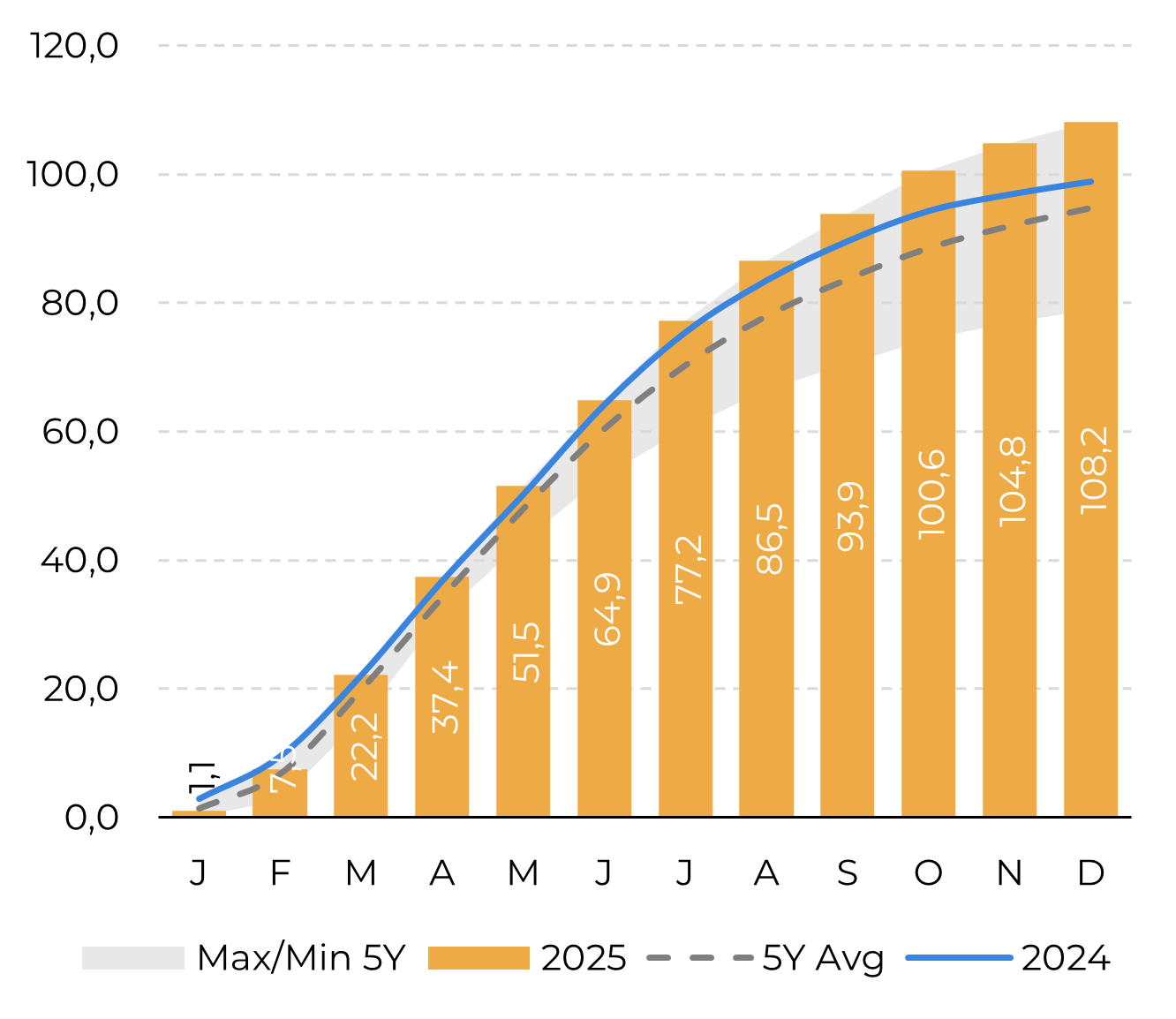
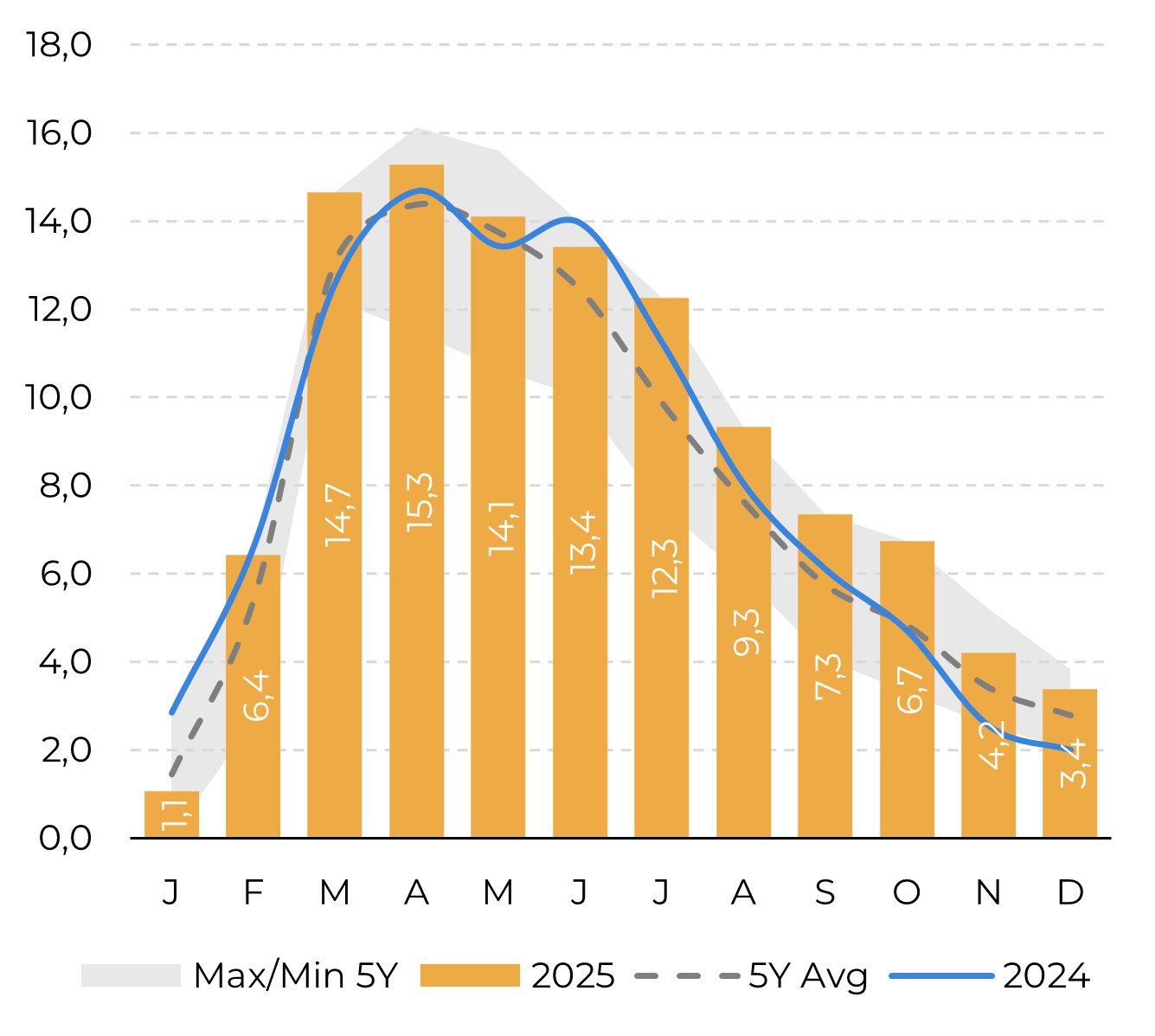
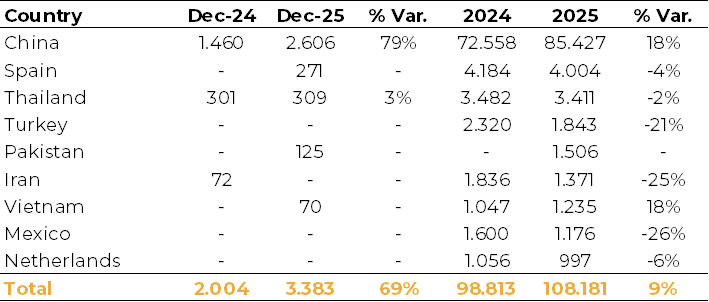
China accounted for 79% of Brazil's soybean exports in 2025, with 85.43 million tons. This volume is 17.7% higher than China's purchases in 2024 (72.56 million tons) and 14.7% higher than the previous record (74.47 million tons) set in 2023. To get an idea of China's relevance in Brazilian soybean purchases, the second country that bought the most soybeans from Brazil in 2025 was Spain, with a "mere" 4 million tons, equivalent to approximately 3.7% of total soybean exports.
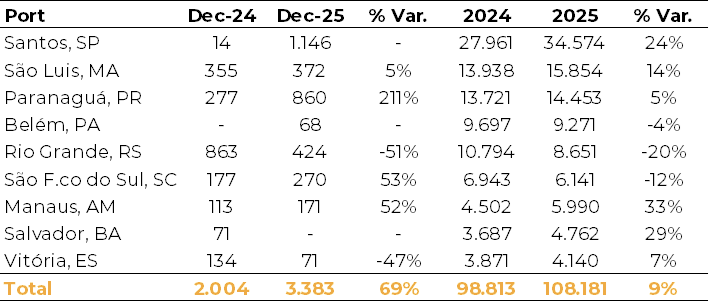
When we look at export corridors, the port of Santos/SP was once again the busiest for soybean shipments in 2025, with 34.57 million tons exported (24% more than last year).
In second place was the port of São Luís/MA, with 15.85 million tons exported in 2025 (14% more than last year). There has been strong growth in exports through the ports of the so-called "Arco Norte" in recent years, with the port of São Luís surpassing the traditional port of Paranaguá/PR for the second consecutive year as the second largest soybean export port in the country.
In addition, the port of Belém/PA appeared just behind Paranaguá in 2025, occupying fourth place and surpassing the also traditional port of Rio Grande/RS. This fact shows the growing importance of ports in the Northeast and North regions in the flow of Brazilian soybean production to the international market.
In the case of corn, exports returned to growth in 2025 after a significant decline in the previous year, despite strong competition from products from Argentina and the US.
As with soybeans, record corn production in the 2024/25 season allowed Brazilian supply to the international market to increase, in contrast to the reduction in supply recorded in the previous season due to production losses.
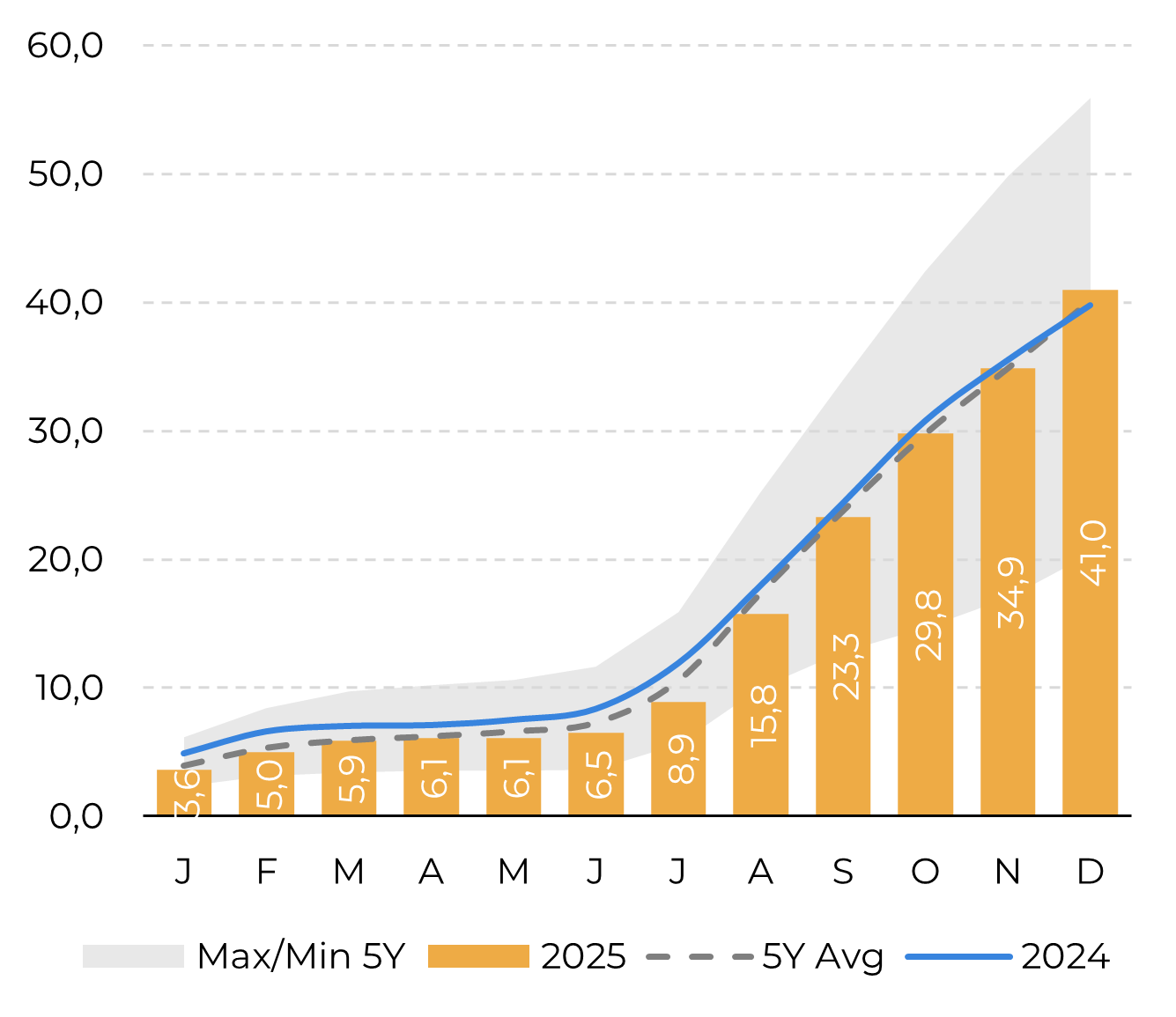
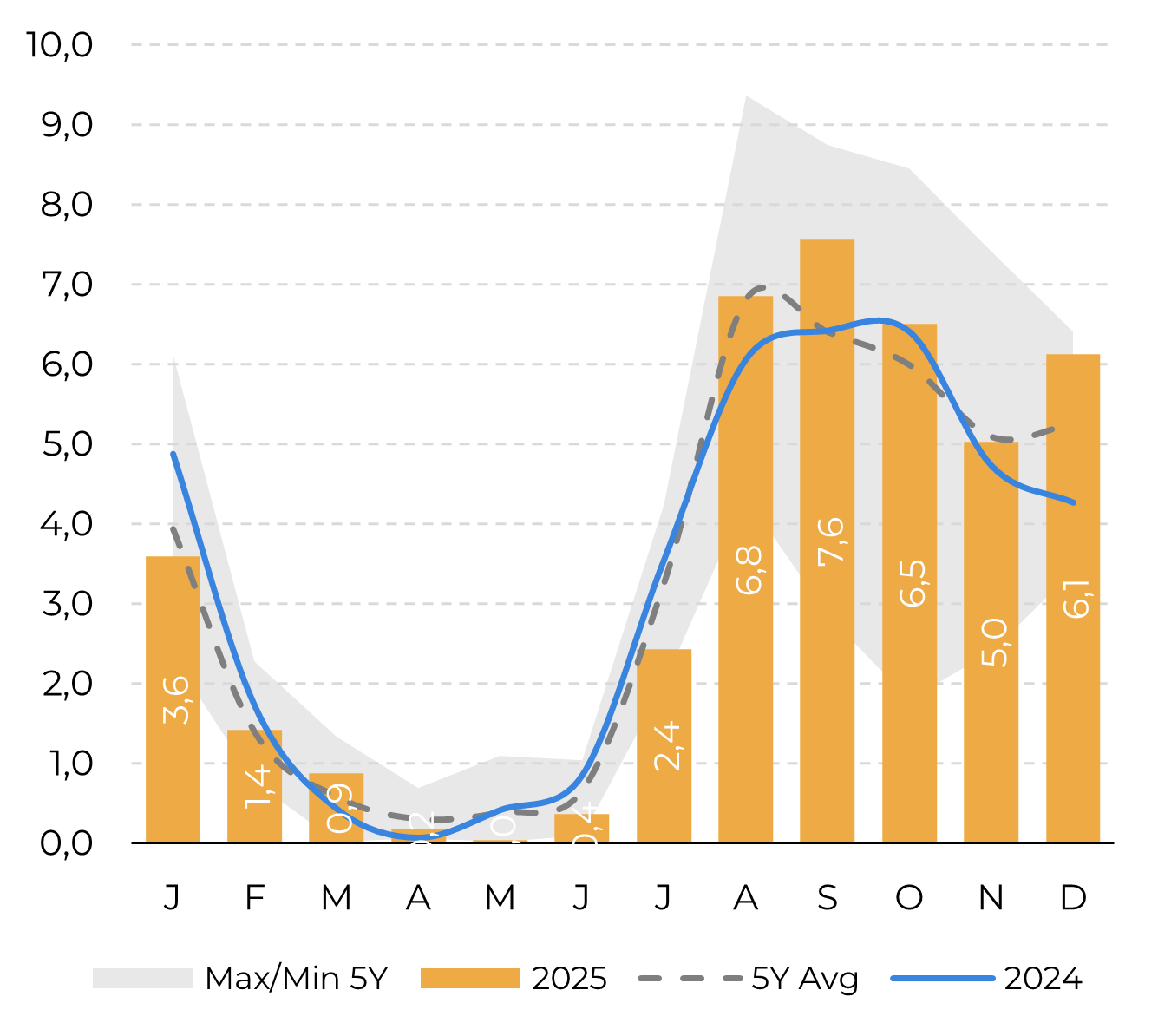
Brazilian corn exports reached 40.98 million tons in 2025, up 3% from the previous year (39.78 million tons). Despite the growth recorded compared to the previous year, the volume exported in 2025 is still well below the record set in 2023, when Brazil exported 55.89 million tons of corn.
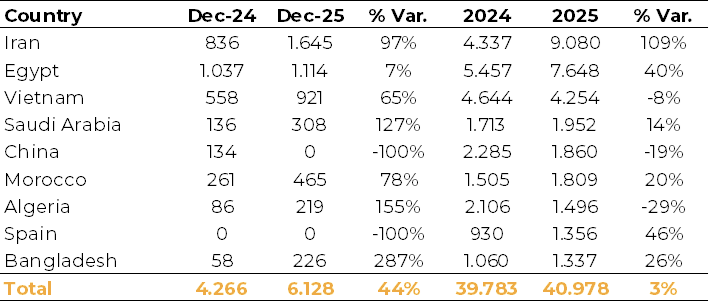
Regarding destinations, Iran once again stood out as the main buyer of Brazilian corn in 2025, after losing its position to Egypt in the previous year. In addition, the strong growth in Iranian purchases of Brazilian corn is noteworthy, jumping from 4.34 million tons in 2024 to 9.08 million tons in 2025 (a 109% increase). In second place, Egypt also saw significant growth in purchases of Brazilian corn, buying 7.65 million tons in 2025, up 40% from the previous year (5.46 million tons).
China ranked only fifth on the list of largest buyers of Brazilian corn in 2025, contrasting with its first place ranking in 2023, when Brazil achieved record corn exports. The drop in Chinese demand for corn imports in 2025 stems from the combination of record corn production and high carryover stocks, which allowed the Asian country to make greater use of its local supply and reduce its need for foreign purchases.
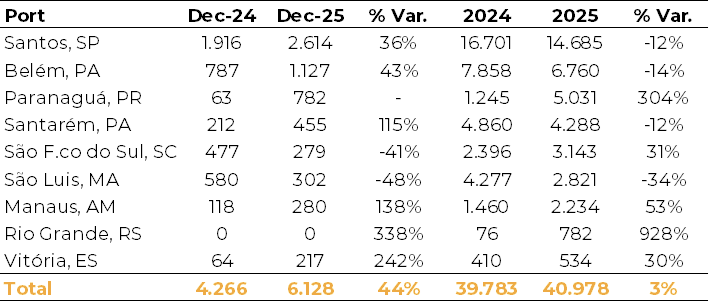
When we look at the port table, we also note the growing importance of the Arco Norte ports for corn exports, as seen with soybeans.
The port of Santos/SP once again led corn exports in 2025, with 14.69 million tons exported. However, the volume was below that exported in 2024, with a 12% drop compared to the previous year (16.70 million tons in 2024).
In second place, the port of Belém/PA exported 6.76 million tons in 2025, down 14% from the previous year (7.86 million tons). Although the volume also declined, the port in the North region maintained its position as the second largest corn exporting port in the country.
In third place, exports via the port of Paranaguá/PR grew significantly, regaining the position lost in the previous year. The port in Paraná was responsible for exporting 5.03 million tons in 2025, an increase of 304% over the previous year (1.25 million tons).
For 2026, if Brazilian soybean and corn production reaches its potential, the trend is likely to see further increases in exports, although the path to growth may be a little more winding.
In the case of soybeans, the expansion of exports will depend directly on Chinese appetite, given the Asian country's relevance in the demand for Brazilian soybeans. In this sense, it is important to closely monitor the relationship regarding the US and China, especially with regard to the trade agreement between the countries. Greater demand for US soybeans could result in the loss of part of the surplus share that Brazil gained in 2025 due to the trade war, which deserves attention. In any case, we believe it is possible for Brazilian soybean exports to reach 112 million tons in 2026.
On the corn side, it will be important to closely monitor the geopolitical situation in the Middle East, with an emphasis on Iran. Possible US economic sanctions on countries that do business with Iran could affect Brazilian exports, given Iran's importance as a buyer of our corn. In addition, possible changes in the Iranian political regime also deserve attention. At the same time, a possible increase in Chinese demand for imports may favor Brazilian corn, with the Asian country possibly increasing its purchases in South America.
Overall, Brazilian corn exports could reach 44 million tons in 2026. However, there are challenges.