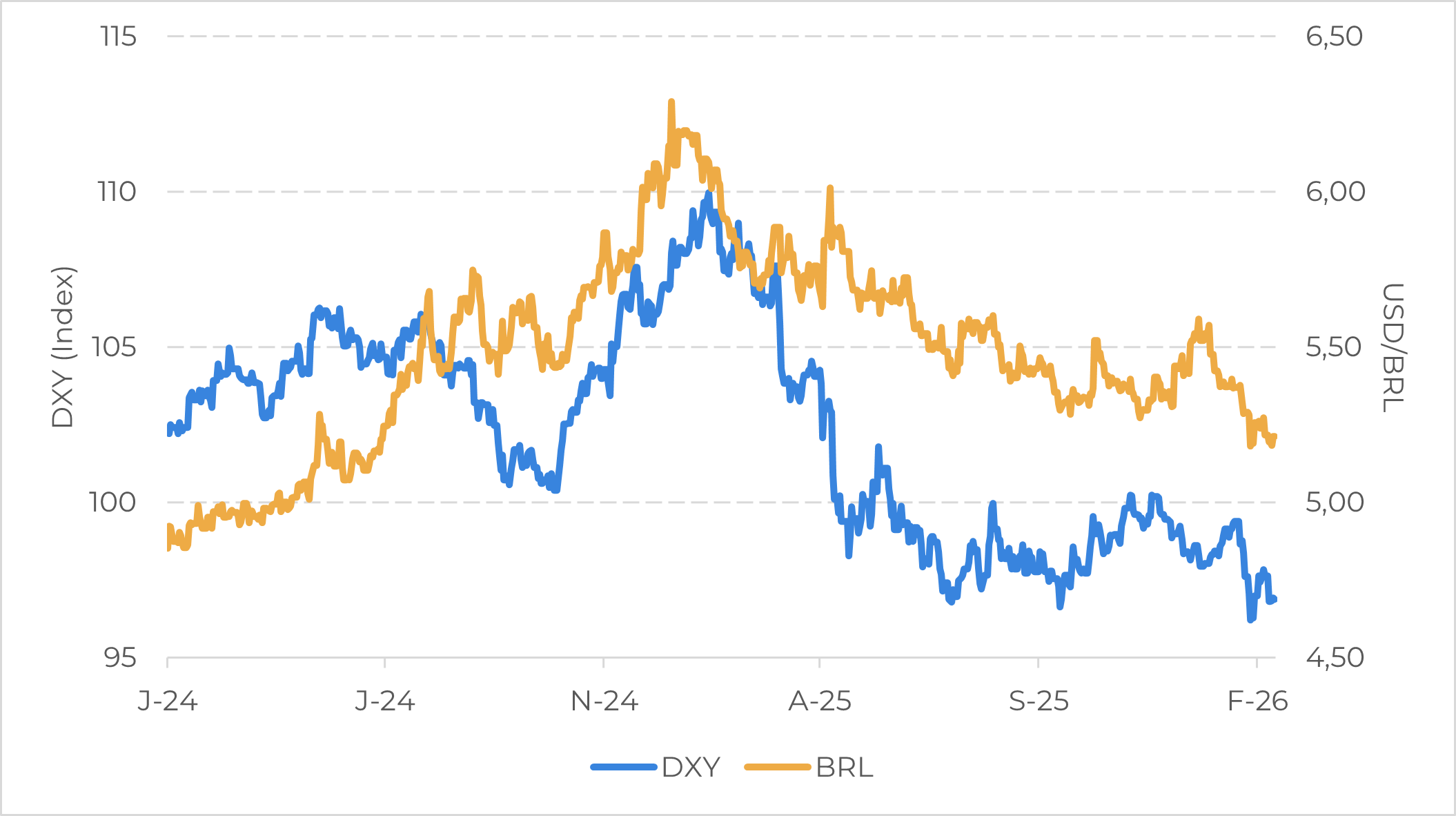
The global macroeconomic environment for 2026 is marked by a trend of structural weakening of the dollar, associated with the beginning of a cycle of interest rate cuts in the United States after the strong monetary tightening observed between 2022 and 2024. The Federal Reserve is expected to continue cutting interest rates throughout 2026, possibly starting in the middle of the year, reducing the rate differential regarding emerging economies.
Another relevant factor is the high level of US government debt, which increases market sensitivity to interest rate movements and contributes to an environment of greater caution among investors. Part of this capital has migrated to assets considered safer, such as gold.
In Europe, despite recent economic and geopolitical difficulties, growth remains resilient, with estimated expansion of around 1.2% in 2026, which maintains the bloc as an important consumer of soybean complex products, especially soybean meal.
China remains the main factor influencing global demand for grains. The country maintains positive economic growth but faces structural challenges, mainly related to the real estate sector and industrial overcapacity.
In Brazil, the combination of still relatively high interest rates and foreign capital inflows tends to favor the real. However, the domestic scenario presents significant risks, especially the high level of public debt and the proximity of the 2026 elections, factors that may generate episodes of exchange rate volatility. In this environment, the exchange rate may fluctuate significantly throughout the year.
At the same time, the recent conflict in the Middle East between the US/Israel and Iran has led to strong risk aversion in international markets, increasing volatility for assets around the world. As a result, the dollar is once again showing some strength against other currencies, which deserves attention at this time.
The global soybean balance is more comfortable today than in previous cycles: demand continues to grow, but supply from the three major producers in the Americas (Brazil, the US, and Argentina) has advanced at a faster pace, allowing for the rebuilding of global stocks. This reduces the likelihood of extreme upward shocks, barring significant weather events.
For corn, the global picture is similar: stocks/use are at a relatively comfortable level, but there is the possibility of upward revisions in Chinese imports if the country chooses to rebuild stocks to historically higher levels.
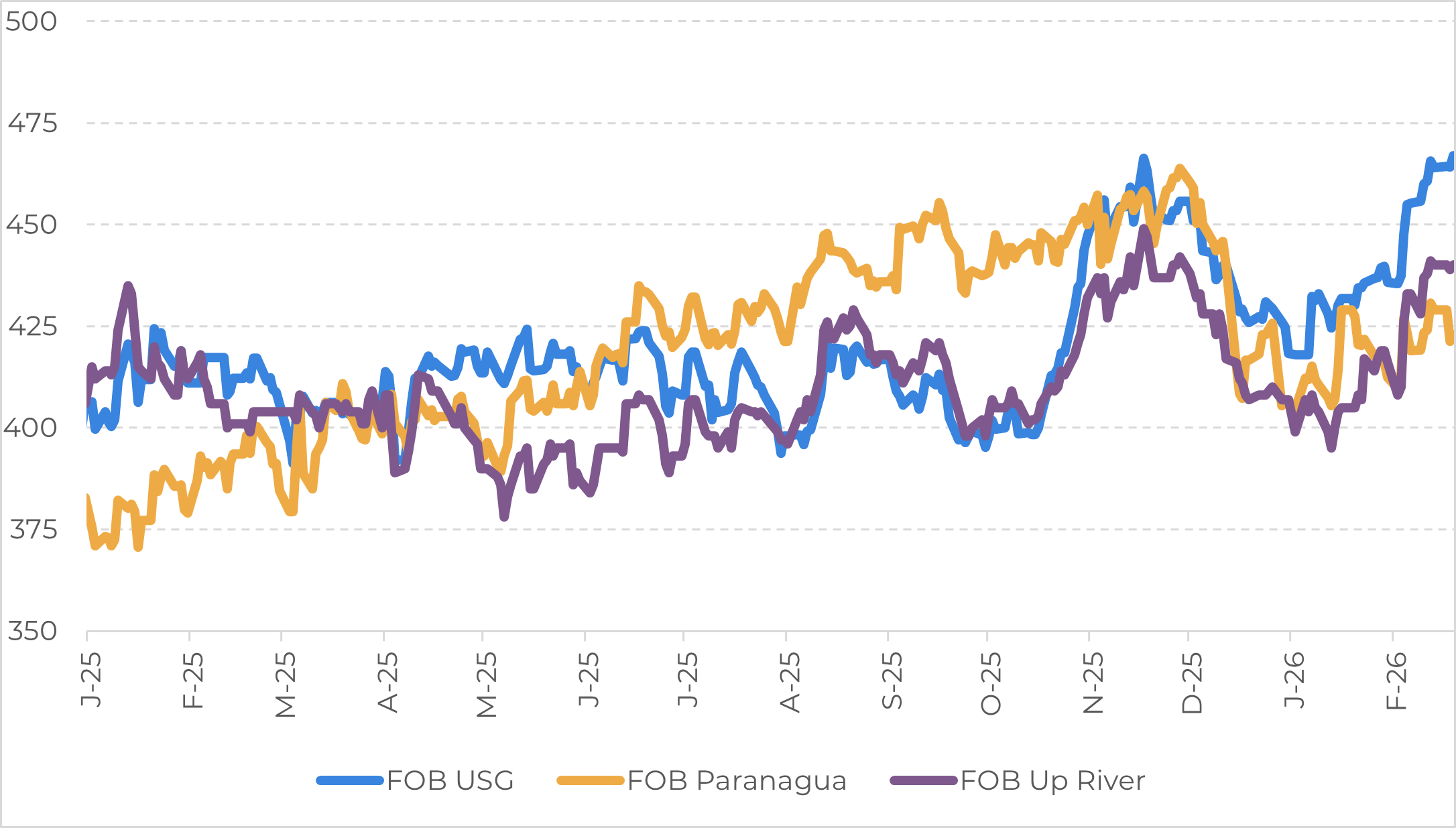
In terms of competitiveness, Brazilian soybeans are currently the cheapest and most attractive product on the international market, which helps explain China's focus on purchases from Brazil, despite recent political announcements about intensifying purchases of US soybeans.
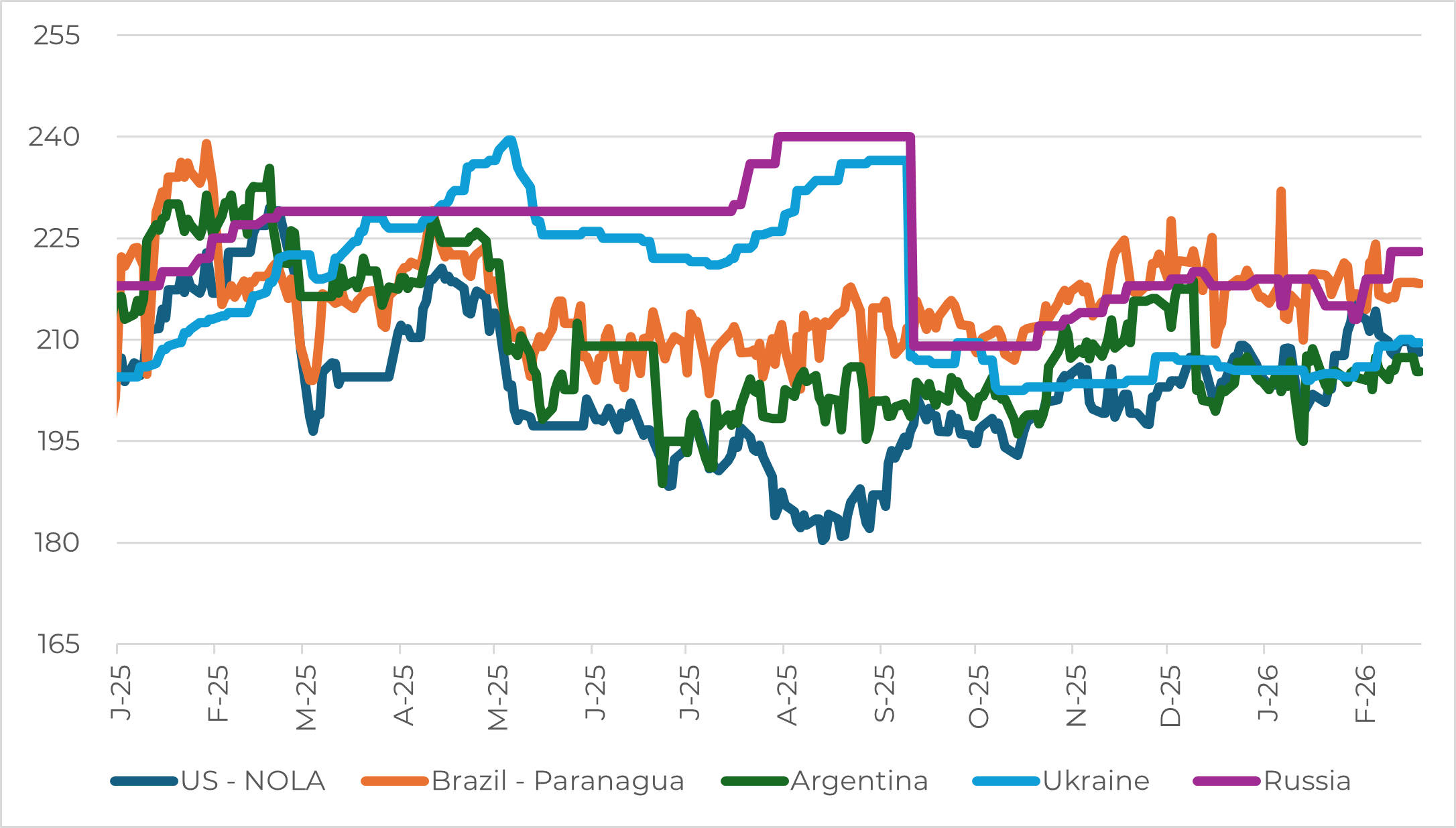
For corn, Argentina stands out as the most competitive source on the export front, with recent declines in local FOB prices. The US remains active with strong exports, while Brazil, at the beginning of this year, appears less in foreign corn sales, as the summer crop is primarily directed to the domestic market.
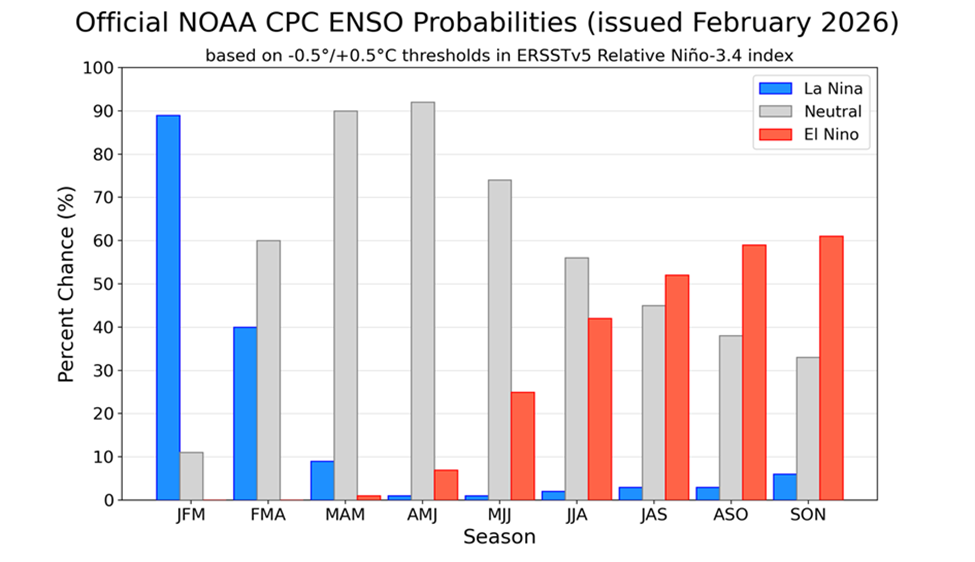
The global climate scenario points to a transition from the La Niña phenomenon to neutral conditions between March and August. This period coincides with planting and crop development in the United States, increasing the importance of monitoring weather conditions.
Historically, years of climate transition can present greater production volatility. An often-cited example is 2012, when the transition from La Niña to a neutral climate brought adverse weather conditions in the US, causing significant losses in corn and soybean crops.
For the second half of 2026 (starting in August/September), models indicate the possible formation of El Niño, which could affect the next South American crop. In El Niño years, the typical weather pattern includes:
• Above-average rainfall in southern South America (Argentina and southern Brazil)
• Below-average rainfall in north-central Brazil
This pattern has already had significant impacts recently, such as in the 2023/24 Brazilian crop, when significant losses occurred in states in north-central Brazil, particularly Mato Grosso. In view of this, extra attention must be paid.
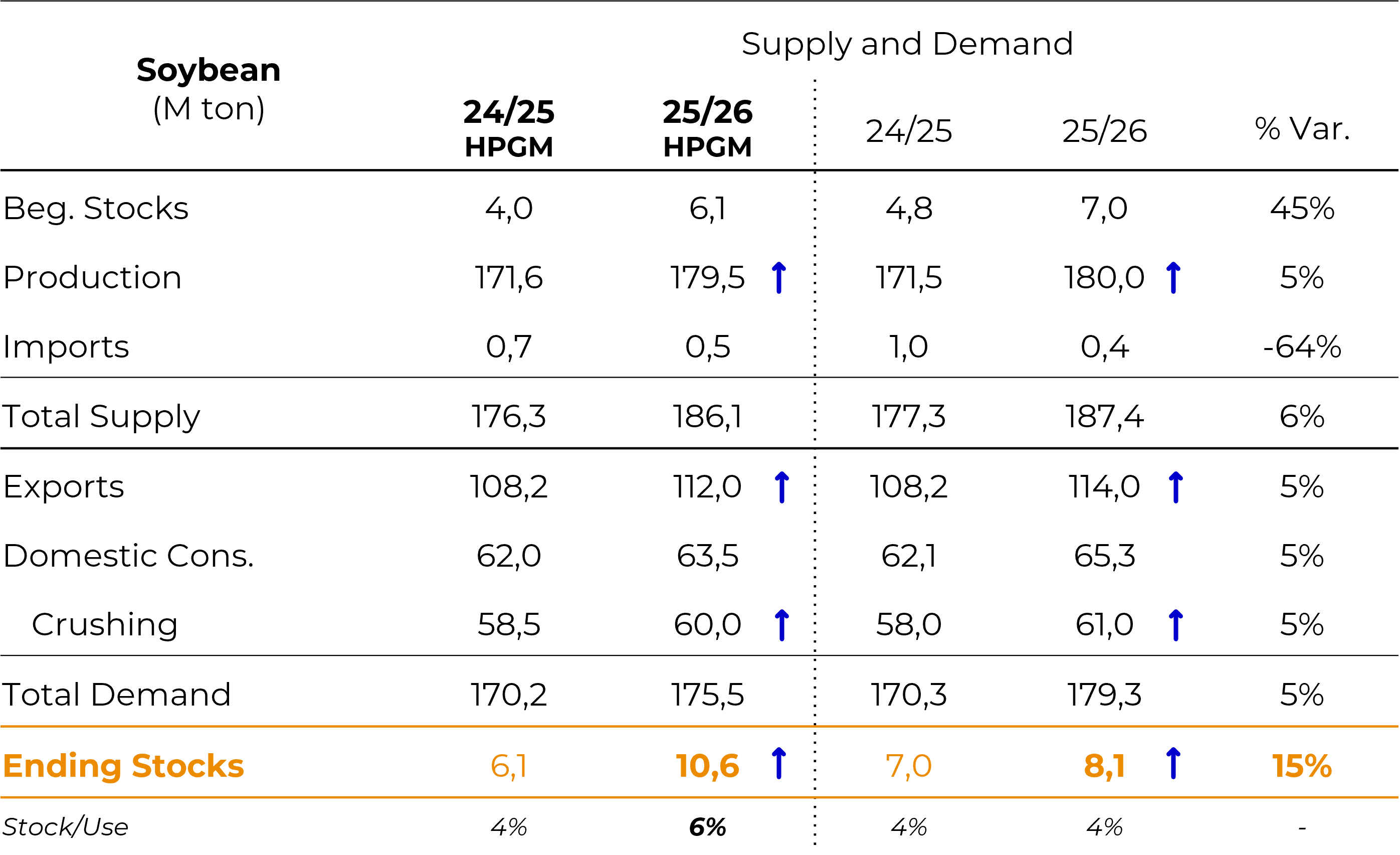
The Brazilian soybean crop is expected to reach a new record in 2025/26. Market estimates indicate production close to 180 million tons. Hedgepoint points to a production of 179.5 million tons.
Despite the generally positive outlook, there is concern about yield in Rio Grande do Sul, which experienced a period of low humidity and high temperatures between late January and early February. Vegetation indicators (NDVI) suggest a possible impact on yield in the state.
Even so, the good results obtained in other producing regions should partially offset these losses, allowing the Brazilian crop to remain at record levels.
With high production, Brazil is likely to maintain its leadership in global exports. After a record 108.2 million tons exported in 2024/25, the country could set a new record in the 2025/26 season. Hedgepoint points to exports of 112 million tons.
Another relevant factor is the growth in domestic crushing, driven by the expansion of biodiesel production. Currently, B15 is in effect, with the possibility of B16 still in 2026. However, the election year may prevent an increase in the blend.
Marketing of the new crop is behind schedule compared to the previous year. About 30% of the 2025/26 crop was sold, compared to approximately 35% in the same period of the previous season, which may generate sales pressure throughout the harvest.
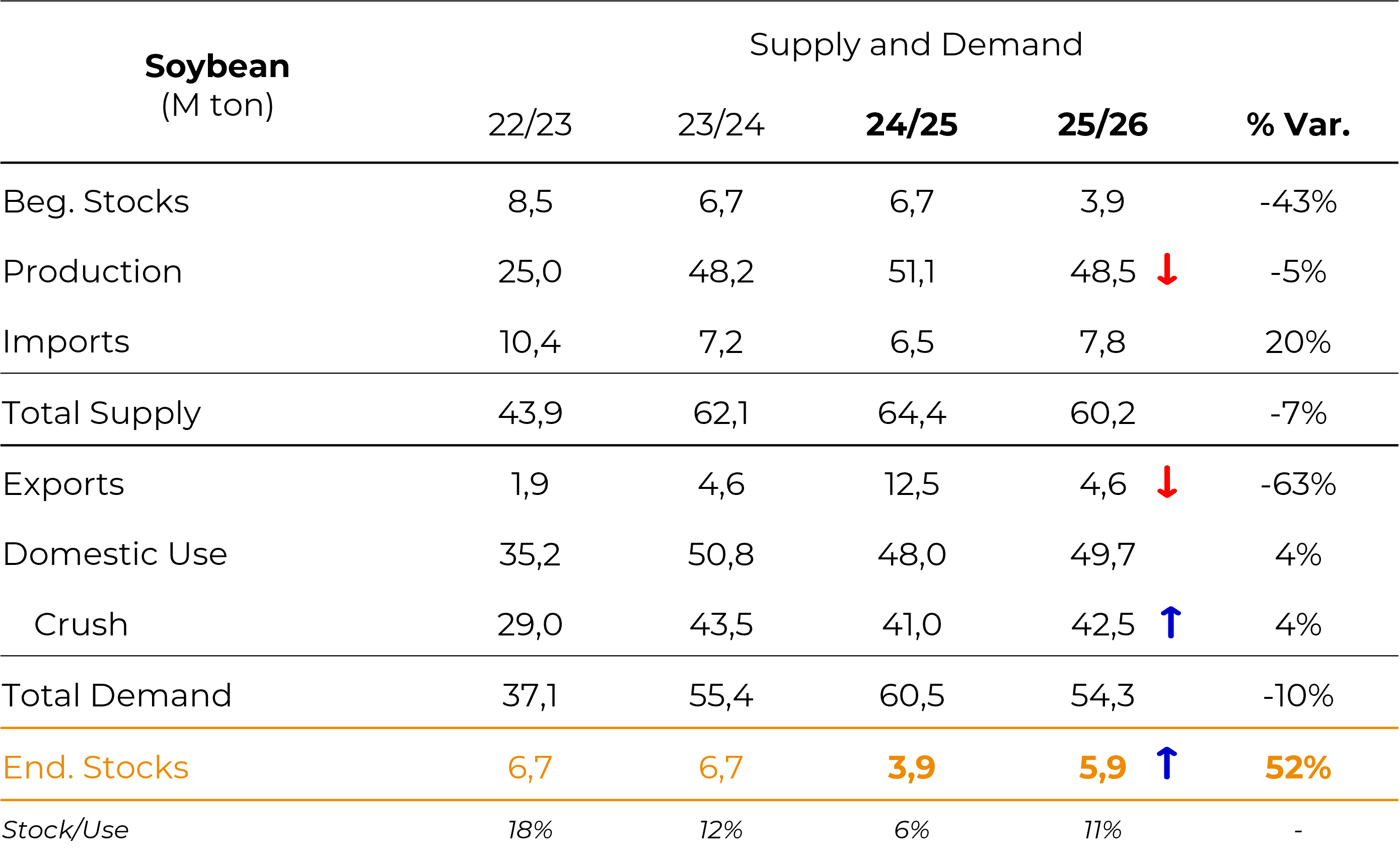
In Argentina, the dynamics are different. Producers have shown a greater preference for corn due to tight margins, which has led to a reduction in the soybean area in the 2025/26 crop season. Production, which was around 51 million tons in the previous crop season, is expected to decline to approximately 48.5 million tons this crop season.
In addition, Argentina tends to prioritize domestic crushing again, reducing the availability of soybeans for export, which should return to the level of 5 million tons (compared to something close to 12 million in 2024/25). This possibility tends to result in greater demand for Brazilian and US soybeans in 2026.
In the United States, the 2026/27 crop is still in the pre-planting phase, with planting scheduled to begin in April.
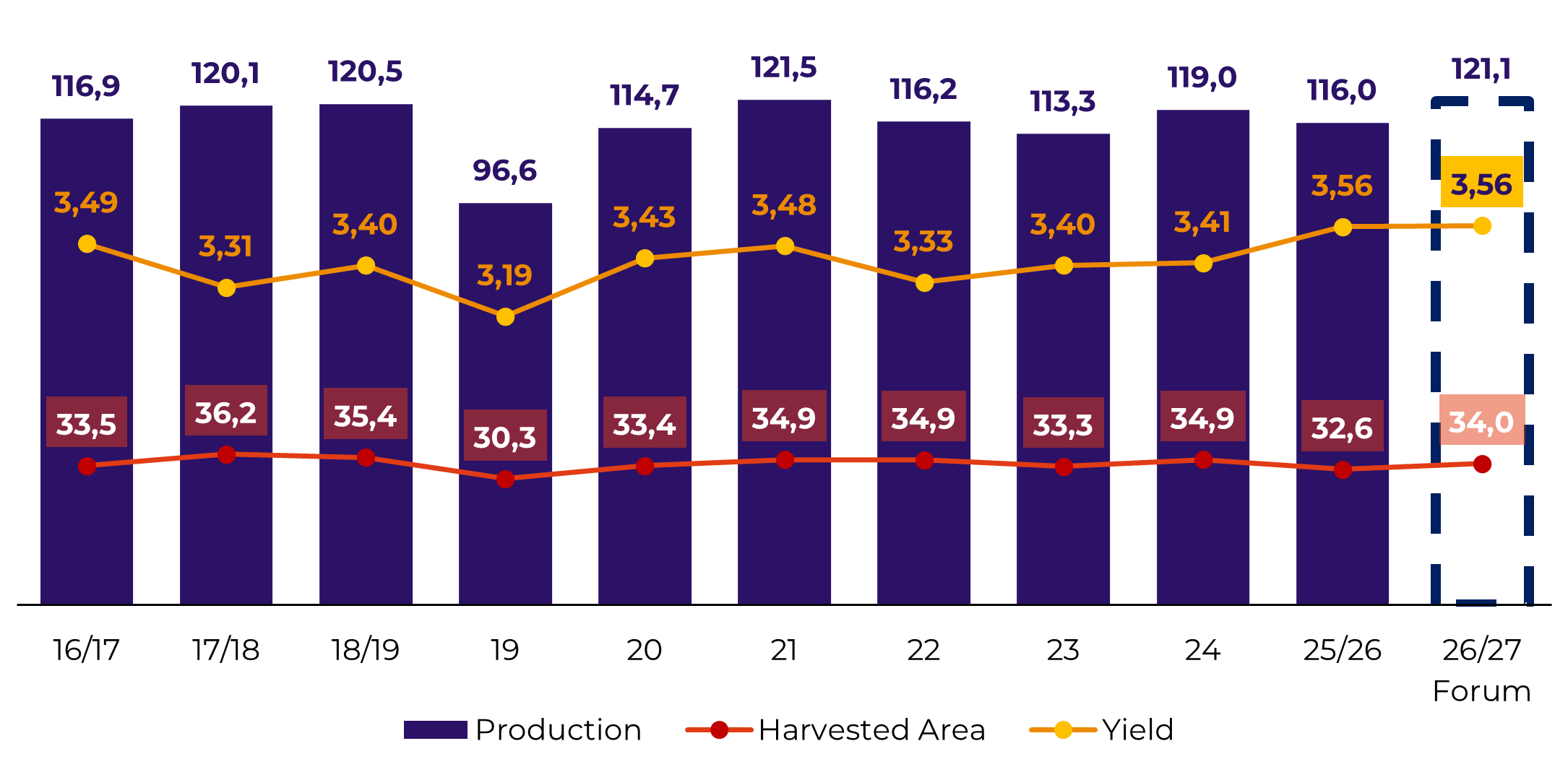
Early indications from the USDA Outlook Forum suggest an increase in soybean acreage. The initial projection points to 85 million acres planted, compared to 81.2 million acres in the previous crop.
This movement is linked to the price ratio between soybeans and corn. When this ratio approaches or exceeds approximately 2.4, soybeans tend to become relatively more attractive to US producers.
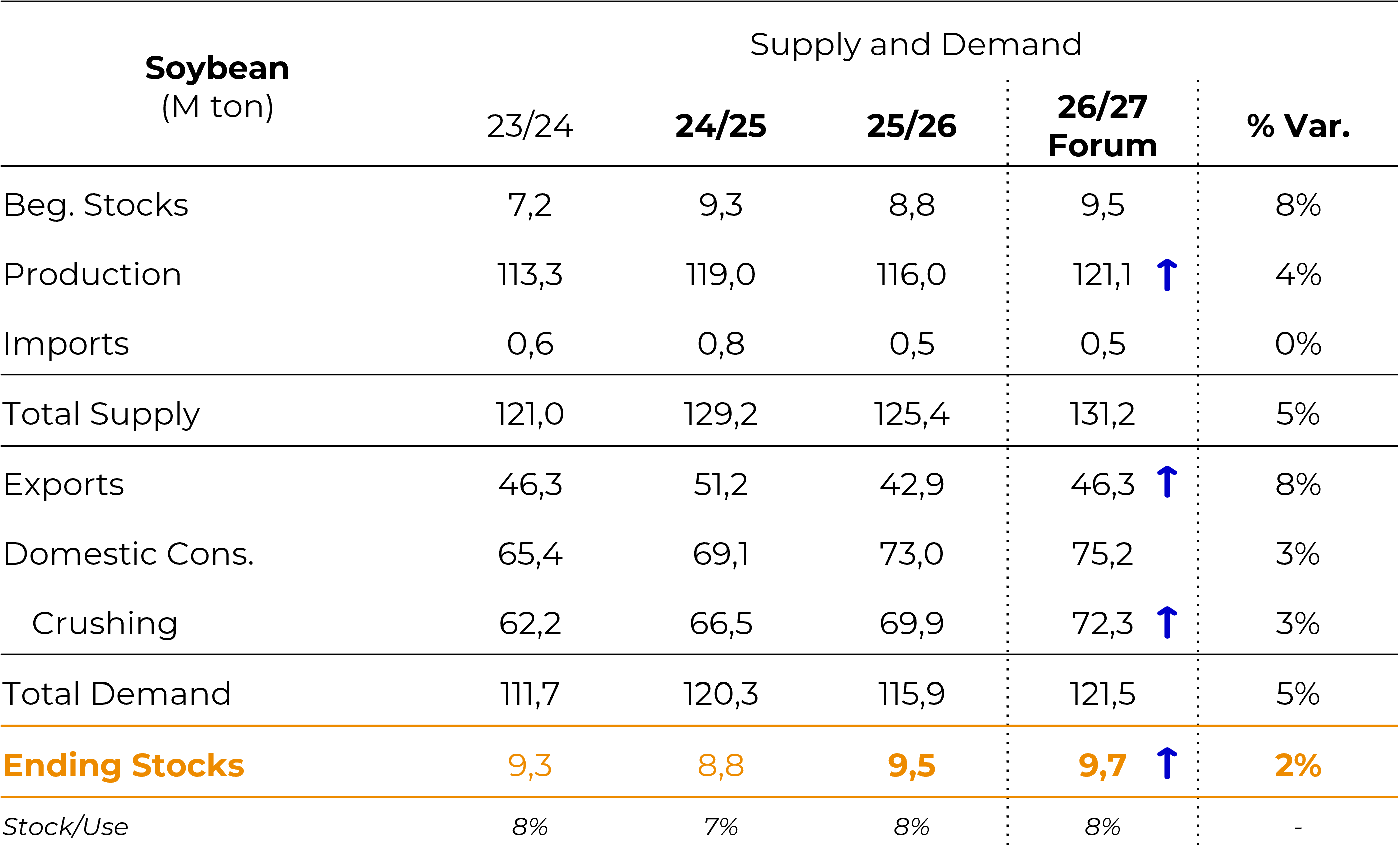
If this projected area is confirmed, US production could return to around 121 million tons, which would be the second highest in the country's history. However, it is important to remember that the first official USDA figures will be published on March 31.
Even with an increase in the soybean area, the market remains attentive to weather conditions during the US summer, a critical period for determining yield.
Yields and the actual size of the area planted are still sources of uncertainty. US farmers are essentially corn producers and, in situations where margins are similar, they have historically tended to favor corn. For this reason, the USDA's official planting intentions report on March 31 is seen as an important trigger for volatility in Chicago.
Weather conditions and rainfall forecasts for March–May suggest, for now, a reasonably favorable environment for planting and initial crop development, despite some pockets of drought in Illinois. The market, however, remains sensitive to any change in weather patterns during planting and full crop development.
A highlight on the demand side is the strong soybean crush in the US, sustained by high margins in soybean oil production, especially in light of biofuel incentive policies. In this regard, the EPA's proposal to increase the biodiesel blend stands out, which could lead to a strong increase in domestic soybean oil use. Recent news points to the definition of the new blend throughout March.
The regression study between US soybean stocks/use and Chicago prices indicates that current price levels (around US$ 11.50/bu) are above the price implied by fundamentals (estimated range between US$ 10.50–11.00/bu), suggesting room for correction if there are no new demand or weather shocks.
In Brazil, total corn production volume depends heavily on the second crop, which is currently being planted as the soybean harvest progresses in the center of the country. Crop development depends on good weather conditions over the next four months. Initial estimates point to a crop of around 140 million tons in 2025/26.
At this point, the delay in the soybean harvest is resulting in a delay in the planting of the second crop, increasing the risk of areas being sown outside the ideal window. However, strong growth in domestic demand – especially for corn ethanol – tends to encourage producers to maintain a large area, even under greater weather risk.
Domestic demand has been growing consistently, driven mainly by the expansion of the corn ethanol industry. Corn ethanol is the major driver of change in the domestic balance: the number of plants in operation is expected to more than double in the coming years, spreading beyond the Midwest. This creates a structurally tighter and more competitive domestic market with exports. While consumption for animal feed is growing more organically, the advance of ethanol has been exponential.
In international trade, Brazil may export 43 million tons of corn in the new 2025/26 crop season, depending on the performance of the second crop.
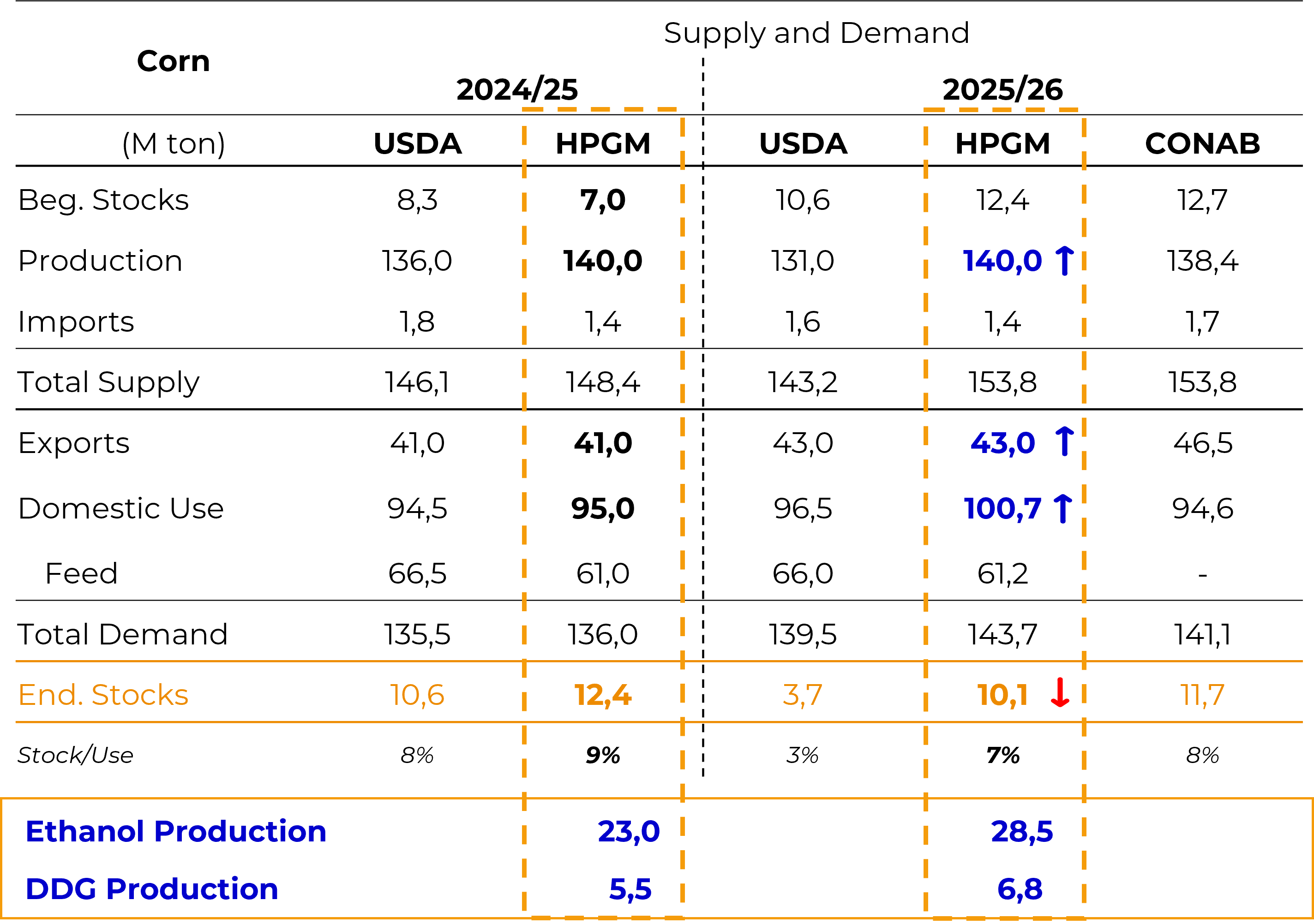
Source: USDA, Conab, Hedgepoint
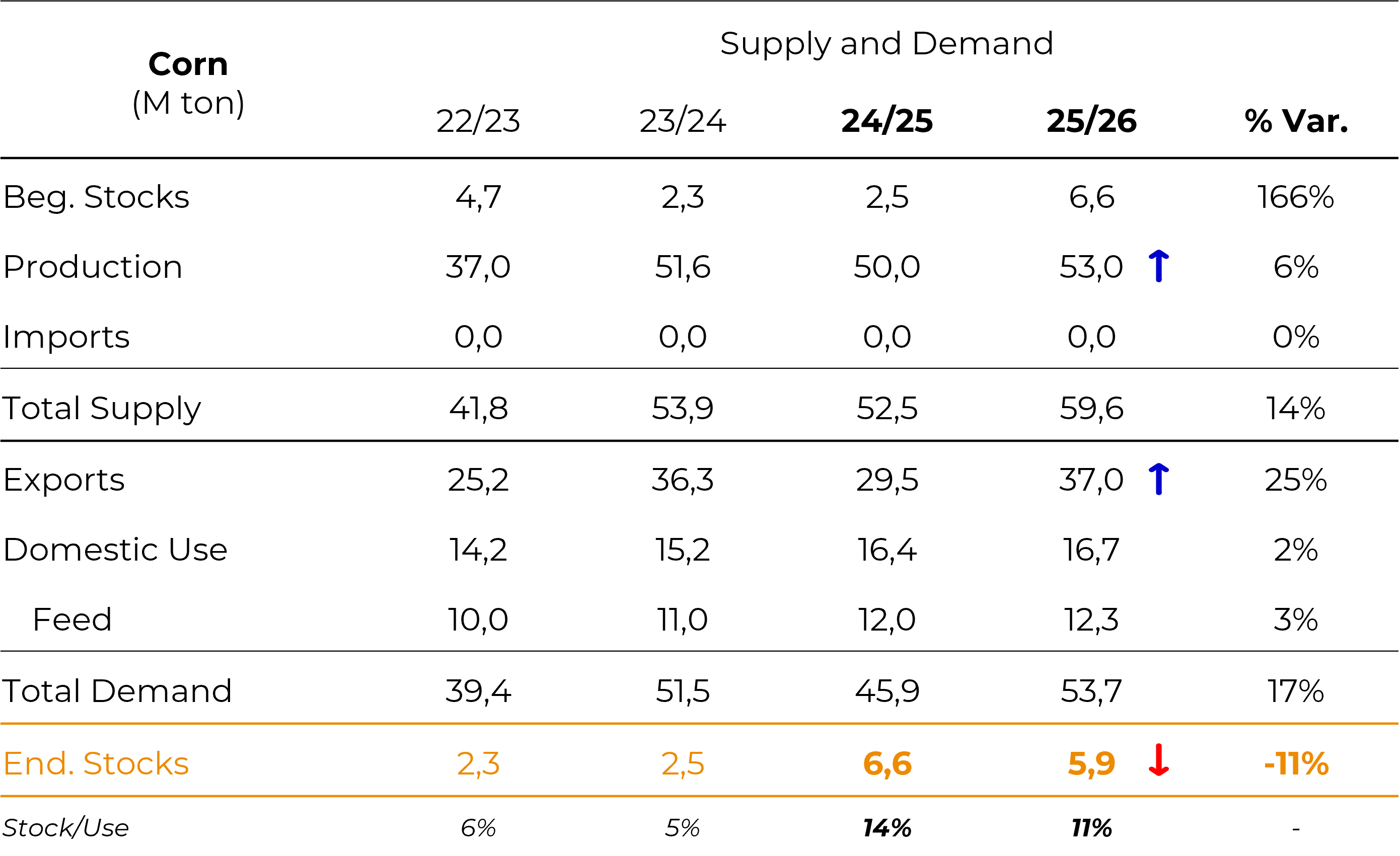
In Argentina, production is expected to grow in 2025/26, supported by better margins than soybeans for producers. The country has expanded its international competitiveness and consolidated itself as a strong competitor to Brazil in global corn exports.
In addition, Argentine producers have been marketing corn more aggressively and with a larger portion already priced, at a faster pace than that observed for soybeans. This indicates that Argentina tends to be a relevant competitor to Brazil and the US in the windows when Argentine volumes are available, adding competitive pressure to Brazilian exports, especially in the second half of the year.
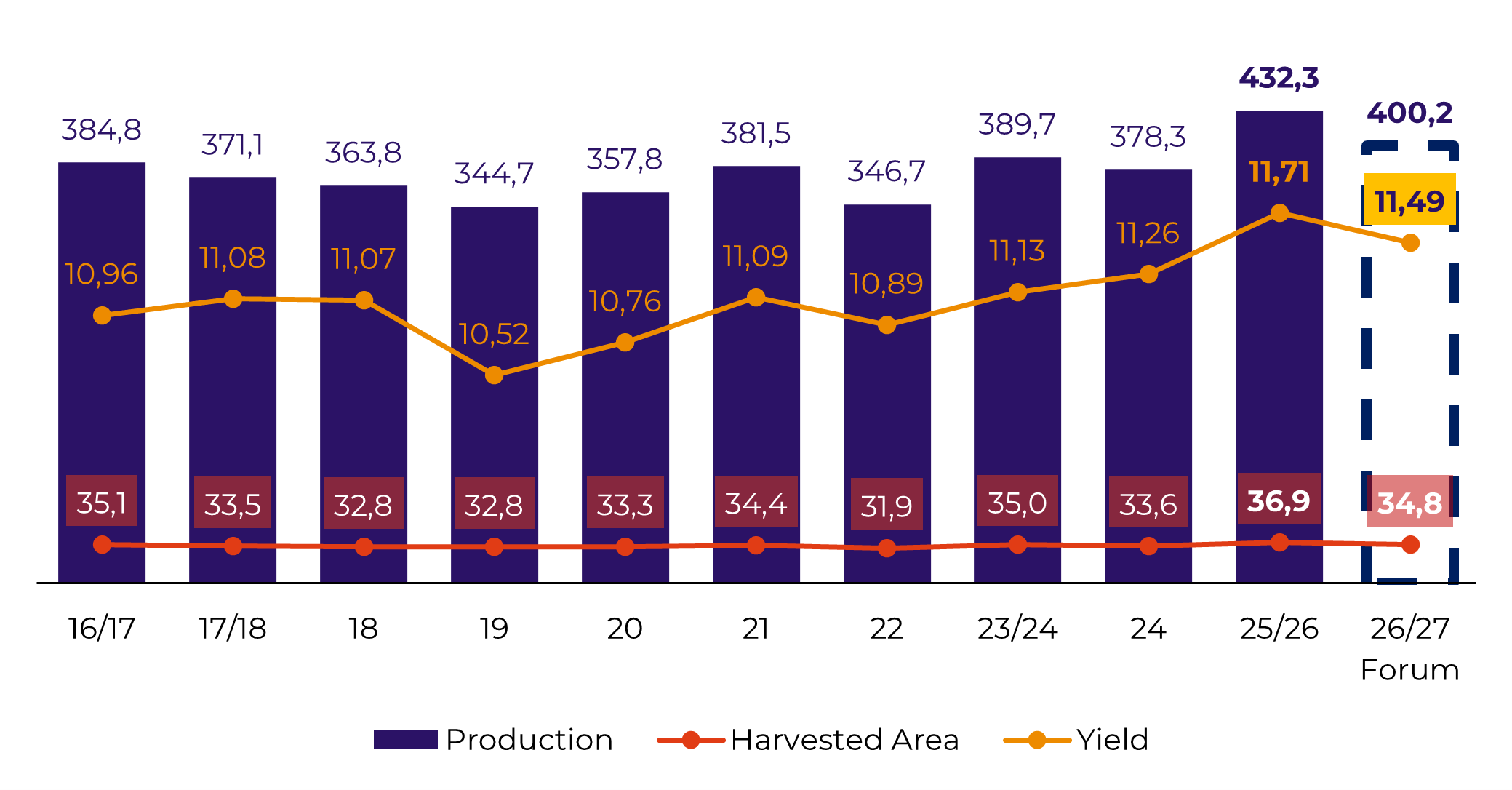
For US corn, the projected area for 2026/27 is down from the previous crop (from 98.8 to around 94.0 million acres), in line with the relative loss of attractiveness regarding soybeans. Even so, despite the slightly smaller area, the combination with still high yield allows for a projected potential production that would be the second largest in history – above 400 million tons.
As with soybeans, the March 31 planting intention report and the weather market between April and August are identified as the two major triggers of volatility for corn in 2026.
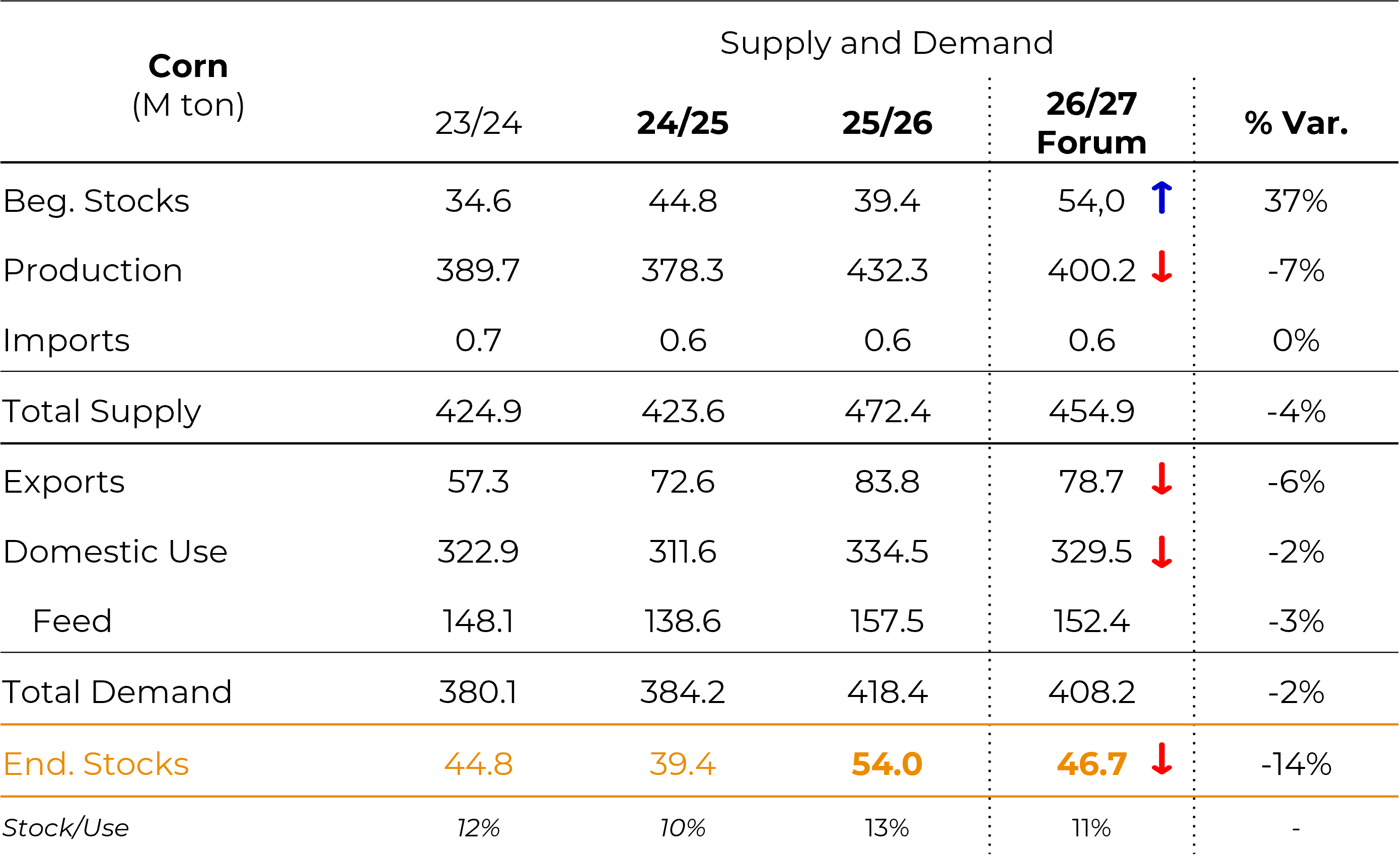
On the demand side, US exports have been an important factor in sustaining the market (even in the face of record production), with consistent growth throughout the season. US corn exports are expected to reach a new record high in 2025/26.
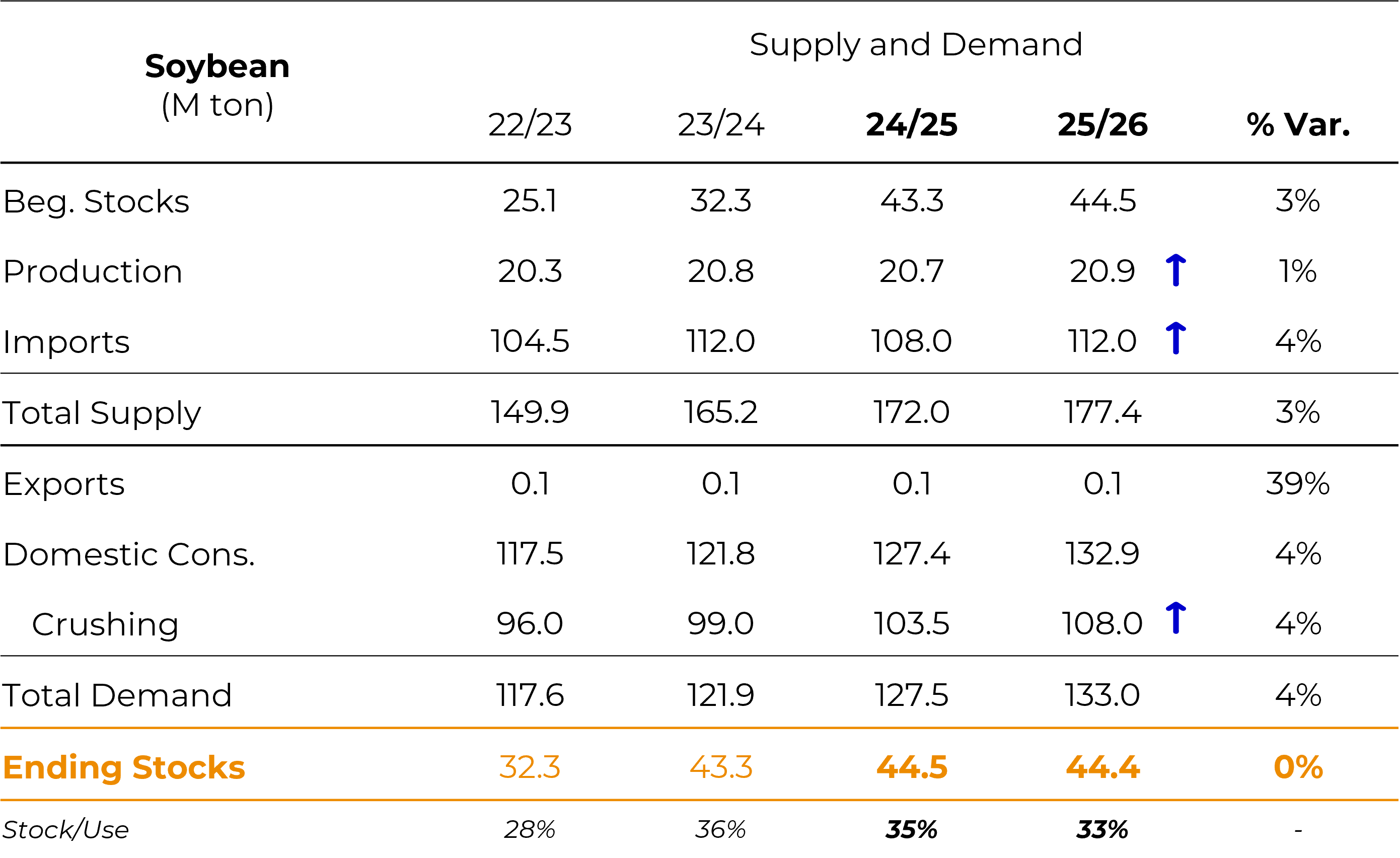
China remains the main driver of global soybean demand, importing large volumes to supply its crushing industry, responsible for the production of meal used in animal feed. The country maintains a standard ending stock of between 43 and 44 million tons, with a stock-to-use ratio of around 33–35%, a level considered "comfortable" in terms of supply security.
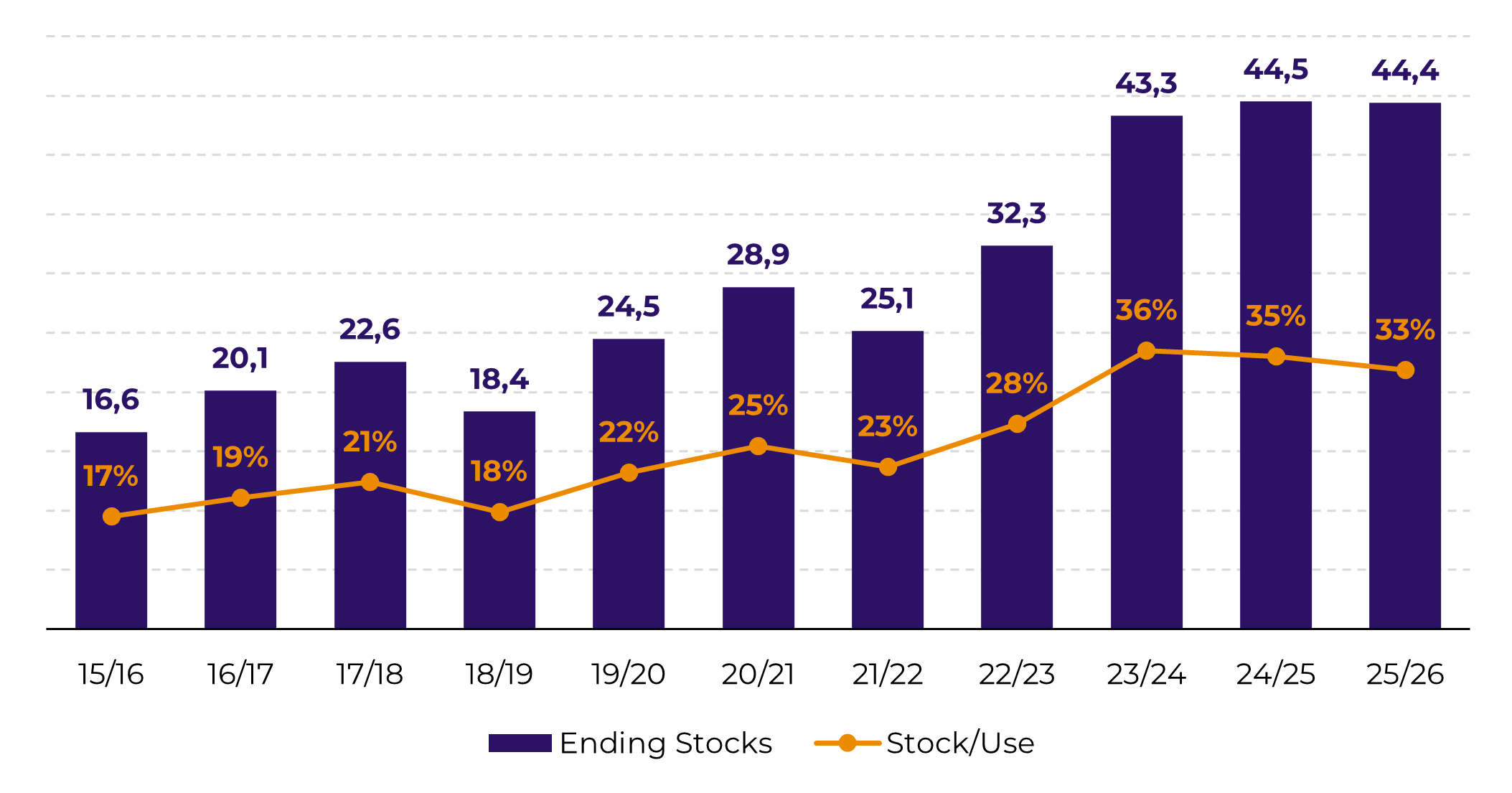
Even with often tight or negative crushing margins, the size of the pig herd remains high, sustaining the need for soybean meal consumption. In other words, the main driver of demand is the herd, not the processor's spot margin.
In this context, Chinese imports are expected to reach 112 million tons in 2025/26, consolidating further growth in demand.
The partial recovery of US soybean purchases after the most acute phase of the trade war coexists with a long-term trend of a reduction in the US share of China's total imports and an increase in Brazil's share. However, Argentina, which gained ground in 2024/25, is likely to see its share decline in 2025/26, opening up more space for the US as well.
Geopolitical dynamics should continue to influence the direction of Chinese demand. Recent comments by officials and the possibility of a meeting between US and Chinese leaders in April add a component of positive or negative political risk to trade flows, which deserves attention.
For corn, the key point is the decline in Chinese stocks over the last few years, which has led to historically low stock-to-use ratios. This contrasts with the more comfortable situation for soybeans and opens space for a policy of rebuilding corn stocks with a view to food security.
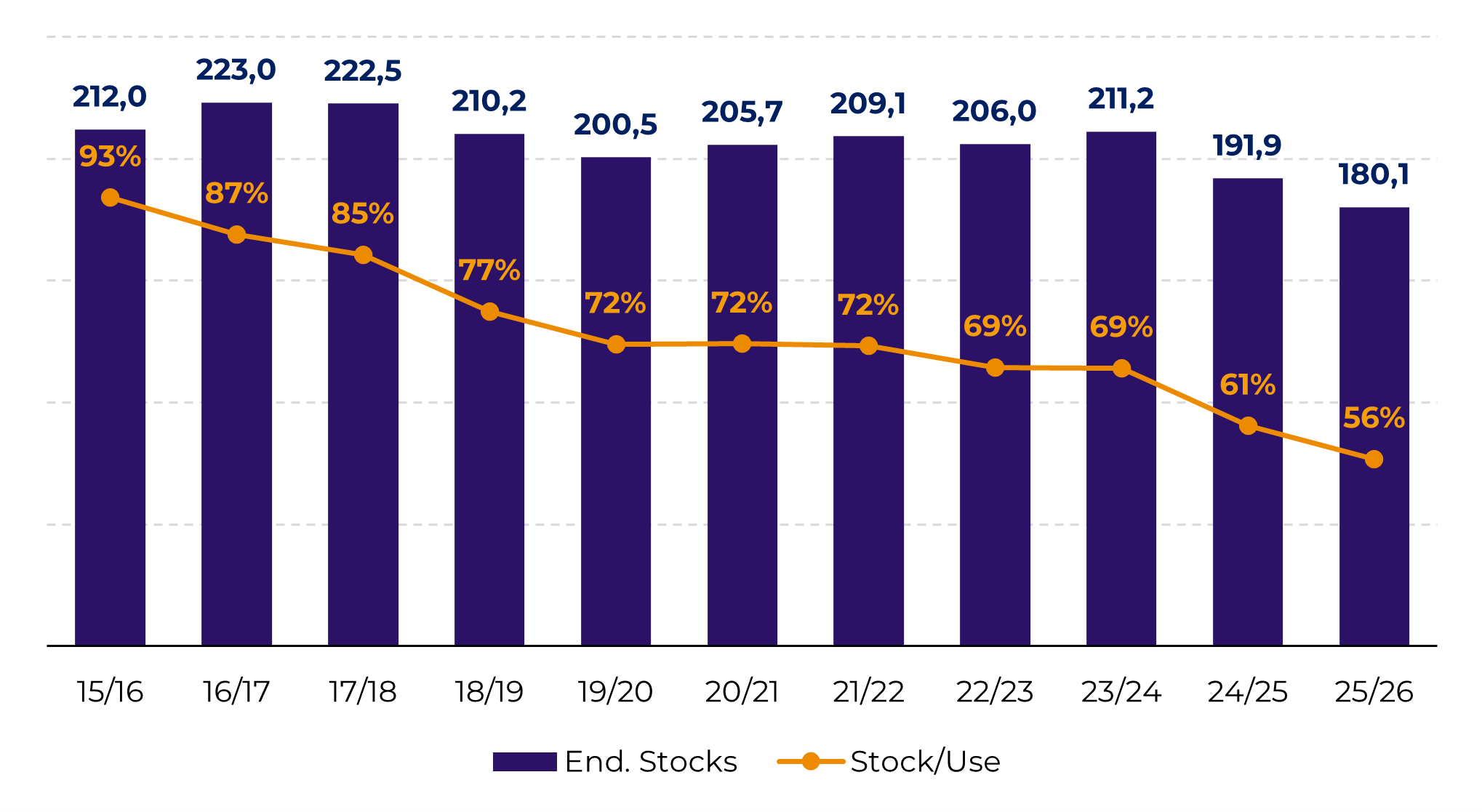
If this occurs, the country may increase imports, creating a window of opportunity for global exporters. A possible positive surprise in China's corn purchases would directly benefit Brazil, Argentina, and the US, with Brazil in a privileged position due to its logistical competitiveness and the growing commercial proximity built up in recent years.
Although China is traditionally more self-sufficient in corn than in soybeans, any change in its stock policy could have a significant impact on international prices.
Macro environment: the backdrop in 2026 is a structurally weaker dollar, falling interest rates in the US, and a spread that remains favorable to emerging market currencies, especially the real. At the same time, high debt levels (US and Brazil) and the Brazilian electoral calendar tend to add volatility to the exchange rate. In addition, the recent conflict in the Middle East (US/Israel vs. Iran) adds even more uncertainty and volatility to the markets, including the foreign exchange market.
Soybeans – Supply: the world enters 2025/26 with a more comfortable balance. Brazil is expected to harvest a new record crop, albeit with significant risk concentrated in Rio Grande do Sul. Argentina is reducing its area and production, but compensating with a greater focus on domestic crushing, reducing grain exports. In the US, there are preliminary indications of an increase in area and strong expansion in crushing, anchored in greater use of soybean oil for biodiesel.
Soybeans – Demand: China maintains moderate demand growth, sustained by a large pig herd and a policy of comfortable stocks. The country continues to gradually reduce the relative share of the US in its mix of origins and reinforce Brazil's role as its main structural supplier.
Corn – Supply: Global supply remains robust. The US and Argentina are heading for new robust crops, while Brazil depends on the performance of the second crop under weather conditions that warrant attention but do not yet point to a reduction in production potential.
Corn – Demand: In Brazil, the major structural change is corn ethanol, which is repositioning the country as a significant consumer and competing directly with the export channel. In China, historically low corn stocks create room for increased imports throughout the cycle, with an upward bias for purchases if there is a political decision in this direction.
Weather: The La Niña → neutral transition in the US and the prospect of a new El Niño for the 2026/27 South American crop keep climate risk at the center of the radar. The history of 2012 (US) and 2023/24 (Brazil) is a reminder that yield shocks can quickly reverse the current comfort of balances.
Funds and financial flows: Speculative funds have migrated to a significant long position in soybeans, driven by expectations of higher oil consumption for biodiesel and optimism regarding Chinese purchases. In corn, they remain mostly sold, reflecting the weight of high stocks and a record crop in the US. Movements by these agents tend to amplify volatility in the face of any climatic, political, or demand surprises.
Implications for players: the combination of factors – a weaker dollar, relatively comfortable balance sheets, latent weather risk, the biofuel regulatory agenda, and China's central role – reinforces the importance of active and dynamic risk management strategies. The implicit recommendation is to take advantage of favorable price windows for hedging, both on the buy and sell sides, with special attention to the March milestones (EPA decision, US acreage report), the US weather market between April and August, and the South American weather market starting in September.
To watch the full Outlook 2026 on the Soybean and Corn markets, click on this
link.